- Animals
- ›Chordates
- ›Vertebrates
- ›Reptiles
- ›Snakes and Lizards
- ›Snakes
- ›Colubrid Snakes
- ›Asia-Pacific Whipsnakes
- ›Dendrelaphis
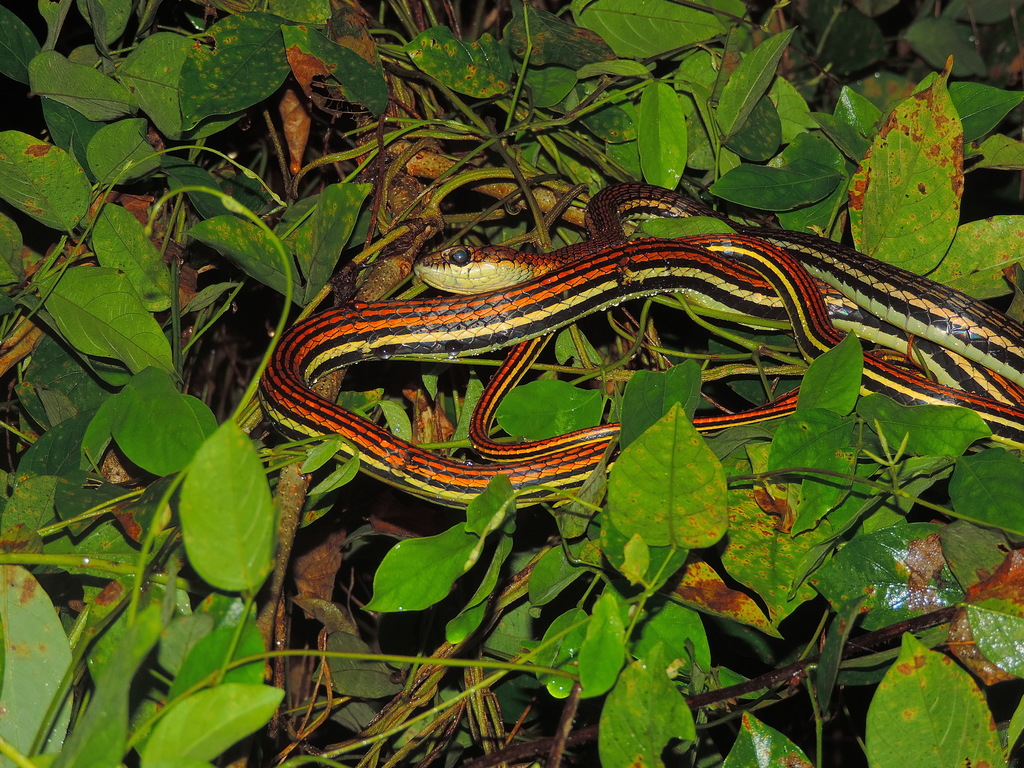
Striped Bronzeback
Dendrelaphis caudolineatus
Dendrelaphis caudolineatus is a common species of colubrid snake known commonly as the striped bronzeback or bronze tree snake. It is erroneously called 'garter snake' in the Philippines. It is not venomous and it is the most commonly sold snake as a pet. Though in captivity, they don't live as long as in the wild.
From the article Dendrelaphis caudolineatus on Wikipedia (CC BY-SA), quoted section by section
Description
Dendrelaphis caudolineatus is a rather small and thin snake, it can reach a length of 180 centimeters but is usually closer to 140 cm. The males are usually thinner than females but are more colorful, ranging from a reddish shade or bright chestnut brown, to a shiny bronze color. The females are usually dull-colored, and more stout-bodied than the males. It is also observed that females of this species tend to be less active than the males.
Range & habitat
Dendrelaphis caudolineatus is found in Malaysia, Thailand, Indonesia, Brunei, and Singapore.
Wikipedia: “Distribution”
What it does
The snake is diurnal and fully arboreal, and has oviparous reproduction, laying clutches of five to eight eggs. It feeds mainly on lizards and tree frogs.
Wikipedia: “Behavior”
In human culture
When John Edward Gray first scientifically described the species in 1834, he did not provide the origin of the scientific name caudolineatus. However, in Latin "cauda" means tail and "linea" mean line, possibly referencing the longitudinal lines reaching from head to tail.
Wikipedia: “Etymology”
Where it lives
Recorded sightings
—
geo-referenced records in GBIF, from museums, herbaria and field observers.
Drag the globe to turn it. Dots are where records exist, not a range map; darker means more records.
In the stacks
Searching the stacks…
Every page naming Dendrelaphis caudolineatus in the Biodiversity Heritage Library →
This page is assembled live from iNaturalist, GBIF, Wikipedia, the Source Library and the Internet Archive. It is not yet part of the hand-edited codex. iNaturalist taxon 26700.