- Animals
- ›Arthropods
- ›Hexapods
- ›Insects
- ›Winged and Once-winged Insects
- ›True Bugs, Hoppers, Aphids, and allies
- ›True Hoppers
- ›Spittlebugs, Cicadas, Leafhoppers and Treehoppers
- ›Leafhoppers and Treehoppers
- ›Typical Leafhoppers
- ›Microleafhoppers
- ›Erythroneurini
- ›Erasmoneura
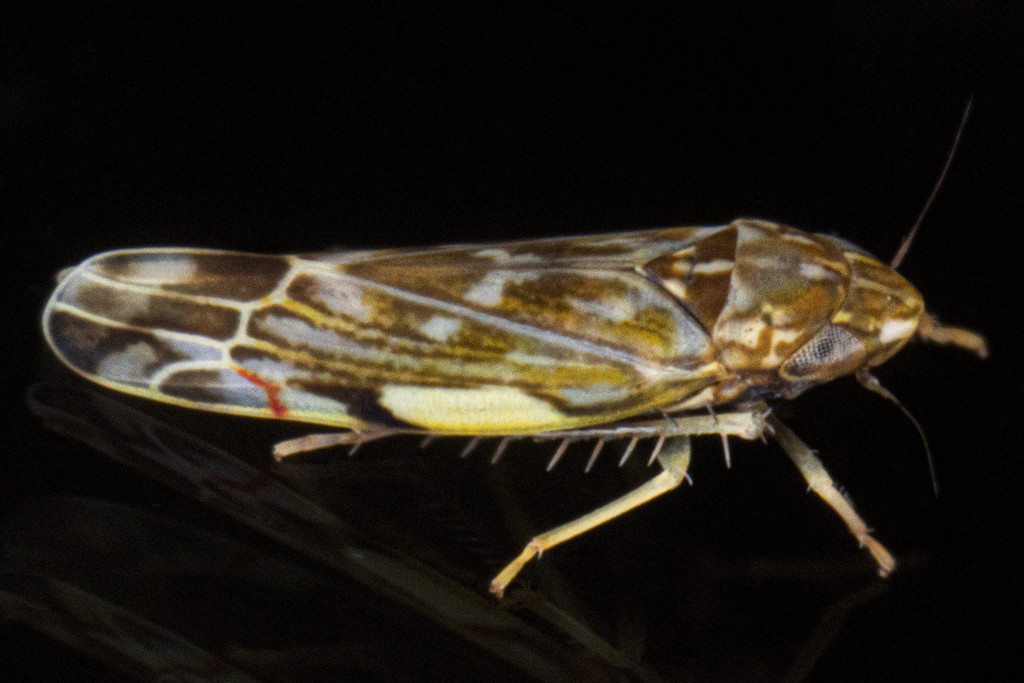
Wounded Leafhopper
Erasmoneura vulnerata
Erasmoneura vulnerata is a species of leafhopper native to North America. The species was found to be in Europe in 2004 where it causes significant economic damage to grapevine yards. E. vulnerata is commonly found on wild and cultivated grapes from both continents. Its Latin name translates to "wounded Erasmoneura" from its original description.
From the article Erasmoneura vulnerata on Wikipedia (CC BY-SA), quoted section by section
Range & habitat
Erasmoneura vulnerata is native to North America. It is widely distributed in both Canada and the USA. It is also found in Mexico. The species was first found in Europe in 2004 as an invasive species. It was found in the region of Veneto in northern Italy recorded on Vitis vinifera. By 2005, the species had migrated to other nearby regions in Italy. By 2010 it was found in Slovenia. The leafhopper can move easily by flight or by attaching and travelling with cars which can accelerate its spread. In 2018 the presence of E. vulnerata was confirmed to be in Romania. The species was additionally found in Switzerland in 2019. Recently, the species was also found to have a few occurrences in Serbia.
Wikipedia: “Distribution”
What it does
Within their native range adults overwinter near vineyard margins where there is adequate canopy cover, inside plant structures or organic material. Similarly, it was observed in Italy that buildings and hedgerows near vineyards seem to be important for the overwintering of the leafhopper. Common overwintering species can include the canopy of V. labrusca and V. vinifera cultivars. Adults will move away from their overwintering sites towards vineyards beginning April around bud break. In their native range it is found that the female leafhoppers oviposit in the vascular bundles on the leaf midrib as well as on the top surface of the leaf. Leafhoppers are hemimetabolous and develop through five nymphal instars. Early instar nymphs can be first detected in late May while older nymph populations peak in June. Time for egg development is 16-20 days whereas overall development for adults requires 35-38 days. Two generations of E. vulnerata per year is detected in their native range. However, 3 peaks are recorded in nymph densities in Europe suggesting the species is capable of 3 generations a year. Its additionally found that the 2nd generation is the most abundant.
Wikipedia: “Life cycle and reproduction”
Listen
Looking for field recordings…
Where it lives
Recorded sightings
—
geo-referenced records in GBIF, from museums, herbaria and field observers.
Drag the globe to turn it. Dots are where records exist, not a range map; darker means more records.
In the stacks
Searching the stacks…
Every page naming Erasmoneura vulnerata in the Biodiversity Heritage Library →
This page is assembled live from iNaturalist, GBIF, Wikipedia, the Source Library and the Internet Archive. It is not yet part of the hand-edited codex. iNaturalist taxon 244814.