- Animals
- ›Chordates
- ›Vertebrates
- ›Birds
- ›Rollers, Kingfishers, and Allies
- ›Kingfishers
- ›Tree Kingfishers
- ›Dacelo
On eBird ↗
Rufous-bellied Kookaburra
Live sightings near you, the range map, bar charts of when it is seen, and Macaulay Library photos and recordings.
Rufous-bellied Kookaburra
Dacelo gaudichaud
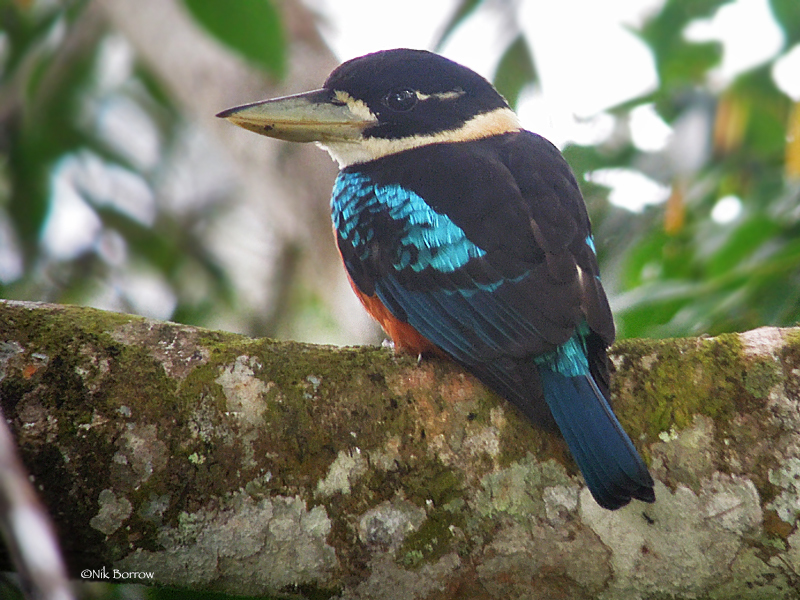
The rufous-bellied kookaburra (Dacelo gaudichaud), originally known as Gaudichaud's kookaburra after French botanist Charles Gaudichaud-Beaupré, is a species of kookaburra that is widely distributed through the forests of lowland New Guinea.
It has a black cap, blue-tinged wings, and a pale, rufous belly and tail feathers, but its white bill distinguishes it very clearly from other kookaburras with their black bills. Juveniles, however, have a dark-grey bill. Like the blue-winged kookaburra, the sexes can be distinguished by the colour of the tail feathers, blue in males and rufous in females and immature birds. Rufous-bellied kookaburras are smaller than other kookaburra species at around 143 g (5.0 oz) as against the laughing kookaburra's 335 g (11.8 oz) and about 28 cm (11.0 in) as against the laughing kookaburra's 46 cm (18.1 in). Despite this major size difference, the rufous-bellied kookaburra has been known to form (infertile) hybrids with all other kookaburra species, though available genetic studies suggest it is clearly the most distant of the four.
Listen
Looking for field recordings…
Where it lives
Recorded sightings
—
geo-referenced records in GBIF, from museums, herbaria and field observers.
Drag the globe to turn it. Dots are where records exist, not a range map; darker means more records.
In the stacks
Searching the stacks…
Every page naming Dacelo gaudichaud in the Biodiversity Heritage Library →
This page is assembled live from iNaturalist, GBIF, Wikipedia, the Source Library and the Internet Archive. It is not yet part of the hand-edited codex. iNaturalist taxon 2416.