- Animals
- ›Chordates
- ›Vertebrates
- ›Birds
- ›Rollers, Kingfishers, and Allies
- ›Kingfishers
- ›Tree Kingfishers
- ›Halcyon
On eBird ↗
Javan Kingfisher
Live sightings near you, the range map, bar charts of when it is seen, and Macaulay Library photos and recordings.
Javan Kingfisher
Halcyon cyanoventris
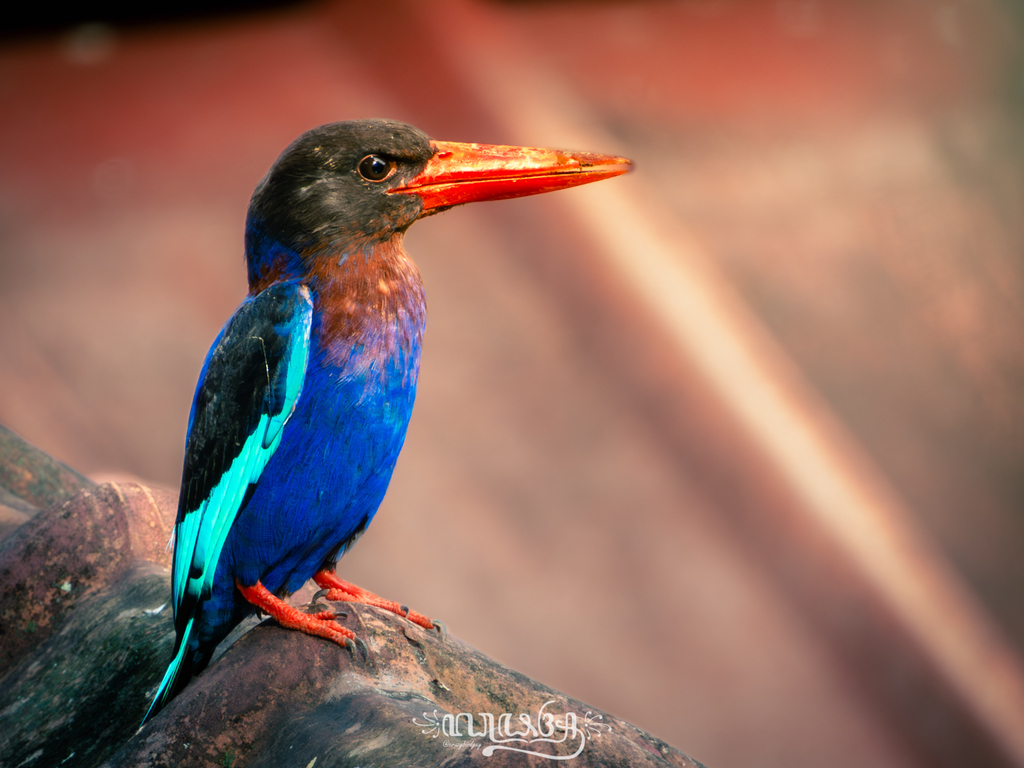
The Javan kingfisher (Halcyon cyanoventris), sometimes called the blue-bellied kingfisher or Java kingfisher, is a medium-sized kingfisher (subfamily Halcyoninae) endemic to the Indonesian islands of Java and Bali.
The brightly-colored Javan kingfisher has the large head and bill typical of kingfishers, although the species is less suited for aquatic hunting than many of its relatives and catches much of its prey on land or near the water's edge. The highly territorial bird lays its round white eggs in burrows excavated from earthen walls and riverbanks.
From the article Javan kingfisher on Wikipedia (CC BY-SA), quoted section by section
Description
The Javan kingfisher is a medium-sized bird (25–27 cm at maturity) with a distinctive large red bill; dark brown irises, head, throat, and collar; a purple body; vivid turquoise primary coverts, secondaries, and tail; white wing patches on the bases of the primaries (visible in flight); and dark red feet. There are no reported significant sexual dimorphisms. Juveniles are duller with brownish-orange bills and whitish throats. Juveniles of the genus Halcyon often show light barring or mottling along areas that are more uniformly colored in adults. The Javan kingfisher's call is described locally as cekakakak cekakakak cekakakak, hence its local name, Cekakak (or variants thereof). Others describe their call as a far-carrying scream that is striking and often heard, yet quieter than that of the collared kingfisher. Alternative published spellings of H. cyanoventris' call include tjie-rie-rie-rie-rie-rie, chee-ree-ree-ree, or cheree-cheree.
Range & habitat
The Javan kingfisher is endemic to the Indonesian islands of Java and Bali. It is a non-migratory species that lives in a variety of habitats, including pastures, fish ponds, paddyfields, marshes, coastal scrub, mangroves, open dry forest, municipal parks and gardens, and orchards. They inhabit some coastal environments but generally avoid contact with seawater. Humid tropical forests with closed canopies are typically avoided, except where roads and development have cleared the open spaces kingfishers require to hunt. Urban and suburban spaces with suitable tree cover can also provide suitable habitat for Javan kingfishers. Unlike many species of kingfisher, the Javan kingfisher does not appear very dependent on proximity to a body of water. It is typically found at elevations below 1,500 m (4,900 ft) above sea level, but one study found Javan kingfishers at nearly 2,500 m (8,200 ft) on Mount Lawu in East-Central Java.
Wikipedia: “Distribution and habitat”
What it does
Like all kingfishers, the Javan kingfisher is highly territorial and tends to stay close to its nesting area. They are mostly solitary animals, and are somewhat skittish around humans. Javan kingfishers are non-migratory.
Feeding. The Javan kingfisher displays classic kingfisher perch-and-wait behavior, preferring isolated perches or exposed branches at forest edges rather than closed-canopy forest interiors. As they display a limited degree of eye rotation, kingfishers use head movements to track their prey. Once a prey item is spotted, the kingfisher will wait for the opportune moment to swoop down and capture it with its large beak; after returning to a perch, the kingfisher will sometimes forcefully swing its prey against a branch in order to kill or soften it. Like other Halcyon kingfishers, the Javan kingfisher typically prefers insects and small prey animals taken on land or at the water's edge over prey items actually within the water, and in fact seems less suited to aquatic hunting than many kingfishers of other genera. A typical diet can include fish, frogs, reptiles, freshwater shrimps, terrestrial and aquatic insects, and the larvae of Dytiscides water beetles. …
Wikipedia: “Behaviour”
Listen
Looking for field recordings…
Where it lives
Recorded sightings
—
geo-referenced records in GBIF, from museums, herbaria and field observers.
Drag the globe to turn it. Dots are where records exist, not a range map; darker means more records.
In the stacks
Searching the stacks…
Every page naming Halcyon cyanoventris in the Biodiversity Heritage Library →
This page is assembled live from iNaturalist, GBIF, Wikipedia, the Source Library and the Internet Archive. It is not yet part of the hand-edited codex. iNaturalist taxon 2352.