- Animals
- ›Arthropods
- ›Hexapods
- ›Insects
- ›Winged and Once-winged Insects
- ›True Bugs, Hoppers, Aphids, and allies
- ›Plant-parasitic Hemipterans
- ›Aphids and Allies
- ›Aphidoidea
- ›Aphids
- ›Hormaphidinae
- ›Hormaphidini
- ›Hormaphis
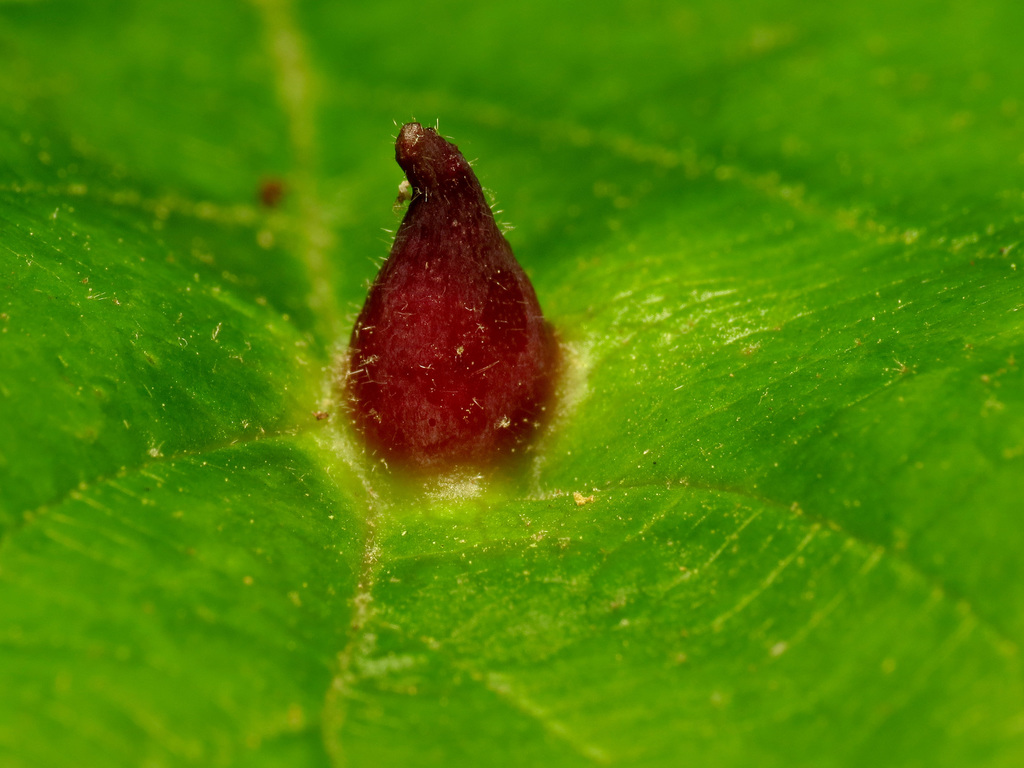
Witch-hazel Cone Gall Aphid
Hormaphis hamamelidis
The witch-hazel cone gall aphid (Hormaphis hamamelidis) is a minuscule insect, a member of the aphid superfamily, whose presence on a witch-hazel (Hamamelis virginiana) plant is easily recognizable by a conical gall structure. The gall is green at first, then turns bright red. This gall, rich in nutrients, provides both food and shelter for the female aphid.
H. hamamelidis have three generations per year, each with a different part in the life cycle. At the start of spring, females or stem mothers crawl to witch-hazel leaf buds. As the leaf grows, the aphid injects it with a substance, possibly an enzyme or hormone, that causes that the galls to form around her. Once inside her gall, the stem mother reproduces parthenogenically and fills the gall with 50–70 female offspring. The second generation develops wings and disperses, repeating the process. The third generation includes both males and females. Towards the end of summer, the third generation reproduces sexually and lays eggs on the bark of the witch-hazel. The cycle begins anew in the following spring.
From the article Witch-hazel cone gall aphid on Wikipedia (CC BY-SA), quoted section by section
In human culture
The first generation of the year is composed entirely of female fundatrices (also called stem mothers), which hatch from winter eggs laid on the bark of witch-hazel. Shortly following bud break, she begins to feed on leaf tissue. She then repeatedly “stings” the abaxial surface of the leaf to induce gall formation. A gall forms around her approximately 7–14 mm tall on the adaxial (upper) side of the leaf. She then reproduces around 45 female offspring through parthenogenesis. The second generation consists of alate sexuparae, which are winged females. As the second generation matures within the gall, the stem mother and juveniles feed on witch-hazel phloem and push waxy detritus through the gall opening on the leaf's underside. All the offspring from a given gall mature at the same time and become winged migrants. At maturity, the females leave the gall and begin to lay the eggs of the third generation on surrounding leaves, often on the same plant that they emerged from. The third generation comprises both male and female sexuales. Individuals begin mating after their final molt. Mating may occur on the leaves where the aphids hatched or on the plant's winter buds. There, females deposit between five and ten eggs, which remain throughout the winter.
Wikipedia: “Life history”
Listen
Looking for field recordings…
Where it lives
Recorded sightings
—
geo-referenced records in GBIF, from museums, herbaria and field observers.
Drag the globe to turn it. Dots are where records exist, not a range map; darker means more records.
In the stacks
Searching the stacks…
Every page naming Hormaphis hamamelidis in the Biodiversity Heritage Library →
This page is assembled live from iNaturalist, GBIF, Wikipedia, the Source Library and the Internet Archive. It is not yet part of the hand-edited codex. iNaturalist taxon 221498.