- Animals
- ›Arthropods
- ›Hexapods
- ›Insects
- ›Winged and Once-winged Insects
- ›Ants, Bees, Wasps, and Sawflies
- ›Narrow-waisted Wasps, Ants, and Bees
- ›Ants, Bees, and Stinging Wasps
- ›Bees and Apoid Wasps
- ›Bees
- ›Honey Bees, Bumble Bees, and Allies
- ›Apine Bees
- ›Bombini
- ›Bombus
- ›Pyrobombus
- ›Bombus lapponicus
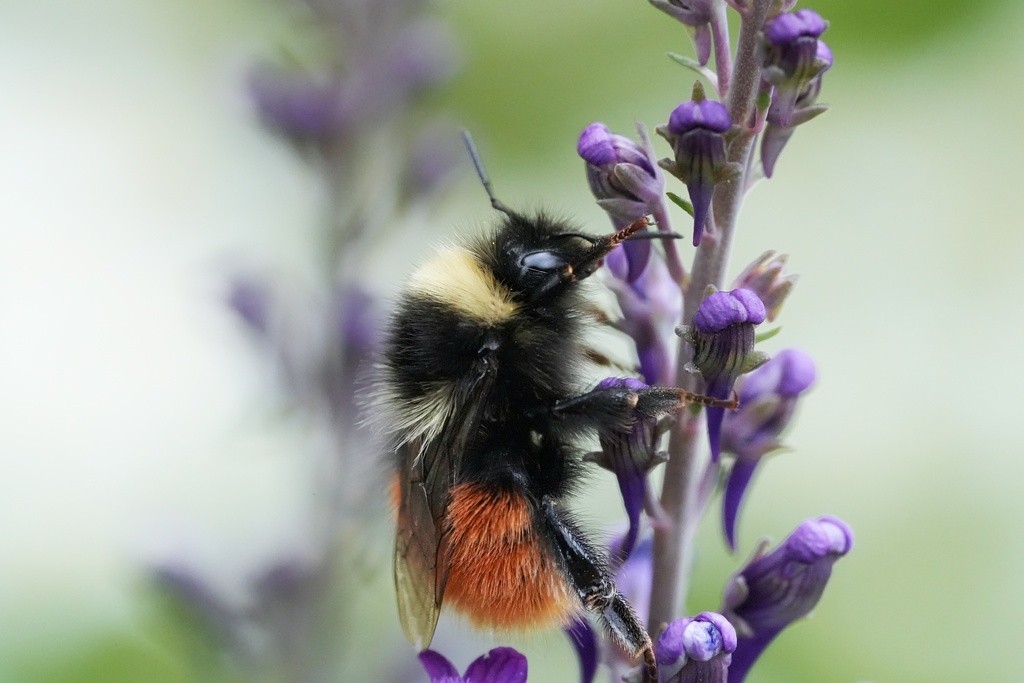
Mountain Bumble Bee
Bombus monticola
Bombus monticola, the bilberry bumblebee, blaeberry bumblebee or mountain bumblebee, is a species of bumblebee found in Europe.
From the article Bombus monticola on Wikipedia (CC BY-SA), quoted section by section
Description
The bilberry bumblebee is rather small and compact, with a broad head and a short tongue. The queens have an average length of 16 mm (0.63 in), and a wingspan of 32 mm (1.3 in). The corresponding lengths of the other castes are 12 mm (0.47 in) (worker) and 14 mm (0.55 in) (male). In the nominate subspecies, the thorax is black, with the exception of a yellow collar (quite broad on the males) and on the edge of the scutellum. The first, and the frontal part of the second terga (abdominal segments) are black, as is the final tergite, but the rest of the abdomen is yellow to red.
Range & habitat
B. monticola is found in most mountainous areas of Europe, as northern Scandinavia (mostly Norway and northern Sweden; the distribution in Finland is rather patchy, and confined to the area along the Norwegian border), the Alps, the Cantabrian Mountains, the Pyrenees, the Apennines, and in the Balkans. It is also found in the lowlands in northern Norway and the Kola peninsula as on the British Islands. In Britain, it lives on upland habitat, predominantly moorland. The major areas populated by this bumblebee are Dartmoor, Exmoor, the Welsh uplands, the Peak District, the North York Moors, and the Scottish mainland. It is a recent arrival in Ireland (first recorded in the 1970s). In Ireland, it is a montane species (hence the name). It is restricted to upland areas of counties Antrim, Dublin, Wicklow, Carlow and Wexford. The decline of this species in England has led Natural England to include the bilberry bumble bee in its Species recovery Programme.
== References ==
Wikipedia: “Distribution”
What it does
The bumblebee is normally a highland species, often found on bilberry, cranberry, and cowberry (Vaccinium vitis-idaea). It is a pollen storer; it actively feeds the larvae from a central pollen storage, rather than providing each larval cell with its own pollen container. It nests underground in the abandoned nesting burrows of small mammals, the relatively small nests frequently house less than 50 workers and their life cycle is 3–4 months. In Great Britain the queens emerge from their hibernation during April; the first workers appear in May, and the males and new queens start to emerge in July and last until early October. The cuckoo bumblebee Bombus sylvestris is likely to be parasitic on this species.
Wikipedia: “Ecology”
Listen
Looking for field recordings…
Where it lives
Recorded sightings
—
geo-referenced records in GBIF, from museums, herbaria and field observers.
Drag the globe to turn it. Dots are where records exist, not a range map; darker means more records.
In the stacks
Searching the stacks…
Every page naming Bombus monticola in the Biodiversity Heritage Library →
This page is assembled live from iNaturalist, GBIF, Wikipedia, the Source Library and the Internet Archive. It is not yet part of the hand-edited codex. iNaturalist taxon 181044.