- Animals
- ›Chordates
- ›Vertebrates
- ›Birds
- ›Woodpeckers and Allies
- ›Woodpeckers
- ›Typical woodpeckers
- ›Pied woodpeckers and allies
- ›Dendrocopos
On eBird ↗
Great Spotted Woodpecker
Live sightings near you, the range map, bar charts of when it is seen, and Macaulay Library photos and recordings.
Great Spotted Woodpecker
Dendrocopos major
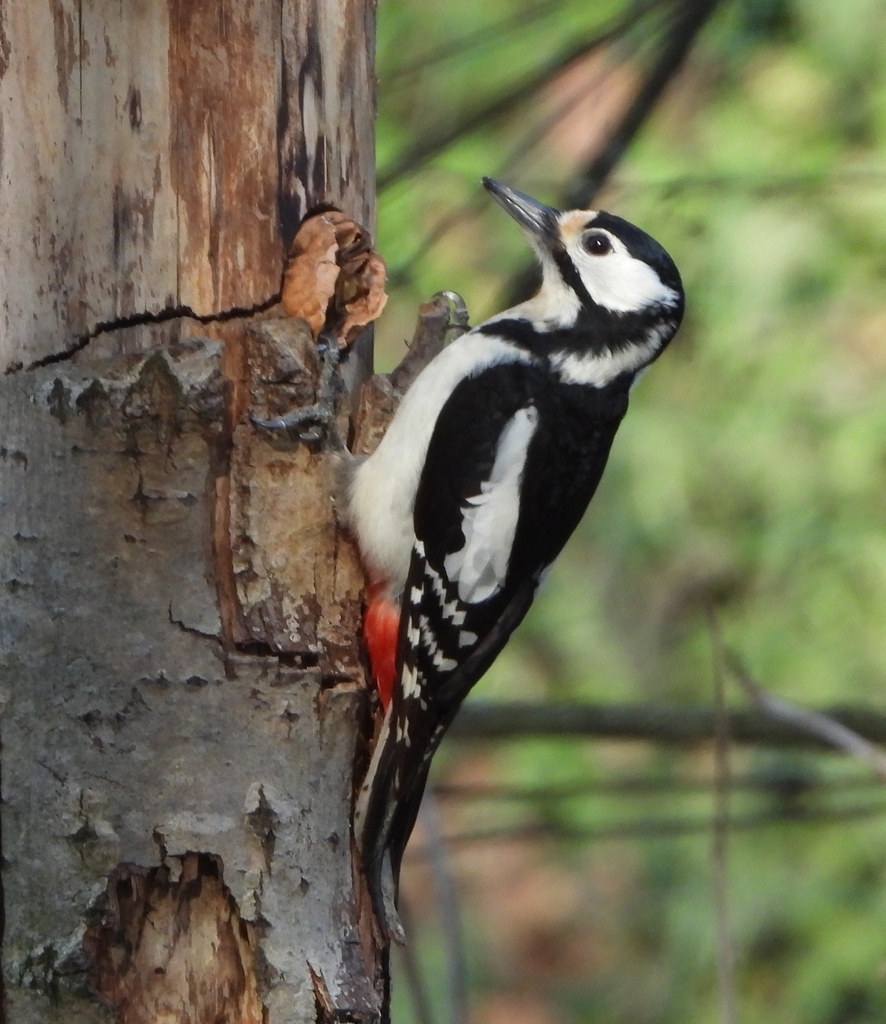
The great spotted woodpecker (Dendrocopos major) is a medium-sized woodpecker with pied black and white plumage and a red patch on the lower belly. Males and young birds also have red markings on the neck or head. This species is found across the Palearctic including parts of North Africa. Across most of its range it is resident, but in the north some will migrate if the conifer cone crop fails. Some individuals have a tendency to wander, leading to the recolonisation of Ireland in the first decade of the 21st century and to vagrancy to North America. Great spotted woodpeckers chisel into trees to find food or excavate nest holes, and also drum for contact and territorial advertisement; like other woodpeckers, they have anatomical adaptations to manage the physical stresses from the hammering action.
This woodpecker occurs in all types of woodlands and eats a variety of foods, being capable of extracting seeds from pine cones, insect larvae from inside trees or eggs and chicks of other birds from their nests. It breeds in holes excavated in living or dead trees, unlined apart from wood chips. The typical clutch is four to six glossy white eggs. Both parents incubate the eggs, feed the chicks, and keep the nest clean. When the young fledge they are fed by the adults for about ten days, each parent taking responsibility for feeding part of the brood.
From the article Great spotted woodpecker on Wikipedia (CC BY-SA), quoted section by section
Description
An adult great spotted woodpecker is 20–24 cm (7.9–9.4 in) long, weighs 70–98 g (2.5–3.5 oz) and has a 34–39 cm (13–15 in) wingspan. The upperparts are glossy blue-black, with white on the sides of the face and neck. Black lines run from the shoulder to the nape, the base of the bill and about halfway across the breast. There is a large white shoulder patch and the flight feathers are barred with black and white, as is the tail. The underparts are white other than a scarlet lower belly and undertail. The bill is slate-black, the legs greenish-grey and the eye is deep red. Males have a crimson patch on the nape, which is absent from the otherwise similar females. Juvenile birds are less glossy than adults and have a brown tinge to their upperparts and dirty white underparts. Their markings are less well-defined than the adult's and the lower belly is pink rather than red. The crown of the juvenile's head is red, less extensively in young females than males. The various subspecies differ in plumage, the general pattern being that northern forms are larger, heavier-billed and whiter beneath, as predicted by Bergmann's rule, so north Eurasian D. m. major and D. m. kamtschaticus are large and strikingly white, whereas D. m. hispanicus in Iberia and D. m. harterti in Corsica and Sardinia are somewhat smaller and have darker underparts. D. m. canariensis and D. m. …
Range & habitat
The species ranges across Eurasia from Ireland to Japan, and in North Africa from Morocco to Tunisia; it is absent only from those areas too cold or dry to have suitable woodland habitat. It is found in a wide variety of woodlands, broadleaf, coniferous or mixed, and in modified habitats like parks, gardens and olive groves. It occurs from sea level to the tree line, up to 2,000 m (6,600 ft) in Europe, 2,200 m (7,200 ft) in Morocco and 2,500 m (8,200 ft) in Central Asia. The great spotted woodpecker is mainly resident year-round, but sizeable movements can occur when there are shortages of pine and spruce cones in the north of the range. Highland populations often descend to lower altitudes in winter. Juveniles also have a tendency to wander some distance from where they were hatched, often as far as 100–600 km (60–400 mi), sometimes up to 3,000 km (1,900 mi). Vagrants have reached the Faroe Islands, Hong Kong and Iceland, and there are several sightings from North America in at least the Aleutian Islands, Pribilof Islands and Alaska. Due to deforestation, this woodpecker was extirpated in Ireland in the seventeenth century, but the island has been naturally recolonised, with the first proven nesting in County Down in 2007. …
Wikipedia: “Distribution and habitat”
What it does
The great spotted woodpecker spends much of its time climbing trees, and has adaptations to this lifestyle, many of which are shared by other woodpecker species. These include the zygodactyl arrangement of the foot, with two toes facing forward and two back, and the stiff tail feathers that are used as a prop against the trunk. In most birds the bones of the tail diminish in size towards its end, but this does not occur in woodpeckers, and the final vertebra, the pygostyle, is very large to anchor the strong tail muscles. The hammering of woodpeckers when drumming or feeding creates great forces which are potentially damaging to the birds. In the great spotted woodpecker and most of its relatives, the hinge where the front of the skull connects with the upper mandible is folded inwards, tensioned by a muscle that braces it against the shock of the impact when the bill is hammering on hard wood. The outer layer of the upper mandible is significantly longer than the more rigid lower mandible and absorbs much of the concussive force. Skeletal adaptations and strengthening also help to absorb the shock, and narrow nostrils protect against flying debris. As well as using holes for breeding, great spotted woodpeckers roost at night, and sometimes during the day, in old nest cavities, excavated by other woodpeckers. …
Wikipedia: “Behaviour”
Listen
Looking for field recordings…
Where it lives
Recorded sightings
—
geo-referenced records in GBIF, from museums, herbaria and field observers.
Drag the globe to turn it. Dots are where records exist, not a range map; darker means more records.
In the stacks
Searching the stacks…
Every page naming Dendrocopos major in the Biodiversity Heritage Library →
This page is assembled live from iNaturalist, GBIF, Wikipedia, the Source Library and the Internet Archive. It is not yet part of the hand-edited codex. iNaturalist taxon 17871.