- Animals
- ›Arthropods
- ›Hexapods
- ›Insects
- ›Winged and Once-winged Insects
- ›True Bugs, Hoppers, Aphids, and allies
- ›True Hoppers
- ›Planthoppers
- ›Fulgoroidea
- ›Lanternflies
- ›Lystrinae
- ›Poiocerini
- ›Poblicia
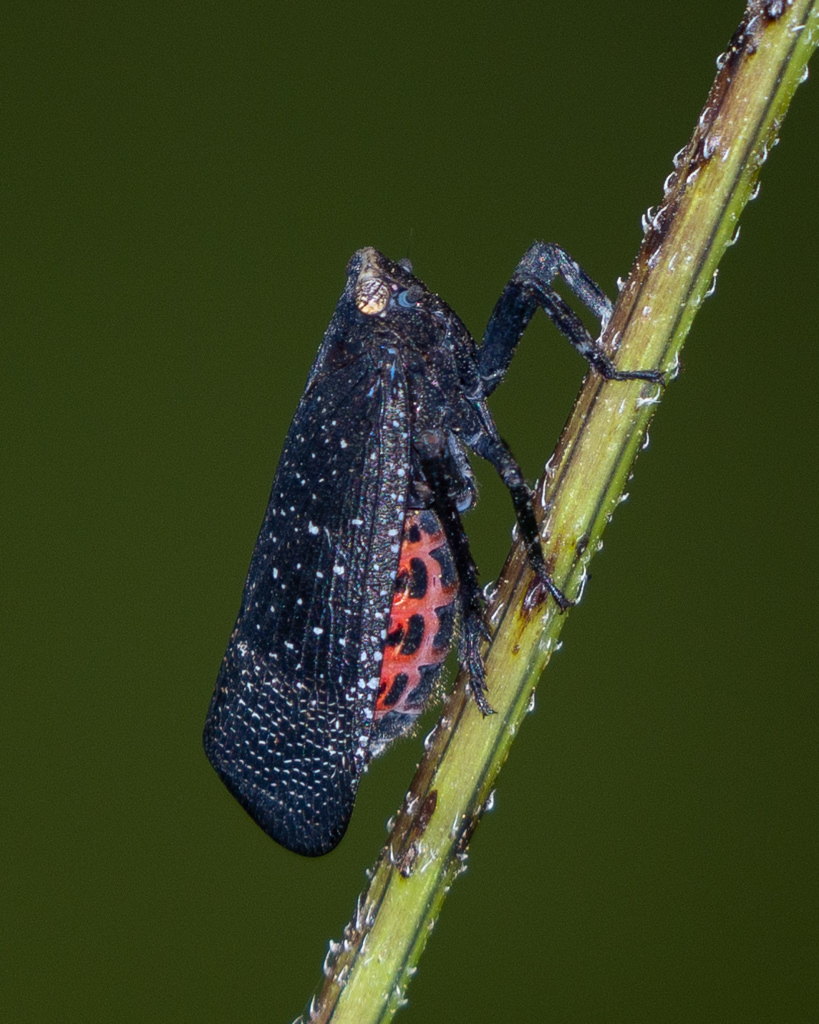
sumac speckled lanternfly
Poblicia fuliginosa
Poblicia fuliginosa is a planthopper native to the United States, described by Guillaume-Antoine Olivier in 1791. The generic placement of the species is disputed. One author in 1954 placed it into the genus Crepusia but this has not generally been accepted; a 2023 review rejected this placement although they note that the genus Poblicia needs further study of its proper constituency.
From the article Poblicia fuliginosa on Wikipedia (CC BY-SA), quoted section by section
Description
Poblicia fuliginosa is mostly dark in color, with minuscule, pale specks on the forewings. The head, specifically the vertex, is short and broad. The hindwings are a smoky grayish-transparent color, except for the proximal area, which is mostly black with two pale blue splotches. The bulbous eyes do not exceed the width of the closed forewings. The thorax and frontal abdominal segments are black, while the posterior abdominal segments are red. Adults are 8–17 mm (0.31–0.67 in) long. The legs often have two white bands on them. Nymphs are grayish-brown, with a dark brown thorax and a white head and abdomen. They have thorns/bumps all over their body. Like many planthoppers, P. fuliginosa prefers to jump rather than fly.
Range & habitat
Poblicia fuliginosa is native to the United States, specifically the states of Alabama, Arkansas, Georgia, Illinois, Kansas, Louisiana, Maryland, Missouri, Mississippi, North Carolina, Oklahoma, South Carolina, Tennessee, and Texas, although there are some records in Mexico; this could be an undescribed species.
== References ==
Wikipedia: “Distribution”
What it does
Poblicia fuliginosa mostly feeds on sumac (Rhus) species, especially the winged sumac (Rhus copallinum.) The species has also been recorded feeding on red maple (Acer rubrum), though this may not be a usual host. A related species, Poblicia thanatophana, formerly treated as a synonym, and occurring in the western United states, feeds on Baccharis salicifolia and Brickellia. It is usually found on the trunk of its host plants, while the nymphs are found near the base of the trunk. Poblicia fuliginosa is hemimetabolous, meaning that it has several nymphal stages before molting into an adult. The eggs are covered with white, creamy wax.
Wikipedia: “Host associations and life cycle”
Listen
Looking for field recordings…
Where it lives
Recorded sightings
—
geo-referenced records in GBIF, from museums, herbaria and field observers.
Drag the globe to turn it. Dots are where records exist, not a range map; darker means more records.
In the stacks
Searching the stacks…
Every page naming Poblicia fuliginosa in the Biodiversity Heritage Library →
This page is assembled live from iNaturalist, GBIF, Wikipedia, the Source Library and the Internet Archive. It is not yet part of the hand-edited codex. iNaturalist taxon 154267.