- Animals
- ›Chordates
- ›Vertebrates
- ›Reptiles
- ›Snakes and Lizards
- ›Snakes
- ›Colubrid Snakes
- ›Dipsadine Snakes
- ›Philodryas
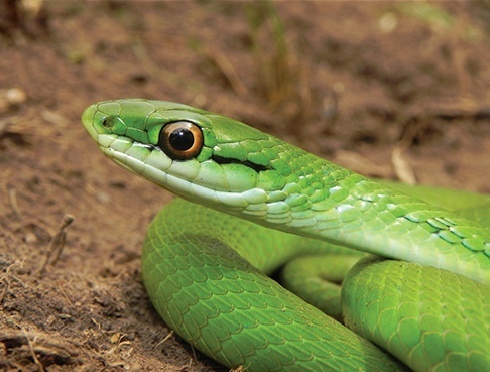
Brazilian Green Racer
Philodryas aestiva
Philodryas aestiva is a species of snake of the family Colubridae. It is commonly known as the Brazilian green racer and the common green racer.
From the article Philodryas aestiva on Wikipedia (CC BY-SA), quoted section by section
Range & habitat
Philodryas aestiva inhabits a wide range of environments in southwestern Brazil, northern Argentina, Paraguay, Bolivia, and Uruguay. They prefer open forests and savannahs (such as the Cerrado biome in Brazil) but are sometimes found in semi-urban or rural areas.
Wikipedia: “Geographic range”
What it does
Philodryas aestiva is a highly agile snake. Its slender body and large eyes contribute not only to its swift movement but also to its climbing ability. It is diurnal meaning it actively forages during the day. It is primarily terrestrial.
Wikipedia: “Behavior”
Toxicity
P. aestiva produces mild venom from its Duvernoy’s glands (gland found in some groups of colubrid snakes, it is distinguished from the venom gland of viperids or elapids) which helps subdue small prey. While not dangerous to humans, the venom contains compounds such as snake venom metalloproteinases that contribute to prey immobilization and digestion through hemorrhagic and inflammatory effects.
Wikipedia: “Venom”
In human culture
The genus Philodryas, Philo which is Greek means "loving" or "fond of" and dryas also Greek means "tree" or "oak," also used for "tree nymph" in mythology. Philodryas can be interpreted as "tree-loving" or "fond of trees." The species name aestiva comes from the Latin aestīvus and means "of the summer" or "summery" which could refer to its active season or its green coloration. If you put the name together, Philodryas aestiva roughly means "summer-loving tree snake" or "summery tree-dweller", hinting at its habitat and activity patterns.
Wikipedia: “Etymology”
Where it lives
Recorded sightings
—
geo-referenced records in GBIF, from museums, herbaria and field observers.
Drag the globe to turn it. Dots are where records exist, not a range map; darker means more records.
In the stacks
Searching the stacks…
Every page naming Philodryas aestiva in the Biodiversity Heritage Library →
This page is assembled live from iNaturalist, GBIF, Wikipedia, the Source Library and the Internet Archive. It is not yet part of the hand-edited codex. iNaturalist taxon 146349.