- Animals
- ›Chordates
- ›Vertebrates
- ›Reptiles
- ›Snakes and Lizards
- ›Snakes
- ›Colubrid Snakes
- ›Colubrine Snakes
- ›Oligodon
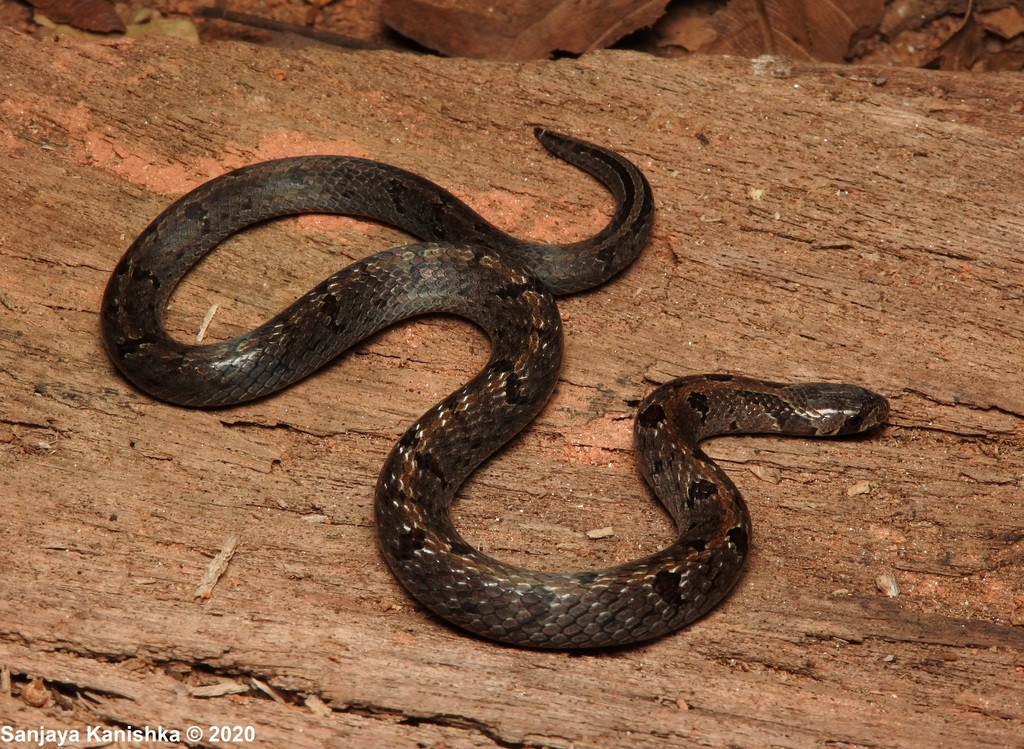
Templeton's Kukri Snake
Oligodon calamarius
Oligodon calamarius, commonly known as the reed-like kukri or Templeton's kukri snake, is a species of nonvenomous colubrid endemic to Sri Lanka. It is known as කබර දත්-කැටියා (kabara dath ketiya) in Sinhala.
From the article Oligodon calamarius on Wikipedia (CC BY-SA), quoted section by section
Description
O. calamarius is a terrestrial snake from lowlands of the wet zone, reaching montane limits, up to 1,800 m (5,900 ft). The head is short, scarcely distinct from the neck. The pupil of the eye is round. The dorsum is light brown with a light vertebral stripe. There are 18–24 narrow dark brown, light-edged cross-bands that are either complete or half-way cross the back. The venter is cream, with square black markings. The forehead has a dark crescentric marking and an elongated spot behind it.
Range & habitat
O. calamarius is known from Udugama in the Southern Province, Hewissa and Mathugama in the Western Province, Ratnapura and Balangoda in the Sabaragamuwa Province, and Peradeniya in Central Province.
Wikipedia: “Distribution”
In human culture
Oligodon templetoni, now a junior synonym of Oligodon calamarius, was named in honour of Irish naturalist Dr. Robert Templeton who obtained the first known specimen.
Wikipedia: “Etymology”
Where it lives
Recorded sightings
—
geo-referenced records in GBIF, from museums, herbaria and field observers.
Drag the globe to turn it. Dots are where records exist, not a range map; darker means more records.
In the stacks
Searching the stacks…
Every page naming Oligodon calamarius in the Biodiversity Heritage Library →
This page is assembled live from iNaturalist, GBIF, Wikipedia, the Source Library and the Internet Archive. It is not yet part of the hand-edited codex. iNaturalist taxon 146308.