- Animals
- ›Chordates
- ›Vertebrates
- ›Reptiles
- ›Snakes and Lizards
- ›Snakes
- ›Colubrid Snakes
- ›Colubrine Snakes
- ›Lampropeltis
- ›Lampropeltis getula
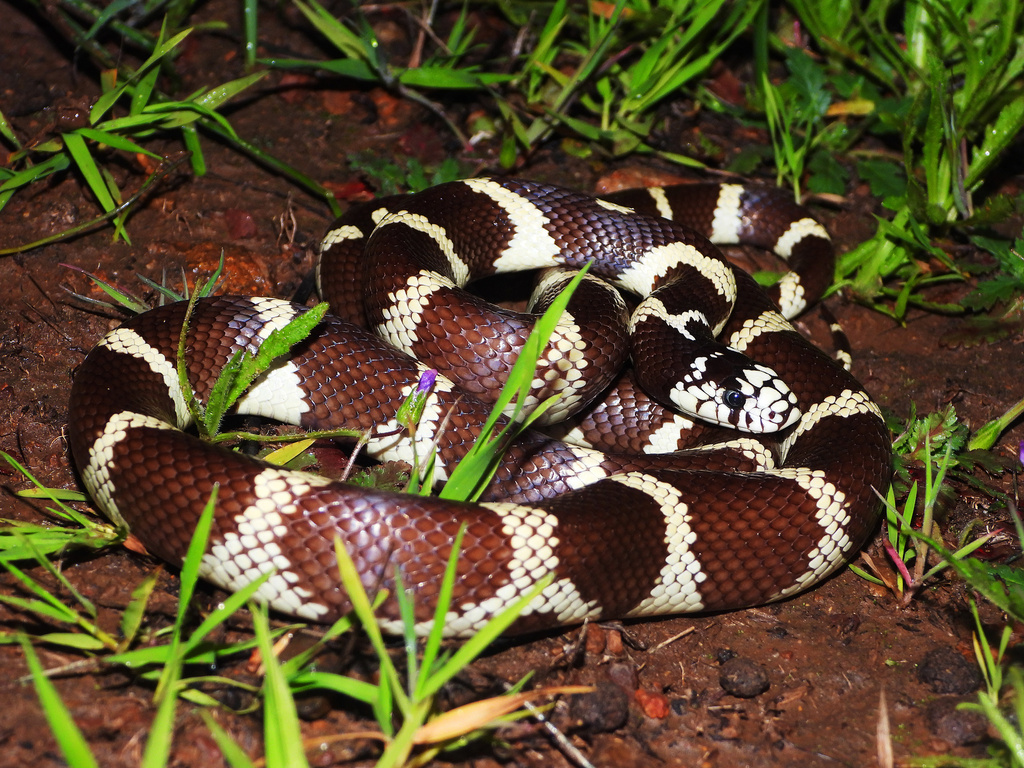
California King Snake
Lampropeltis californiae
The California kingsnake (Lampropeltis getula californiae) is a nonvenomous colubrid snake endemic to the western United States and northern Mexico. It is a relatively small subspecies of the common kingsnake and is found in a variety of habitats. Due to ease of care and a wide range of color variations, the California kingsnake is one of the most popular snakes in captivity.
From the article California kingsnake on Wikipedia (CC BY-SA), quoted section by section
Description
Wild California kingsnakes are typically encountered at a length of 2.5–3.5 feet (76–107 cm), though they can grow larger; California kingsnakes on Isla Ángel de la Guarda, Baja California, Mexico, have been documented growing to 78 inches (2 m). A wide range of color morphs exist in the wild; they are usually found with alternating dark and light bands ranging in color from black and white to brown and cream. Some populations may have longitudinal stripes instead of bands. Most California kingsnakes live to be around ten to fifteen years old, even surpassing twenty if well cared for in captivity. California kingsnakes stripes and bands are essential to their survival as the patterns camouflage the snakes body to hide from predators. Their predators include hawks, eagles, coyotes, skunks, foxes, bobcats, and other kingsnakes.
Range & habitat
The California kingsnake is widespread along the West Coast of North America to elevations of approximately 6,100 ft (1,900 m) in the Tehachapi Mountains and to over 7,000 ft (2,100 m) in the southeastern Sierra Nevada Mountains. This species lives in a wide variety of habitats, including woodland chaparral, grassland, deserts, marshes, and even suburban areas. These snakes live in Oregon, California, Nevada, Utah, Arizona, southwestern Colorado, northwestern New Mexico, and northwestern Mexico. These snakes thrive in the temperatures between 80–84 °F and a humidity around 35–60%. The optimal environment can differ depending on the biological state of the snake. For instance, during reproduction they prefer even warmer temperatures, and in the process of shedding, they prefer higher humidity. In Arizona, they intergrade with the desert kingsnake (Lampropeltis splendida) and the Mexican black kingsnake (Lampropeltis getula nigrita). The species has also become invasive on the Spanish island of Gran Canaria. In 2014 the population there had reached an estimated 20,000 individuals. California kingsnakes in Gran Canaria tend to use rocky or stony habitats with good vegetation cover, even frequently using other invasive shrub species such as Opuntia dillenii and Cenchrus setaceus.
Wikipedia: “Range and habitat”
What it does
The California kingsnake is cathemeral; it may be active day or night depending on ambient temperatures. When disturbed, California kingsnakes often coil their bodies into a ball to hide their heads, hiss, and rattle their tails, which can produce a sound somewhat resembling that of a rattlesnake. When they are nervous they tend to twitch their tails. They are considered harmless to humans, but if handled it is common for this species to bite, as well as to excrete musk and fecal contents from their cloaca. It is also common for this musky odor to be excreted when the snake feels threatened. California kingsnakes are considered to be generally solitary, but when mating season or brumation is in process, they group together. California Kingsnakes, along with other reptiles and amphibians in winter months, brumate as a means of conserving energy and to regulate body temperatures during cold temperatures. During brumation, California king snakes neither eat nor excrete feces, but they occasionally awake to drink water. Also in efforts to regulate body temperatures, California kingsnakes tend to burrow underneath vegetation or other coverings to cool down, and to bask in the sun to increase their internal temperatures.
Wikipedia: “Behavior”
Where it lives
Recorded sightings
—
geo-referenced records in GBIF, from museums, herbaria and field observers.
Drag the globe to turn it. Dots are where records exist, not a range map; darker means more records.
In the stacks
Searching the stacks…
Every page naming Lampropeltis californiae in the Biodiversity Heritage Library →
This page is assembled live from iNaturalist, GBIF, Wikipedia, the Source Library and the Internet Archive. It is not yet part of the hand-edited codex. iNaturalist taxon 146199.