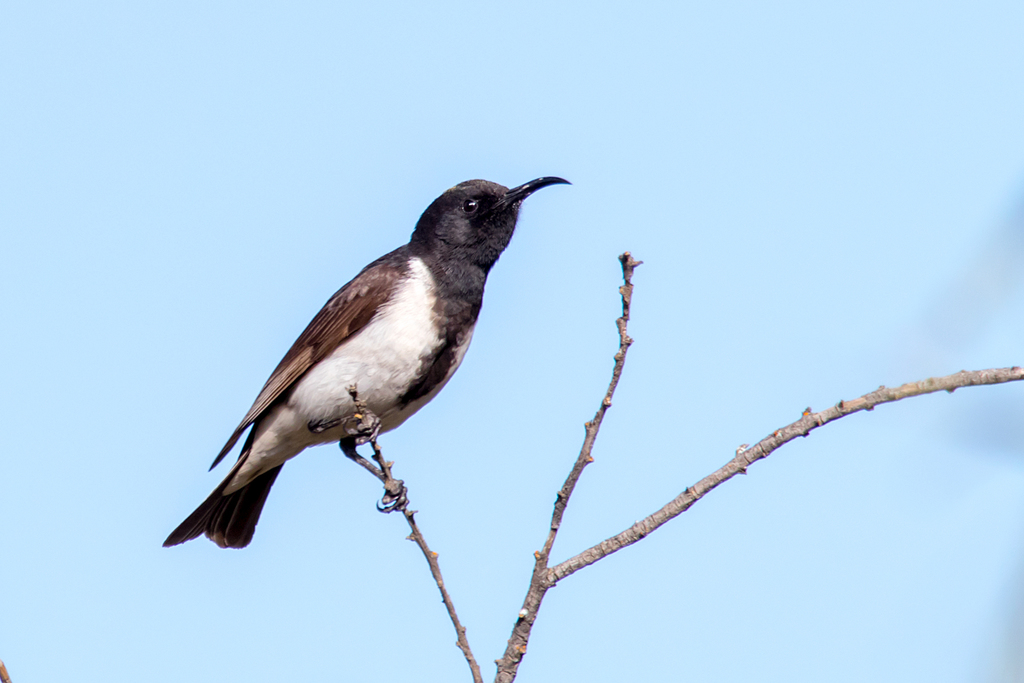
Sugomel
The black honeyeater (Sugomel nigrum) is a species of bird in the honeyeater family Meliphagidae and the sole species in the genus Sugomel. The black honeyeater exhibits sexual dimorphism, with the male being black and white while the female is a speckled grey-brown; immature birds look like the female. The species is endemic to Australia, and ranges widely across the arid areas of the continent, through open woodland and shrubland, particularly in areas where the emu bush and related species occur.
A nectar feeder, the black honeyeater has a long curved bill to reach the base of tubular flowers such as those of the emu bush. It also takes insects in the air, and regularly eats ash left behind at campfires. Cup-shaped nests are built in the forks of small trees or shrubs. The male engages in a soaring song flight in the mating season, but contributes little to nest-building or incubating the clutch of two or three eggs. Both sexes feed and care for the young. While the population appears to be decreasing, the black honeyeater is sufficiently numerous and widespread and hence is considered to be of least concern on the International Union for Conservation of Nature (IUCN)'s Red List of Endangered species.
1 branches of this genus, most-observed first · about 1 known species
See this branch on the Wheel of Life →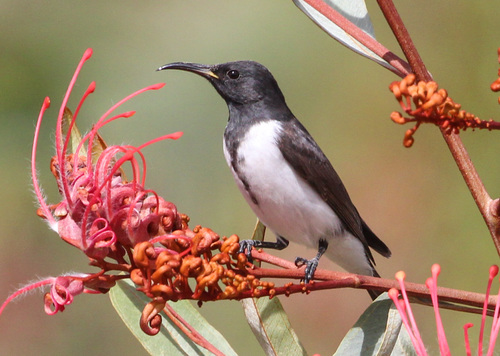
Where it lives
Recorded sightings
—
geo-referenced records in GBIF, from museums, herbaria and field observers.
Drag the globe to turn it. Dots are where records exist, not a range map; darker means more records.
In the stacks
Searching the stacks…
Every page naming Sugomel in the Biodiversity Heritage Library →
This page is assembled live from iNaturalist, GBIF, Wikipedia, the Source Library and the Internet Archive. It is not yet part of the hand-edited codex. iNaturalist taxon 144338.