 NL·0300
Herbarium of the Nature Library
- Name
- Bucorvus leadbeateri
- Family
- Bucorvidae
- Native to
- Eastern and southern Africa, from Kenya and Burundi south to South Africa
- Habitat
- Savanna, Grassland, Open woodland
On eBird ↗
Southern Ground-Hornbill
Live sightings near you, the range map, bar charts of when it is seen, and Macaulay Library photos and recordings.
Southern ground hornbill
Bucorvus leadbeateri
Also calledInsingizi (Zulu) · Intsikizi (Xhosa) · Bromvoël (Afrikaans)
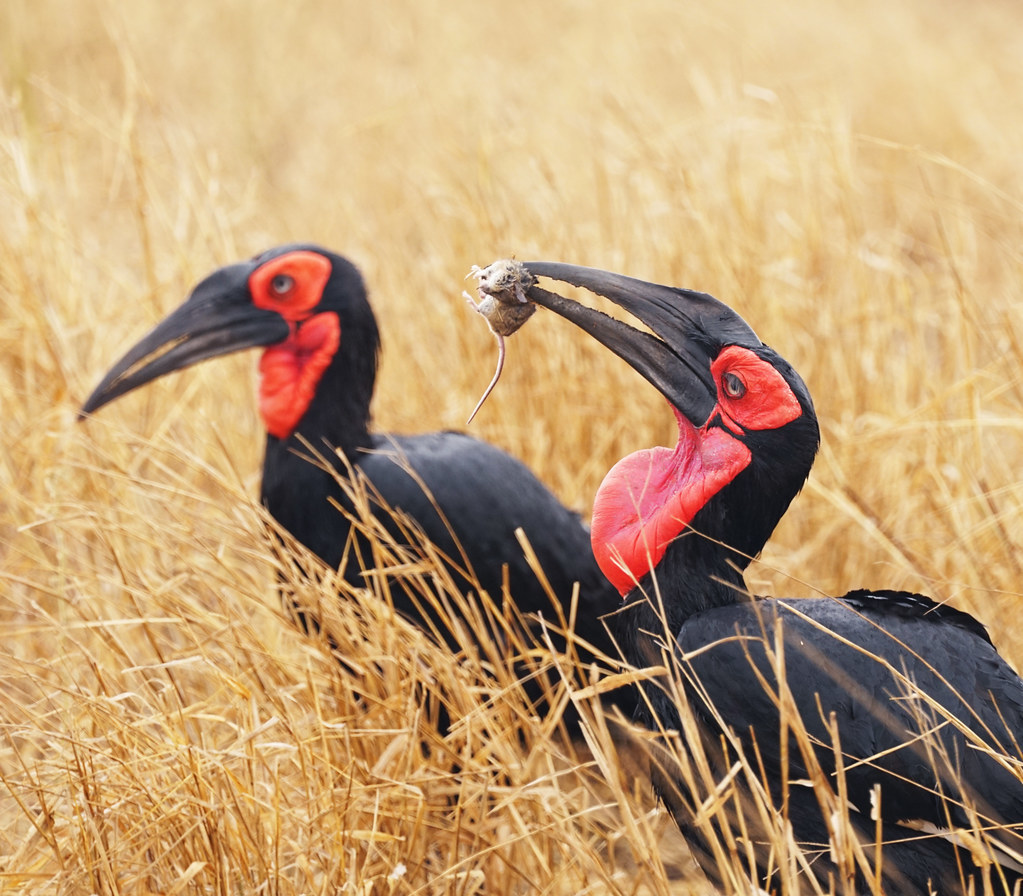
A turkey-sized black hornbill with scarlet facial wattles that walks the savanna in family groups, hunting everything from beetles to tortoises and snakes. It is among the slowest-breeding birds in the world, with groups raising on average one chick every nine years.
The southern ground hornbill is one of two species of ground hornbill, both of which are found solely within Africa, and is the largest species in the hornbill order worldwide. It can be found in the southern regions of Africa, ranging from Kenya to South Africa. Within these regions, they inhabit both woodlands and savannas. The other species of the genus Bucorvus is the Abyssinian ground hornbill, B. abyssinicus. Wikipedia
What it can do
- iCooperative breeder: a dominant pair is helped by older offspring and other group members
- iiBooming dawn chorus carries several kilometres across the savanna
- iiiKills snakes, hares and tortoises with blows of its massive bill
- ivCan live several decades, matching its very slow reproductive rate
In the field
Field marks
- aVery large all-black bird with white primaries visible in flight
- bBright red bare skin on face and inflatable throat wattle
- cFemales have a violet-blue patch on the throat
- dHeavy, down-curved black bill with low casque
- eLong eyelashes; walks on the ground like a turkey
- Voice
- A deep, resonant booming duet, 'oomph oomph-oomph', given mostly at dawn and audible several kilometres away.
- Not to be confused with
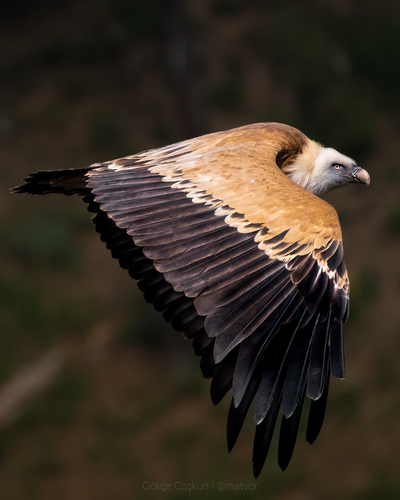
- Abyssinian ground hornbill, north of the equator, has blue and red bare skin and an open-ended tubular casque. Distant birds are sometimes mistaken for turkeys or vultures on the ground, but the red face wattle is distinctive.
- Where to see it
- Kruger National Park, Hluhluwe-iMfolozi, the Okavango and Serengeti; often walking in open grass
- When
- Resident year-round; breeding in the southern summer rains
Listen
Looking for field recordings…
Life & habits
- Diet
- Insects, reptiles including snakes and tortoises, frogs, small mammals and birds
- Habitat
- Savanna and grassland with large trees for nesting cavities
- Size
- About 90–130 cm long; 3–6 kg
- Lifespan
- Several decades; captive birds have lived over 40 years
A group of 2–10 birds holds a large territory, walking together all day and booming in chorus at dawn to declare ownership.
Where it lives
Recorded sightings
—
geo-referenced records in GBIF, from museums, herbaria and field observers.
Native range
Eastern and southern Africa, from Kenya and Burundi south to South Africa
Drag the globe to turn it. Dots are where records exist, not a range map; darker means more records.
In the old herbals & bestiaries
No plate in the Source Library names this exact species, so these show its closest relatives as the old naturalists drew them: same genus, or the same kind of animal. Click a plate to read the page it came from, with translation.

The Malay Archipelago: The Land of the Orang-Utan and the Bird of Paradise
Relative · Alfred Russel Wallace · 1869 · p.167

Ornithology
Relative · Ulisse Aldrovandi · 1599 · p.840

De Indiae utriusque re naturali et medica
Relative · Willem Piso · 1658 · p.464

Ornithology: The History of Birds
Relative · Ulisse Aldrovandi · 1599 · p.837

Ornithology: The History of Birds
Relative · Ulisse Aldrovandi · 1599 · p.818

Ornithologiae: de avibus historiae libri XII
Relative · Ulisse Aldrovandi · 1599 · p.824

De Indiae utriusque re naturali et medica
Relative · Willem Piso · 1658 · p.466
In the stacks
Searching the stacks…
Every page naming Bucorvus leadbeateri in the Biodiversity Heritage Library →
Marginalia
Among Zulu and Xhosa peoples the bird is linked to rain and storms and is traditionally protected by taboo; its booming is said to forecast rain, and some communities would only kill one in times of drought.
Curiosity
Usually only one of the two eggs is raised; the second chick hatches days later and normally starves, which is why conservationists 'harvest' second chicks for captive rearing and reintroduction.
Kinship





Photographs: iNaturalist contributors under the licences shown. Records: GBIF.org. Historical plates: Source Library (CC BY-SA 4.0; originals public domain). Summary text: Nature Library editors and Wikipedia (CC BY-SA). Medicinal and edibility notes are historical and educational, not advice. iNaturalist taxon 144281.