 NL·0605
Herbarium of the Nature Library
- Name
- Argusianus argus
- Family
- Phasianidae
- Native to
- Malay Peninsula (southern Myanmar, Thailand, Malaysia), Sumatra and Borneo
- Habitat
- Tropical rainforest
On eBird ↗
Great Argus
Live sightings near you, the range map, bar charts of when it is seen, and Macaulay Library photos and recordings.
Great argus
Argusianus argus
Also calledKuang raya (Malay) · Kuau (Malay/Indonesian) · Dà yǎn bān zhì 大眼斑雉 (Chinese)
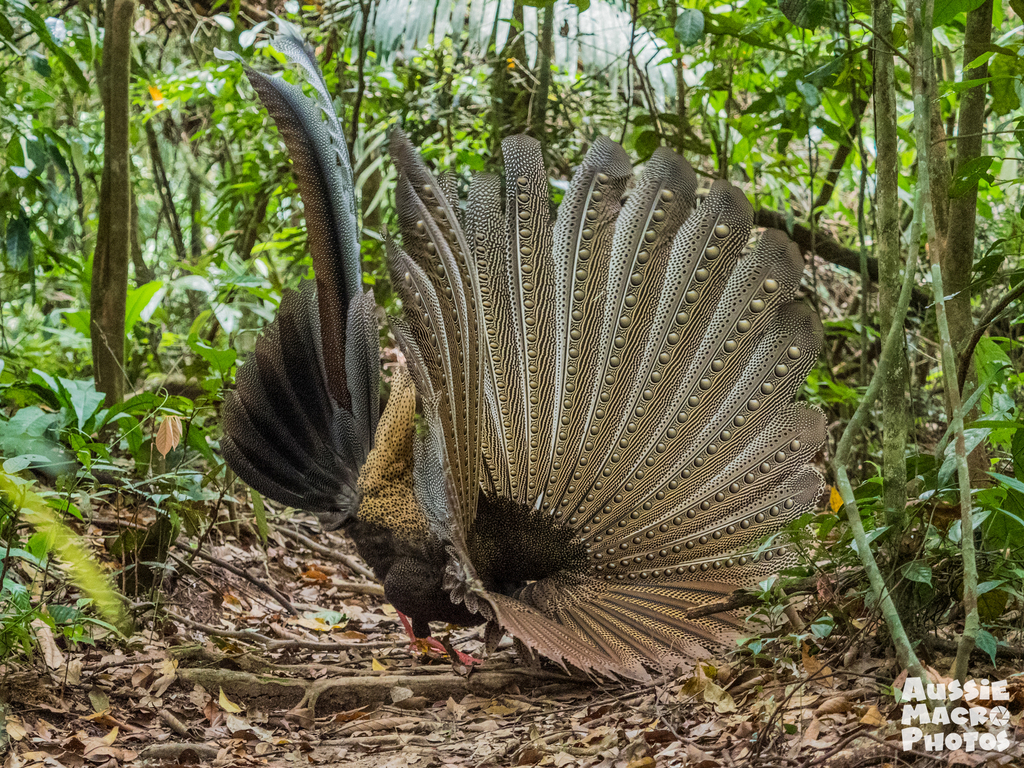
A huge, secretive pheasant of Sundaic rainforest whose male has enormous wing feathers covered with rows of shaded eyespots, which he fans into a great circular screen during display. Charles Darwin wrote at length about the eyespots as evidence for sexual selection.
The great argus or greater argus is a large species of pheasant native to the jungles of Borneo, Sumatra and the Malay Peninsula in southeast Asia. It is known for its impressive plumage and courtship behavior. It is not to be confused with the two species of closely related crested argus, genus Rheinardia. Wikipedia
What it can do
- iMale clears a 'dancing ground' on the forest floor of leaves and debris
- iiFans its huge secondary feathers into an upright disc displaying hundreds of eyespots
- iiiEyespots are shaded so they appear three-dimensional, like balls in sockets
In the field
Field marks
- aVery large pheasant with a small bare blue head
- bMale: extremely long central tail feathers and broad secondaries with rows of eyespots
- cOverall brown, finely patterned plumage
- dFemale much smaller with a short tail
- Voice
- Loud, far-carrying 'kwow-wow' calls from males, and a long series of 'wow' notes that accelerate; one of the classic sounds of Malaysian forests
- Not to be confused with
- Crested argus (Vietnam, Laos, Malaysia's highlands) has a crest and different eyespot pattern; peacock-pheasants are much smaller with metallic eyespots.
- Where to see it
- Taman Negara, Malaysia; Danum Valley, Sabah; Khao Sok and Hala-Bala in Thailand
- When
- Resident year-round
Listen
Looking for field recordings…
Life & habits
- Diet
- Fallen fruit, seeds, leaves, ants and other invertebrates
- Habitat
- Lowland and hill dipterocarp rainforest
- Size
- Males up to about 1.6–2 m including the tail; females about 75 cm
Males call from their dancing grounds and display there to visiting females; the species is far more often heard than seen.
Where it lives
Recorded sightings
—
geo-referenced records in GBIF, from museums, herbaria and field observers.
Native range
Malay Peninsula (southern Myanmar, Thailand, Malaysia), Sumatra and Borneo
Drag the globe to turn it. Dots are where records exist, not a range map; darker means more records.
In the stacks
Searching the stacks…
Every page naming Argusianus argus in the Biodiversity Heritage Library →
Marginalia
Named after Argus Panoptes, the hundred-eyed giant of Greek myth. In 'The Descent of Man' (1871), Darwin used the gradation of the great argus's eyespots to argue how sexual selection could build complex ornaments step by step.
Curiosity
The male's display is so rarely witnessed in the wild that much of what is known comes from captive birds and camera traps.
Kinship


Fact-checked: 2 corrections made to this sheet. Photographs: iNaturalist contributors under the licences shown. Records: GBIF.org. Historical plates: Source Library (CC BY-SA 4.0; originals public domain). Summary text: Nature Library editors and Wikipedia (CC BY-SA). Medicinal and edibility notes are historical and educational, not advice. iNaturalist taxon 144264.