On eBird ↗
Gambel's Quail
Live sightings near you, the range map, bar charts of when it is seen, and Macaulay Library photos and recordings.
Gambel's Quail
Callipepla gambelii
Gambel's quail (Callipepla gambelii) is a small ground-dwelling bird in the New World quail family. It inhabits the desert regions of Arizona, California, Colorado, New Mexico, Nevada, Utah, Texas, and Sonora; also New Mexico-border Chihuahua and the Colorado River region of Baja California. Gambel's quail is named in honor of William Gambel, a 19th-century naturalist and explorer of the Southwestern United States.
The species is not as widely introduced as the related California quail. It was, however, released on San Clemente Island in 1912 by Charles T. Howland et al., where it is currently still established.
From the article Gambel's quail on Wikipedia (CC BY-SA), quoted section by section
Description
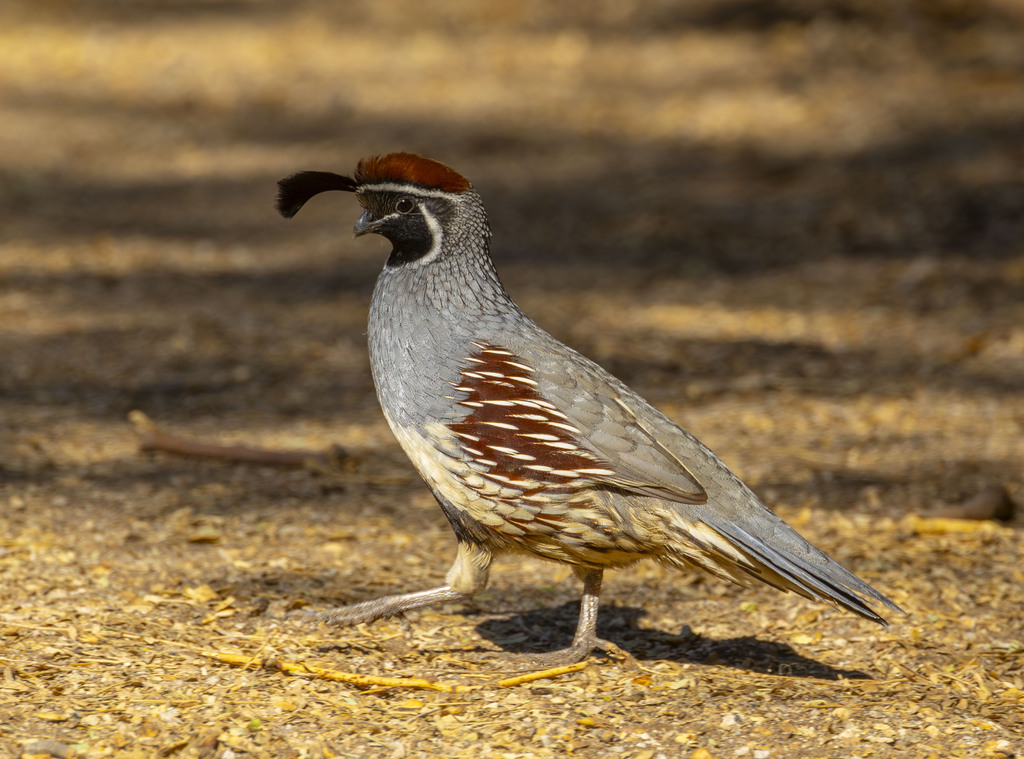
The Callipepla gambelii birds are easily recognized by their top knots and scaly plumage on their undersides. Gambel's quail have bluish-gray plumage on much of their bodies, and males have copper feathers on the top of their heads, black faces, and white stripes above their eyes. Their average length is 11 in (28 cm) with a wingspan of 14–16 in (36–41 cm). These birds have relatively short, rounded wings and long, featherless legs. Their diet consists primarily of plant matter and seeds. Gambel's quail can be commonly confused with California quail due to their similar plumage. They can usually be distinguished by range, but when this does not suffice, California quail have a more scaly appearance and the black patch on the lower breast of the male Gambel's quail is absent in the California quail. The two species are sister taxa which diverged during the Late Pliocene or Early Pleistocene, 1 to 2 million years ago.
What it does
Gambel's quail primarily move about by walking and can move surprisingly fast through brush and undergrowth. They are a non-migratory species and are rarely seen in flight. Any flight is usually short and explosive, with many rapid wingbeats, followed by a slow glide to the ground. In the late summer, fall, and winter, the adults and immature young congregate into coveys of many birds. In the spring, Gambel's quail pair off for mating and become very aggressive toward other pairs. The chicks are decidedly more insectivorous than adults, gradually consuming more plant matter as they mature. Gambel's quail are monogamous and rarely breed in colonies. The female typically lays 10–12 eggs in a simple scrape concealed in vegetation, often at the base of a rock or tree. Incubation lasts from 21–23 days, usually performed by the female and rarely by the male. The chicks are precocial, leaving the nest with their parents within hours of hatching.
Wikipedia: “Behavior”
Listen
Looking for field recordings…
Where it lives
Recorded sightings
—
geo-referenced records in GBIF, from museums, herbaria and field observers.
Drag the globe to turn it. Dots are where records exist, not a range map; darker means more records.
In the stacks
Searching the stacks…
Every page naming Callipepla gambelii in the Biodiversity Heritage Library →
This page is assembled live from iNaturalist, GBIF, Wikipedia, the Source Library and the Internet Archive. It is not yet part of the hand-edited codex. iNaturalist taxon 1406.