- Animals
- ›Arthropods
- ›Hexapods
- ›Insects
- ›Winged and Once-winged Insects
- ›Ants, Bees, Wasps, and Sawflies
- ›Narrow-waisted Wasps, Ants, and Bees
- ›Ants, Bees, and Stinging Wasps
- ›Formicoidea
- ›Ants
- ›Army Ants and Allies
- ›Dorylus
- ›Dorylus nigricans
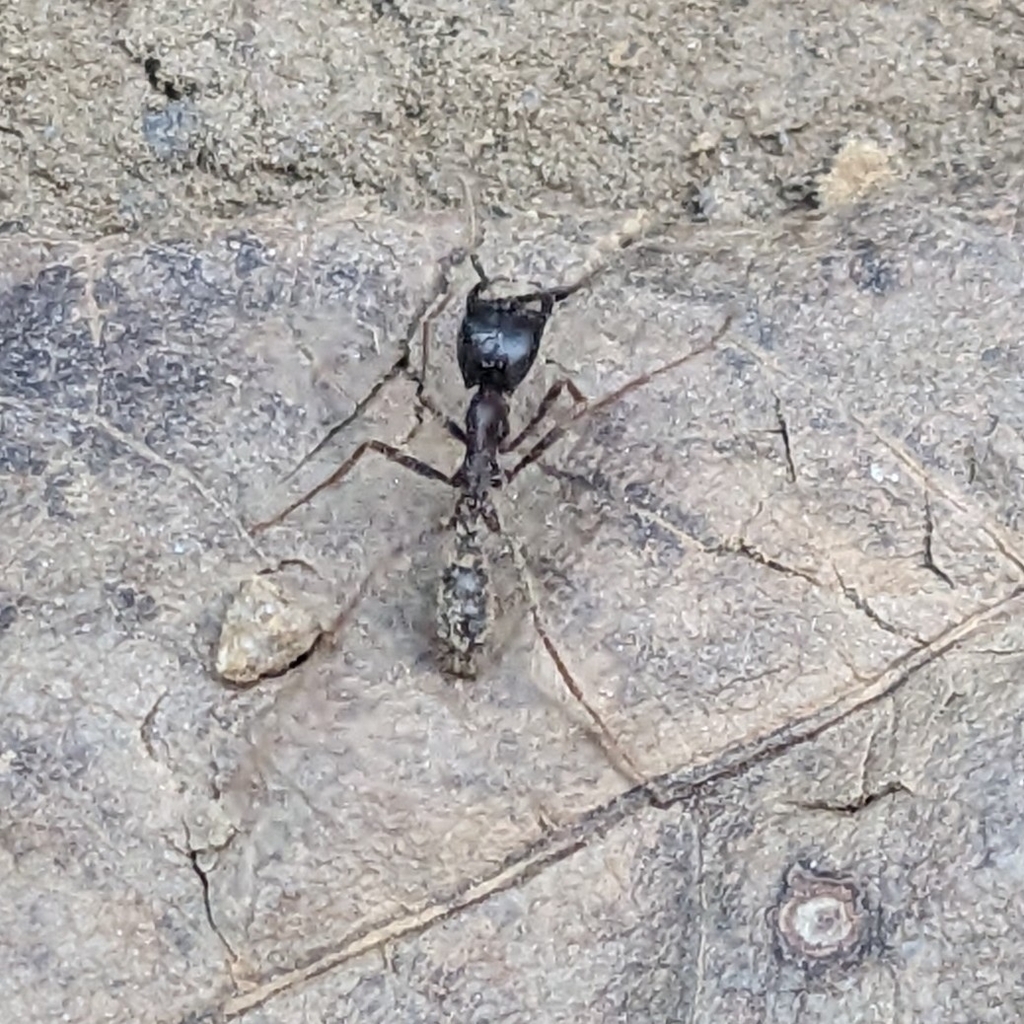
Dorylus wilverthi
Dorylus, also known as driver ants, safari ants, or siafu, is a large genus of army ants found primarily in central and east Africa, although the range also extends to southern Africa and tropical Asia. The term siafu is a loanword from Swahili, and is one of numerous similar words from regional Bantu languages used by indigenous peoples to describe various species of these ants. Unlike the New World members of the former subfamily Ecitoninae (now Dorylinae), members of this genus form temporary subterranean bivouacs in underground cavities which they excavate and inhabit - either for a few days or up to three months. Also, unlike some New World army ants, driver ants are not specialized predators of other species of ant, instead being more generalistic with a diet consisting of a diversity of invertebrates. Their colonies are enormous compared to other ant species, and can contain over 20 million individuals. As with their American counterparts, workers exhibit caste polymorphism with the soldiers having particularly large heads that power their scissor-like mandibles. They are capable of stinging, but very rarely do so, relying instead on their powerful shearing jaws. A large part of their diet consists of earthworms. Driver ant queens are the largest living ants known, with the largest measuring between 40 - 63 millimeters (1.5 - 2.4 inches) in total body length depending on their physiological condition.
From the article Dorylus on Wikipedia (CC BY-SA), quoted section by section
What it does
Seasonally, when food supplies become short, they leave the hill and form marching columns of up to 20,000,000 ants, which constitute a considerable threat to humans, though they can be easily avoided as a column can only travel about 20 meters in an hour. It is for those unable to move, or when the columns pass through homes, that there is the greatest risk. The presence of a mobile column of safari ants is, conversely, beneficial to certain human communities, such as the Maasai. They perform a pest prevention service in farming communities, consuming the majority of other crop-pests, from insects to large rats. For example, driver ants prey on larvae of the African sugarcane borer, a pest moth in sub-Saharan Africa. The characteristic long columns of ants will fiercely defend themselves against anything that attacks them. Columns are arranged with the smaller ants being flanked by the larger soldier ants. These instinctively take up positions as sentries, and set a perimeter corridor through which the smaller ants can run safely. Their bite is severely painful, each soldier leaving two puncture wounds when removed. Removal is difficult, however, as their jaws are extremely strong, and one can pull a soldier ant in two without it releasing its hold. Large numbers of ants can kill small or immobilized animals and strip them to husks. …
Wikipedia: “Life cycle”
Listen
Looking for field recordings…
Where it lives
Recorded sightings
—
geo-referenced records in GBIF, from museums, herbaria and field observers.
Drag the globe to turn it. Dots are where records exist, not a range map; darker means more records.
In the stacks
Searching the stacks…
Every page naming Dorylus wilverthi in the Biodiversity Heritage Library →
This page is assembled live from iNaturalist, GBIF, Wikipedia, the Source Library and the Internet Archive. It is not yet part of the hand-edited codex. iNaturalist taxon 1404153.