On eBird ↗
Spot-winged Wood-Quail
Live sightings near you, the range map, bar charts of when it is seen, and Macaulay Library photos and recordings.
Spot-winged Wood-Quail
Odontophorus capueira
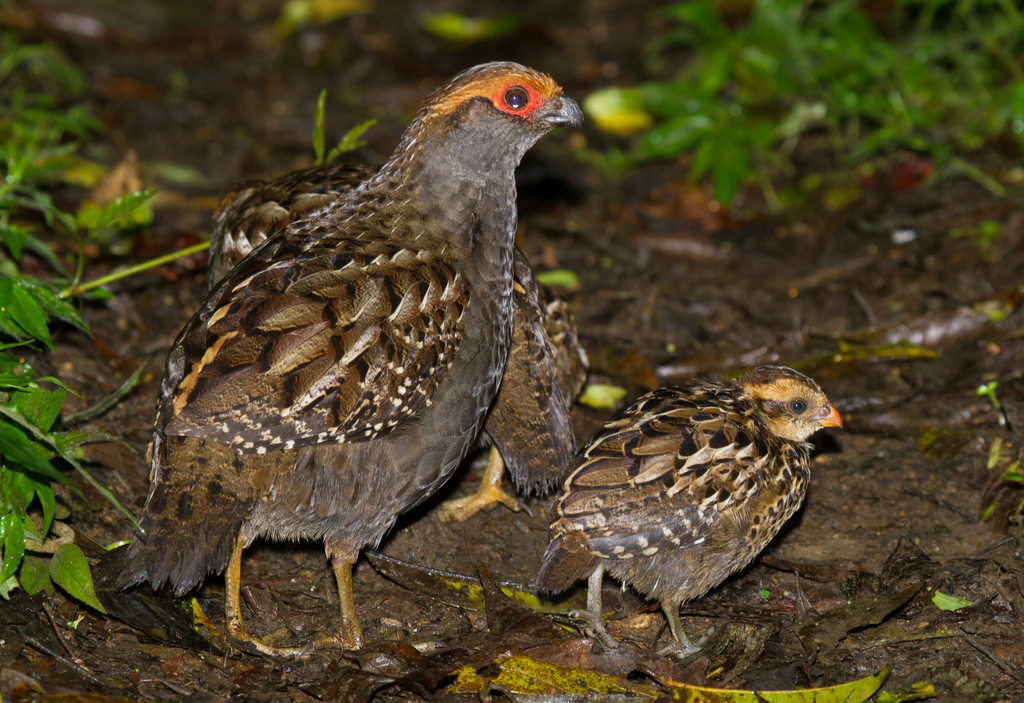
The spot-winged wood quail (Odontophorus capueira) is a species of bird in the family Odontophoridae. It is found in Brazil, Argentina and Paraguay, and formerly in Uruguay. Its natural habitats are subtropical or tropical dry lowland forests. Its population is thought to be declining but at a moderate rate, so the International Union for Conservation of Nature has assessed it as being a "least-concern species".
From the article Spot-winged wood quail on Wikipedia (CC BY-SA), quoted section by section
Description
Male and female spot-winged wood quails are similar in appearance but the female is slightly smaller. The bird has a reddish-brown crown with a loose crest, speckled with buff. The supercilium (stripe above the eye) and the chest-band are reddish-cinnamon. The upper parts are greyish-brown, with dark vermiculations and speckling, with the individual feathers on neck, mantle, back and scapulars having white streaks beside the shaft. The sides of the head, throat and underparts are slatey-grey. The legs are dark grey, the bill is blackish, the iris brown and the bare area around the eyes red. The length range is about 26 to 30 cm (10 to 12 in). Juveniles are similar in colouring but have reddish bills, more speckled upper parts and grey underparts flushed with rust and speckled with white.
Range & habitat
The spot-winged wood quail is native to eastern and southeastern Brazil, the extreme northeastern part of Argentina and the eastern part of Paraguay. It inhabits dry lowland forest, including secondary forest, at altitudes not exceeding 1,600 m (5,200 ft).
Wikipedia: “Distribution”
What it does
Spot-winged wood quails tend to move around on the ground by day in small groups of typically six to eight, but sometimes up to fifteen. When disturbed they move off into the undergrowth and seldom take to the wing, especially when the group includes chicks. The birds sometimes freeze and crouch. The diet includes fallen nuts of Araucaria and other trees, the berries of pokeweed and other plants and probably invertebrates. At night these birds roost well off the ground in trees. They are monogamous and breeding takes place between August and November. The nest is built on the ground with a side entrance and a roof of dead leaves. About four white eggs are laid which soon become discoloured. The female incubates the clutch, which hatch after about eighteen days, and she also rears the chicks without help.
Wikipedia: “Ecology”
Listen
Looking for field recordings…
Where it lives
Recorded sightings
—
geo-referenced records in GBIF, from museums, herbaria and field observers.
Drag the globe to turn it. Dots are where records exist, not a range map; darker means more records.
In the stacks
Searching the stacks…
Every page naming Odontophorus capueira in the Biodiversity Heritage Library →
This page is assembled live from iNaturalist, GBIF, Wikipedia, the Source Library and the Internet Archive. It is not yet part of the hand-edited codex. iNaturalist taxon 1384.