On eBird ↗
Long-tailed Wood-Partridge
Live sightings near you, the range map, bar charts of when it is seen, and Macaulay Library photos and recordings.
Long-tailed Wood-Partridge
Dendrortyx macroura
The long-tailed wood partridge (Dendrortyx macroura) is a species of bird in the Odontophoridae family. It is found only in Mexico. Its natural habitat is subtropical or tropical moist montane forests.
From the article Long-tailed wood partridge on Wikipedia (CC BY-SA), quoted section by section
Description
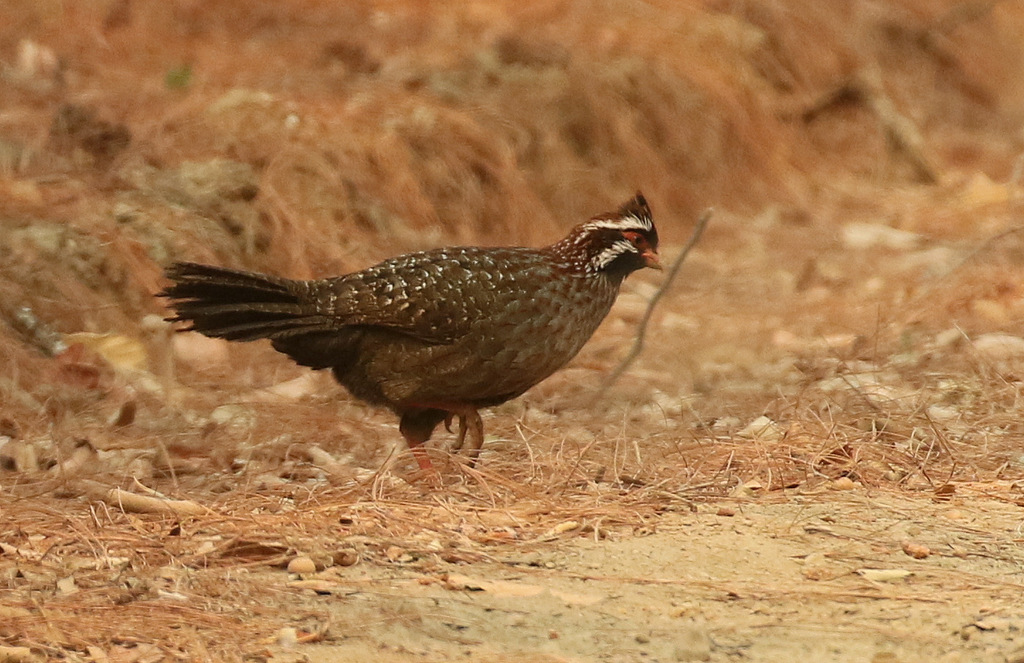
The long-tailed wood partridge is 29.0 to 42.2 cm (11.4 to 16.6 in) long and weighs 266 to 465 g (9.4 to 16.4 oz). Males are heavier than females, and adults of both sexes have a long tail though the female's is somewhat shorter. In adults, most of the head is black; the face has white streaks above and below the eye. The short crest on the crown is tipped with buff. The upper back is chestnut edged with gray and the lower back is olive brown, black, and tawny mottling. The breast is bluish gray with chestnut streaks. The juvenile is similar but with dark brown spots and less chestnut on the underparts. There are variations among the subspecies, but it is unknown if there are vocal differences or genetic ones other than plumage color among them.
Range & habitat
The subspecies of the long-tailed wood partridge are distributed in four discrete zones.
D. m. macroura, Mexico and Veracruz states (east central Mexico) D. m. griseipectus, the Pacific slope of Mexico, Mexico City, and Morelos (central Mexico) D. m. diversus, northwestern Jalisco (west central Mexico) D. m. striatus, southern Jalisco, Michoacán, and Guerrero (west central Mexico) D. m. inesperatus, central Guerrero and southern Oaxaca (southern Mexico) D. m. oaxacae, Oaxaca (southern Mexico) The long-tailed wood partridge inhabits humid pine-oak, pine, fir, and montane evergreen forests with dense understories. In elevation it ranges between 1,200 and 3,300 m (3,900 and 10,800 ft).
Wikipedia: “Distribution and habitat”
What it does
The long-tailed wood partridge forages mainly on the ground, scratching in leaf litter, but also climbs in low branches to search. Its diet is mostly seeds and small fruits but also includes small arthropods and leaves.
Wikipedia: “Feeding”
Listen
Looking for field recordings…
Where it lives
Recorded sightings
—
geo-referenced records in GBIF, from museums, herbaria and field observers.
Drag the globe to turn it. Dots are where records exist, not a range map; darker means more records.
In the stacks
Searching the stacks…
Every page naming Dendrortyx macroura in the Biodiversity Heritage Library →
This page is assembled live from iNaturalist, GBIF, Wikipedia, the Source Library and the Internet Archive. It is not yet part of the hand-edited codex. iNaturalist taxon 1331.