- Animals
- ›Chordates
- ›Vertebrates
- ›Birds
- ›Swifts and Hummingbirds
- ›Hummingbirds
- ›Bee Hummingbirds, Emeralds, Mountain-gems, and Allies
- ›Emerald Hummingbirds and Allies
- ›Cynanthus
On eBird ↗
Golden-crowned Emerald
Live sightings near you, the range map, bar charts of when it is seen, and Macaulay Library photos and recordings.
Golden-crowned Emerald
Cynanthus auriceps
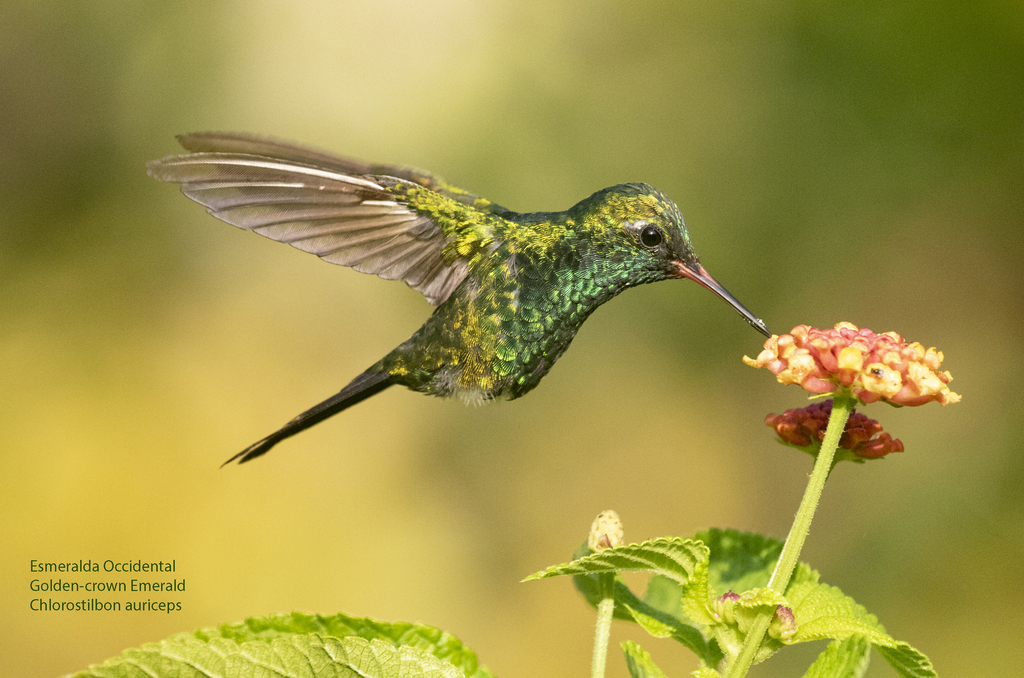
The golden-crowned emerald (Cynanthus auriceps) is a species of hummingbird in the "emeralds", tribe Trochilini of subfamily Trochilinae. It is endemic to western Mexico.
From the article Golden-crowned emerald on Wikipedia (CC BY-SA), quoted section by section
Description
The golden-crowned emerald is 7.5 to 9.5 cm (3.0 to 3.7 in) long and weighs about 2.2 g (0.078 oz). The adult male's crown is brilliant golden green and the rest of its upperparts duller golden green to bronzy green. Its underparts transition from an almost pure green on the chin and throat to brilliant golden green at the vent. The tail is long and deeply forked; its feathers are black with a violet-bluish gloss, and the central three pairs have broad brownish gray tips. The adult female's upperparts are like the male's. Its underparts are light gray that is palest on the belly and vent. Its cheeks are dusky with a grayish white streak behind the eye. Its tail is also forked but much shorter than the male's; the central feathers are bluish green to bronze green and most have a black band near the end and gray tips. The male's bill is red with a black tip, the female's mandible is red with a black tip and the maxilla is black.
Range & habitat
The golden-crowned emerald is found in western Mexico from Sinaloa south to eastern Oaxaca and also inland up the Balsas River basin to southern Morelos. It inhabits tropical dry forest at elevations from sea level to 1,800 m (5,910 ft).
Wikipedia: “Distribution and habitat”
What it does
The golden-crowned emerald is a "trap-line" feeder, visiting a circuit of flowering plants to take nectar. They wag their tail and spread its fork as they feed. In addition to nectar, they take insects from foliage.
Wikipedia: “Feeding”
Listen
Looking for field recordings…
Where it lives
Recorded sightings
—
geo-referenced records in GBIF, from museums, herbaria and field observers.
Drag the globe to turn it. Dots are where records exist, not a range map; darker means more records.
In the stacks
Searching the stacks…
Every page naming Cynanthus auriceps in the Biodiversity Heritage Library →
This page is assembled live from iNaturalist, GBIF, Wikipedia, the Source Library and the Internet Archive. It is not yet part of the hand-edited codex. iNaturalist taxon 1289677.