- Animals
- ›Chordates
- ›Vertebrates
- ›Birds
- ›Swifts and Hummingbirds
- ›Hummingbirds
- ›Bee Hummingbirds, Emeralds, Mountain-gems, and Allies
- ›Emerald Hummingbirds and Allies
- ›Saucerottia
On eBird ↗
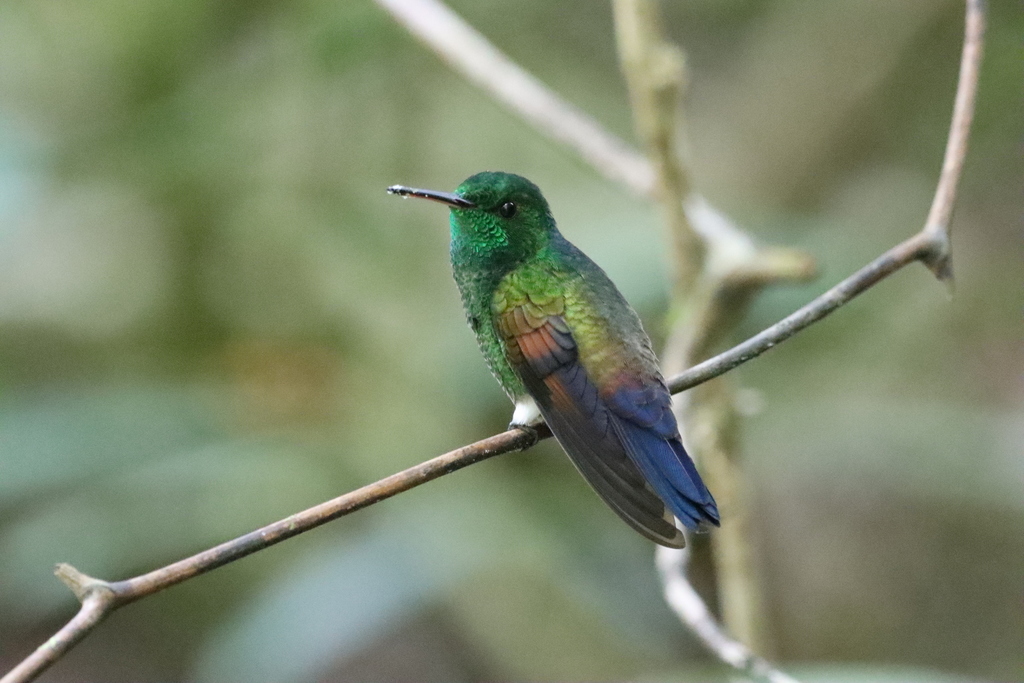
Blue-tailed Hummingbird
Live sightings near you, the range map, bar charts of when it is seen, and Macaulay Library photos and recordings.
Blue-tailed Hummingbird
Saucerottia cyanura
The blue-tailed hummingbird (Saucerottia cyanura) is a species of hummingbird in the "emeralds", tribe Trochilini of subfamily Trochilinae. It is found in Costa Rica, El Salvador, Guatemala, Honduras, Mexico, and Nicaragua.
From the article Blue-tailed hummingbird on Wikipedia (CC BY-SA), quoted section by section
Description
The blue-tailed hummingbird is 9 to 10 cm (3.5 to 3.9 in) long. One male specimen weighed 3.9 g (0.14 oz) and females weigh about 4.5 g (0.16 oz). Both sexes of all subspecies have a black bill with a reddish base to the mandible. Males of the nominate subspecies have a deep metallic green crown and back, a dull purplish bronze rump, and dark metallic bluish uppertail coverts. Their primaries and secondaries are chestnut and show as a patch on the closed wing. Their tail is dark metallic violet blue. Their underparts are mostly bright metallic green with dull steel blue undertail coverts. Females are similar to males but duller. Their rump is less purplish and their underparts' feathers usually have narrow whitish margins. Their belly has some dull buffy whitish mixed in and their undertail coverts are grayish. Subspecies S. c. guatemalae is much darker than the nominate. The chestnut on the wings is darker, the tail's blue more violaceous to metallic purple, and the undertail coverts dark steel blue to blue-black. S. c. impatiens is somewhat larger than the nominate. Its head and back are darker green, the rufous or cinnamon patch on the wings is larger, and the undertail coverts are dull steel blue with rich ferruginous edges.
Range & habitat
The blue-tailed hummingbird subspecies S. c. guatemalae is found on the Pacific slope from southeastern Chiapas in Mexico to southern Guatemala. The nominate S. c. cyanura is found in southern Honduras, eastern El Salvador, and northwestern Nicaragua. S. c. impatiens is found in northwestern and central Costa Rica. (The map omits this last subspecies' range.) It inhabits a variety of semi-open landscapes such as the edges and clearings of humid and dry oak and pine forest, secondary forest, scrublands, and shade coffee plantations. In elevation it ranges between 100 and 1,800 m (330 and 5,900 ft) in Mexico and Guatemala and from near sea level to 1,200 m (3,900 ft) in El Salvador, Honduras, and Nicaragua.
Wikipedia: “Distribution and habitat”
What it does
The blue-tailed hummingbird forages for nectar at all levels of its habitat. Though details of its diet are lacking, it is known to frequent Inga trees. It is assumed to also consume insects like other hummingbirds.
Wikipedia: “Feeding”
Listen
Looking for field recordings…
Where it lives
Recorded sightings
—
geo-referenced records in GBIF, from museums, herbaria and field observers.
Drag the globe to turn it. Dots are where records exist, not a range map; darker means more records.
In the stacks
Searching the stacks…
Every page naming Saucerottia cyanura in the Biodiversity Heritage Library →
This page is assembled live from iNaturalist, GBIF, Wikipedia, the Source Library and the Internet Archive. It is not yet part of the hand-edited codex. iNaturalist taxon 1289656.