- Animals
- ›Chordates
- ›Vertebrates
- ›Birds
- ›Swifts and Hummingbirds
- ›Hummingbirds
- ›Bee Hummingbirds, Emeralds, Mountain-gems, and Allies
- ›Emerald Hummingbirds and Allies
- ›Chrysuronia
On eBird ↗
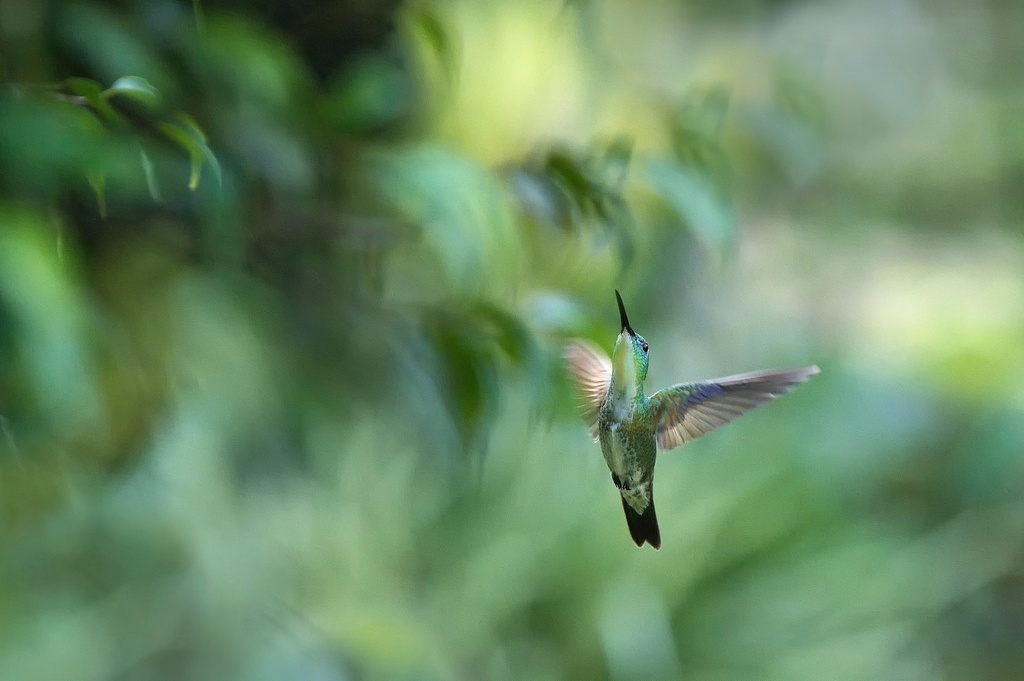
White-chested Emerald
Live sightings near you, the range map, bar charts of when it is seen, and Macaulay Library photos and recordings.
White-chested Emerald
Chrysuronia brevirostris
The white-chested emerald (Chrysuronia brevirostris) is a hummingbird in the "emeralds", tribe Trochilini of subfamily Trochilinae. It is found in Brazil, the Guianas, Trinidad, and Venezuela.
From the article White-chested emerald on Wikipedia (CC BY-SA), quoted section by section
Description
The white-chested emerald is 9 to 10 cm (3.5 to 3.9 in) long. Males weigh about 4.6 g (0.16 oz) and females 4.4 g (0.16 oz). Adults of both sexes of all subspecies have a short, straight, blackish bill and the sexes are almost alike in plumage. The nominate subspecies has iridescent turquoise-green crown and cheeks and shining bronze-green upperparts that become coppery on the rump. Its central tail feathers are coppery and the outer ones bronze to copperish with blackish bars near the end of their underside. Its underside from throat to belly is white with bronze-green sides and flanks. Its undertail coverts are golden-green with white edges. The female differs from the male only by having grayish tips on the outer tail feathers. Juveniles resemble adult females with a yellowish to reddish base on their mandible. Subspecies C. b. chionopectus is significantly larger than the other two subspecies but has the same plumage as the nominate. C. b. orienticola is similar to the nominate but has darker, more bronze colored, upperparts and flanks.
Range & habitat
The nominate subspecies of white-chested emerald is the most widespread. It is found in eastern Venezuela, Guyana, Suriname, and extreme northern Brazil's Roraima state. C. b. chionopectus occurs only on Trinidad and C. b. orienticola only in coastal French Guiana. The species inhabits a variety of landscapes including rainforest; semi-deciduous, gallery, and secondary forests; scrublands; savanna; and some cultivated areas. C. b. chionopectus favors more open landscapes including cacao plantations. There are very few specimens or sightings of C. b. orienticola, and all are from coastal areas.
Wikipedia: “Distribution and habitat”
What it does
The white-chested emerald forages for nectar at a variety of flowering plants and trees; species in at least nine families are known to be sources. In addition to nectar it feeds on insects captured by hawking from a perch or by gleaning from vegetation.
Wikipedia: “Feeding”
Listen
Looking for field recordings…
Where it lives
Recorded sightings
—
geo-referenced records in GBIF, from museums, herbaria and field observers.
Drag the globe to turn it. Dots are where records exist, not a range map; darker means more records.
In the stacks
Searching the stacks…
Every page naming Chrysuronia brevirostris in the Biodiversity Heritage Library →
This page is assembled live from iNaturalist, GBIF, Wikipedia, the Source Library and the Internet Archive. It is not yet part of the hand-edited codex. iNaturalist taxon 1289641.