- Animals
- ›Chordates
- ›Vertebrates
- ›Birds
- ›Swifts and Hummingbirds
- ›Hummingbirds
- ›Bee Hummingbirds, Emeralds, Mountain-gems, and Allies
- ›Emerald Hummingbirds and Allies
- ›Campylopterus
On eBird ↗
Diamantina Sabrewing
Live sightings near you, the range map, bar charts of when it is seen, and Macaulay Library photos and recordings.
Diamantina Sabrewing
Campylopterus diamantinensis
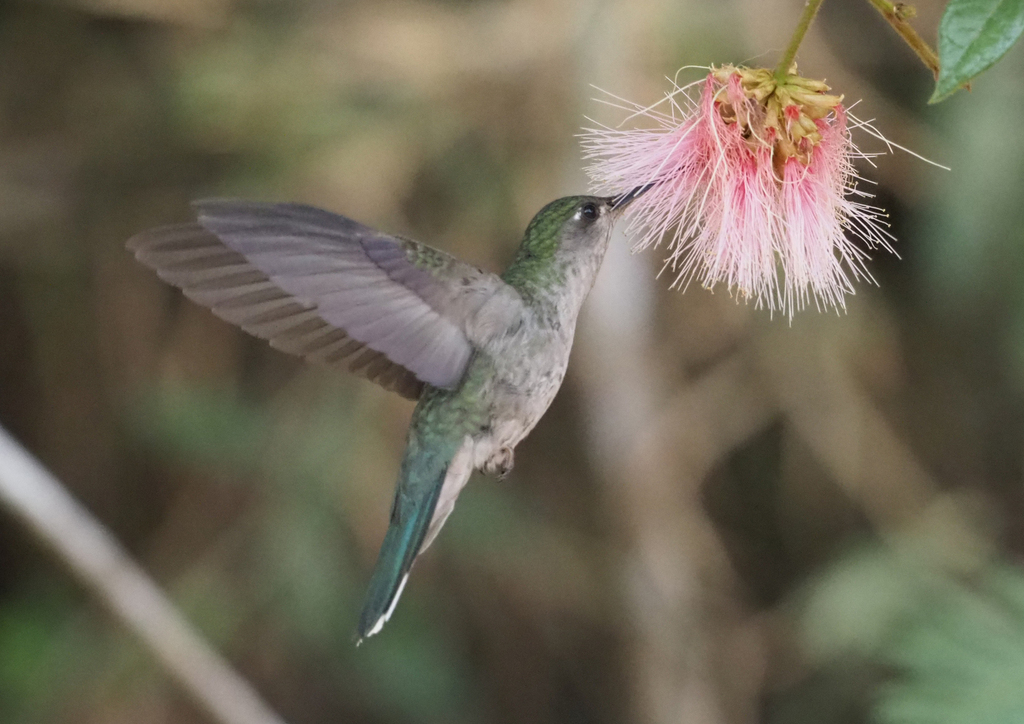
The Diamantina sabrewing (Campylopterus diamantinensis) is a Near-threatened species of hummingbird in the "emeralds", tribe Trochilini of subfamily Trochilinae. It is endemic to southeastern Brazil.
From the article Diamantina sabrewing on Wikipedia (CC BY-SA), quoted section by section
Description
The Diamantina sabrewing is a large hummingbird, about 13.4 cm (5.3 in) long. Males weigh about 8.5 g (0.30 oz) and females 8.0 g (0.28 oz). The sexes have almost identical plumage including a white spot behind the eye. Their bill is long and slightly decurved; the maxilla is black and the mandible whitish with a brownish tip. Male's upperparts are dark grass green with a darker crown and their underparts dark gray. Their tail's central two pairs of feathers are metallic bronze-green. The other three pairs have bright bronze-green bases that grades through dark olive gray to a wide white tip. The female differs only by being a slightly duller green.
Range & habitat
The Diamantina sabrewing is found only in the Espinhaço Range of southeastern Brazil's Minas Gerais state. It inhabits forested streams and ravines in campos rupestre, a high elevation, dry, fire-prone biome between 1,000 and 2,000 m (3,300 and 6,600 ft). The type locality is Córrego das Pedras in the municipality of Diamantina.
Wikipedia: “Distribution and habitat”
What it does
The Diamantina sabrewing's foraging strategy and diet are not known but are assumed to be similar to those of its former "parent" the grey-breasted sabrewing.
Wikipedia: “Feeding”
Listen
Looking for field recordings…
Where it lives
Recorded sightings
—
geo-referenced records in GBIF, from museums, herbaria and field observers.
Drag the globe to turn it. Dots are where records exist, not a range map; darker means more records.
In the stacks
This page is assembled live from iNaturalist, GBIF, Wikipedia, the Source Library and the Internet Archive. It is not yet part of the hand-edited codex. iNaturalist taxon 1289206.