On eBird ↗
Macgregor's Honeyeater
Live sightings near you, the range map, bar charts of when it is seen, and Macaulay Library photos and recordings.
MacGregor's Honeyeater
Macgregoria pulchra
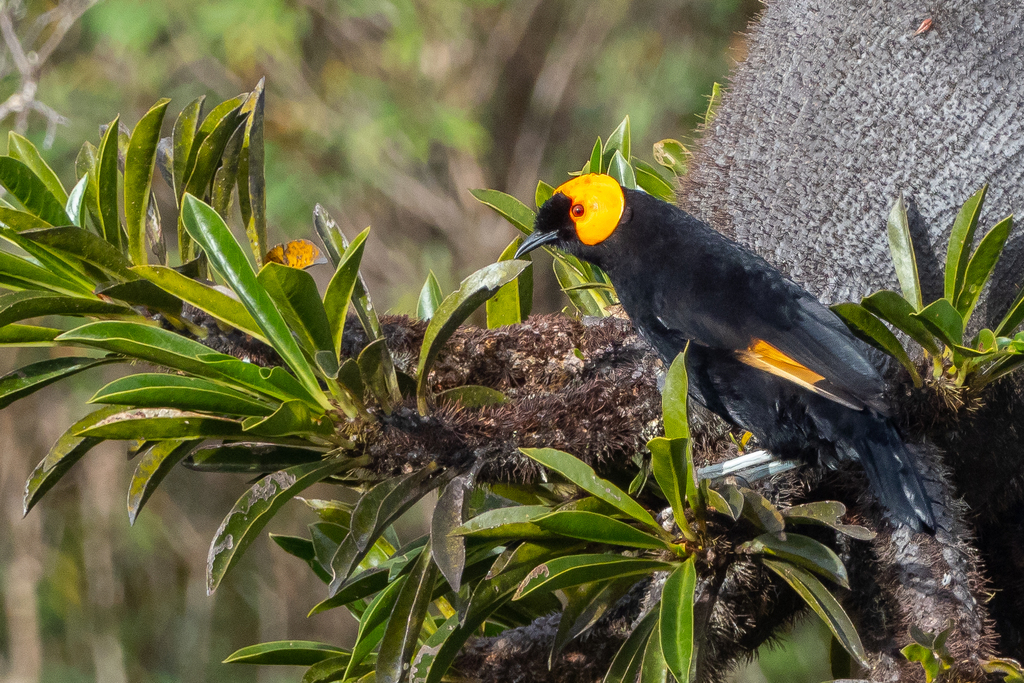
MacGregor's honeyeater (Macgregoria pulchra), also known as giant wattled honeyeater, MacGregor's giant honeyeater, MacGregor's bird of paradise, and ochre-winged honeyeater, is a large (up to 40 centimetres or 16 inches long), black, crow-like bird with large orange-yellow eye-wattles and black-tipped, ochre primary wing feathers endemic to the island of New Guinea. The sexes are similar, with the male being slightly larger than the female. It is the only member of the genus Macgregoria.
From the article MacGregor's honeyeater on Wikipedia (CC BY-SA), quoted section by section
Description
MacGregor's honeyeater is one of the largest members of the honeyeater family. Adult males measure roughly 40 centimetres or 16 inches in length, while females average about 35 to 40 centimetres or 14 to 16 inches. Males typically weigh around 242 to 357 grams (8.5 to 12.6 oz; 0.534 to 0.787 lb) and females slightly less. They are predominantly glossy black with dense, silky plumage and broad, rounded wings. A conspicuous bare, semicircular facial wattle surrounds the eye and varies from yellow-orange to reddish-orange, occasionally deepening in color during courtship activity. The wings display prominent ochre-yellow patches visible both at rest and in flight. The subspecies carolinae is generally larger-bodied, with proportionally smaller wings and tail, and often reduced ochre wing markings.
The beak is black, heavy, and slightly decurved. Legs are bluish-grey to blackish. Females resemble males but are generally duller, browner below, and possess smaller wattles. Juveniles are softer-textured, browner overall, and have reduced facial wattles and wing markings.
Vocalizations. The species produces a variety of whistles, nasal notes, clicks, and wheezy calls. One of the most frequently heard vocalizations is a repeated high-pitched whistled “jeet” note used both as a contact and alarm call. Mechanical wing sounds are especially characteristic. …
Range & habitat
MacGregor's honeyeater is found on the island of New Guinea, where it inhabits cloud forest and subalpine Dacrycarpus forest at elevations of 2,800–4,000 m (9,200–13,100 ft). It is commonly observed in Dacrycarpus groves when the trees are fruiting, but relatively little is known about where it removes to when the trees are not fruiting.
Wikipedia: “Distribution and habitat”
What it does
MacGregor's honeyeater is monogamous and largely non-territorial, with pairs maintaining overlapping foraging ranges. Courtship involves hopping chases, aerial pursuits, gliding descents, and conspicuous wing-noise displays. These displays frequently occur near nests under construction and may involve additional birds besides the breeding pair. The nest is a bulky open cup constructed primarily of moss, woody stems, lichens, orchid stems, and leaves. Nests are generally placed high in podocarp trees or near forest edges adjacent to alpine grasslands. Only a single egg is definitively known. It is described as vinaceous pink with brown and purplish spotting. Incubation is performed solely by the female and likely lasts roughly 26–30 days. Both parents feed the nestling through regurgitation. Nestling development appears unusually slow, likely reflecting both the species’ cold high-elevation environment and fruit-dominated diet.
Wikipedia: “Reproduction”
Listen
Looking for field recordings…
Where it lives
Recorded sightings
—
geo-referenced records in GBIF, from museums, herbaria and field observers.
Drag the globe to turn it. Dots are where records exist, not a range map; darker means more records.
In the stacks
Searching the stacks…
Every page naming Macgregoria pulchra in the Biodiversity Heritage Library →
This page is assembled live from iNaturalist, GBIF, Wikipedia, the Source Library and the Internet Archive. It is not yet part of the hand-edited codex. iNaturalist taxon 12692.