On eBird ↗
Yellow Chat
Live sightings near you, the range map, bar charts of when it is seen, and Macaulay Library photos and recordings.
Yellow Chat
Epthianura crocea
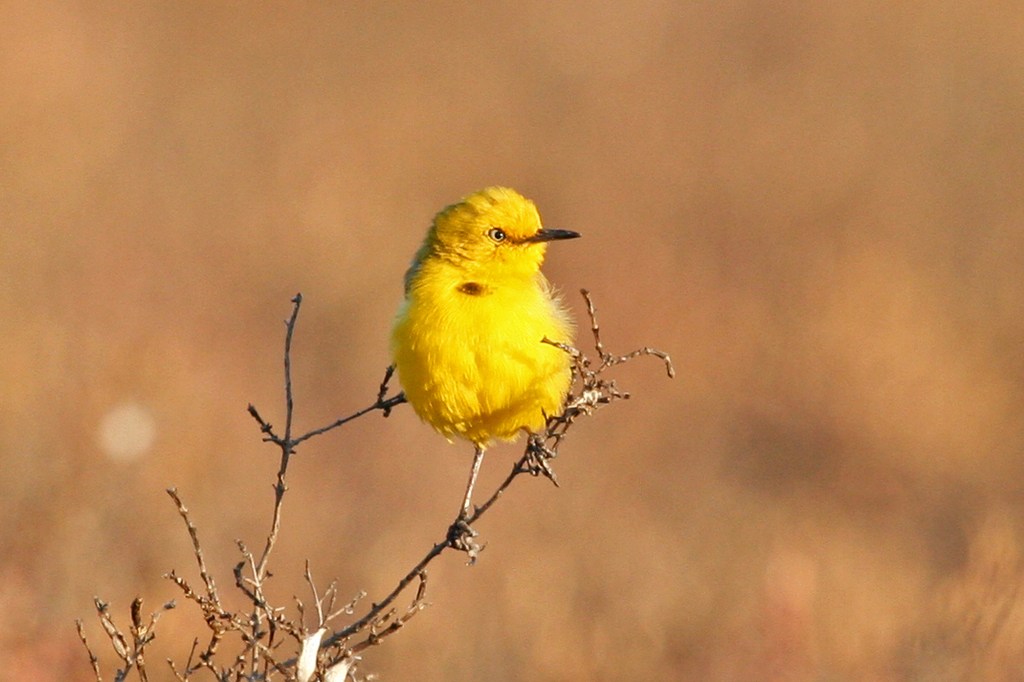
The yellow chat (Epthianura crocea) is a small passerine bird endemic to Australia. They are known for their remarkable adaptions that aid their survival in their arid habitat.
From the article Yellow chat on Wikipedia (CC BY-SA), quoted section by section
Description
The yellow chat is a small passerine bird usually seen in groups of 2-10 individuals. They are approximately 11 cm (4.3 in) tall and weigh 9 g (0.32 oz). They are sexually dimorphic with the adult male having a bright golden-yellow forehead and underparts with a prominent black crescent breast band. The crown and nape are a grey-olive colour, the back is yellowish-brown and the tail is black with yellow tips on the feathers. The female is of similar colouring to the male but with a paler yellow colour and with no breast band. The juveniles are distinguished by being more greyish-brown in colour than the yellow displayed by their parents. All yellow chats, including juveniles, have a distinctive yellow rump when in flight. They have relatively long legs and toes, allowing them to forage with ease for food over low vegetation and on the ground. Yellow chats can also be identified by their distinctive, high-pitched and tuneful pee pee call.
Range & habitat
The yellow chat occurs patchily throughout northern Australia, ranging across the arid zone from north-eastern South Australia and south-western Queensland to the north-west of the Northern Territory. There are some isolated populations in eastern Queensland and in north-west Western Australia. Their habitat is subject to high temperatures for most of the year and contains marshy plains vegetated with saltbush, rank grasses, or cumbungi reeds. These marshes have been formed by marine lagoons or inland artesian bore drains, creating a saline environment. This distribution includes the central arid region and the hot, subhumid monsoonal region. Most of the annual rainfall falls during the summer monsoon, leaving the remaining six months of the year with little rainfall.
Arid zone adaptations. It has been presumed that yellow chats would encounter problems living in their harsh, arid environment with high ambient temperatures, low ambient humidities and small amounts of surface water. Birds with small body weights are predicted to have high metabolic rates. Furthermore, small body weights will also lead to a higher rate of evaporative water loss compared to larger birds. These predictions suggest that the small body size of the yellow chats combined with their hot, dry, arid environment will result in heat stress and a high loss of water. …
Wikipedia: “Distribution and habitat”
What it does
The yellow chat is a predominately insectivorous bird. They scavenge for their food in damp substrates, low vegetation or in shallow water.
Wikipedia: “Diet”
Listen
Looking for field recordings…
Where it lives
Recorded sightings
—
geo-referenced records in GBIF, from museums, herbaria and field observers.
Drag the globe to turn it. Dots are where records exist, not a range map; darker means more records.
In the stacks
Searching the stacks…
Every page naming Epthianura crocea in the Biodiversity Heritage Library →
This page is assembled live from iNaturalist, GBIF, Wikipedia, the Source Library and the Internet Archive. It is not yet part of the hand-edited codex. iNaturalist taxon 12647.