On eBird ↗
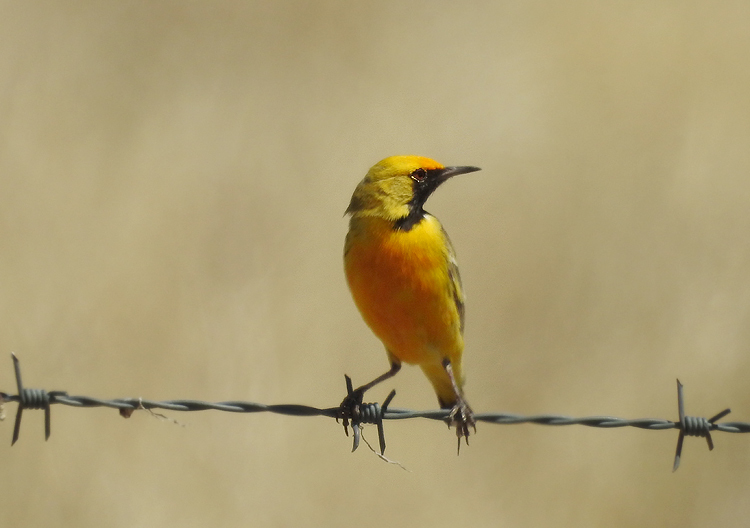
Orange Chat
Live sightings near you, the range map, bar charts of when it is seen, and Macaulay Library photos and recordings.
Orange Chat
Epthianura aurifrons
The orange chat (Epthianura aurifrons) is a species of bird in the family Meliphagidae.
It is endemic to Australia.
From the article Orange chat on Wikipedia (CC BY-SA), quoted section by section
Description
The orange chat (Epthianura aurifrons) is endemic to Australia. Orange chats are usually 10–12 cm (3.9–4.7 in) in length, 10–12 g (0.35–0.42 oz) in weight and have an average wingspan of 19 cm (7.5 in). The orange chat is a small ground songbird with relatively long, broad, rounded wings and a short, square-ended tail. The orange chat is potbellied in shape with long thin legs, a short slender straight bill and a brush-tipped tongue. Male feathers are mostly a deep, warm, cadmium yellow with an orange overtone, and this colour is strongest on the crown and breast. Males' lores and throat are black, their rump is a golden orange with a tail finely tipped with white. Female chats are mottled in grey-brown with underparts being a softer fawny yellow. Orange chats do not have any seasonal differences in plumage.
Similar species. Bird species similar to and often confused with the orange chat are the yellow chat and the crimson chat; these birds are similar in size and shape. Orange chats have straighter and on average shorter bills. The adult male orange chat is rarely mistaken for another species with its vivid orange colouration and black throat patch. The male yellow chat is coloured almost as brightly as the orange chat but without such a warm orange overtone, being rather an intense lemon yellow. …
Range & habitat
Orange chats are strongly nomadic within the arid and semi-arid zones of Australia that they inhabit. They are found mainly in the interior with some sightings in the northern tropics, and very occasionally they reach the coastal areas of South and Western Australia. The orange chat mostly occurs in dry, low-lying, saline environments that are rarely flooded such as sparsely vegetated gibber plains, salt pans, salt lakes, or claypans. They mainly inhabit low, treeless chenopod shrublands dominated by saltbush, bluebush or samphire, with either open or continuous shrub cover. They are sometimes recorded in other open or shrubby habitats, often near wetlands: low mulga, low buloke woodland; open acacia scrubland; dongas (steep-sided gullies) vegetated with tall shrubs or small trees including mulga, dead finish, belah or sugarwood; grassland; or sedgeland. The orange chat has occasionally been recorded in mallee woodlands and on farmlands, including areas over-run by scotch thistle.
Movement. The orange chat is nomadic, but less so than the crimson chat, and moves around irregularly. Movements are often determined by weather conditions, which will affect the availability of food in an area. During droughts or dry spells, the orange chat will be absent or nearly so from normal habitats and will sometimes be recorded towards the periphery of their usual range.
Banding. …
Wikipedia: “Distribution and habitat”
What it does
The orange chat is gregarious and mobile with undulating flight, but they are also very wary, which does not allow close interactions. They are easy to see from a distance perched atop low bushes, shrubs or trees, due to the vivid orange plumage of the male. Males will often keep watch from a tall shrub or bush whilst the rest of the flock feeds out of sight. Foraging occurs on the ground or from low shrubs. Orange chats are usually seen in pairs or small groups of up to 15 birds, although flocks of more than 400 have been recorded locally. They are often spotted mixing with flocks of crimson and white-fronted chats and seen near or with flocks of zebra finches. When flushed, the orange chat will fly high, briefly perching atop a low shrub before disappearing onto the ground and between shrub cover. At the start of the breeding season, flocks disperse into pairs. After the pair has formed, the male accompanies the female at all times until the eggs have been laid and chases other birds, often other males, that approach the pair; this behaviour is rarely seen outside the breeding season.
Defensive behaviour. Defence of territory is mainly performed by males when breeding; females usually only become involved when the male is absent.
Distraction displays. …
Wikipedia: “Behaviour”
Listen
Looking for field recordings…
Where it lives
Recorded sightings
—
geo-referenced records in GBIF, from museums, herbaria and field observers.
Drag the globe to turn it. Dots are where records exist, not a range map; darker means more records.
In the stacks
Searching the stacks…
Every page naming Epthianura aurifrons in the Biodiversity Heritage Library →
This page is assembled live from iNaturalist, GBIF, Wikipedia, the Source Library and the Internet Archive. It is not yet part of the hand-edited codex. iNaturalist taxon 12645.