On eBird ↗
Red Wattlebird
Live sightings near you, the range map, bar charts of when it is seen, and Macaulay Library photos and recordings.
Red Wattlebird
Anthochaera carunculata
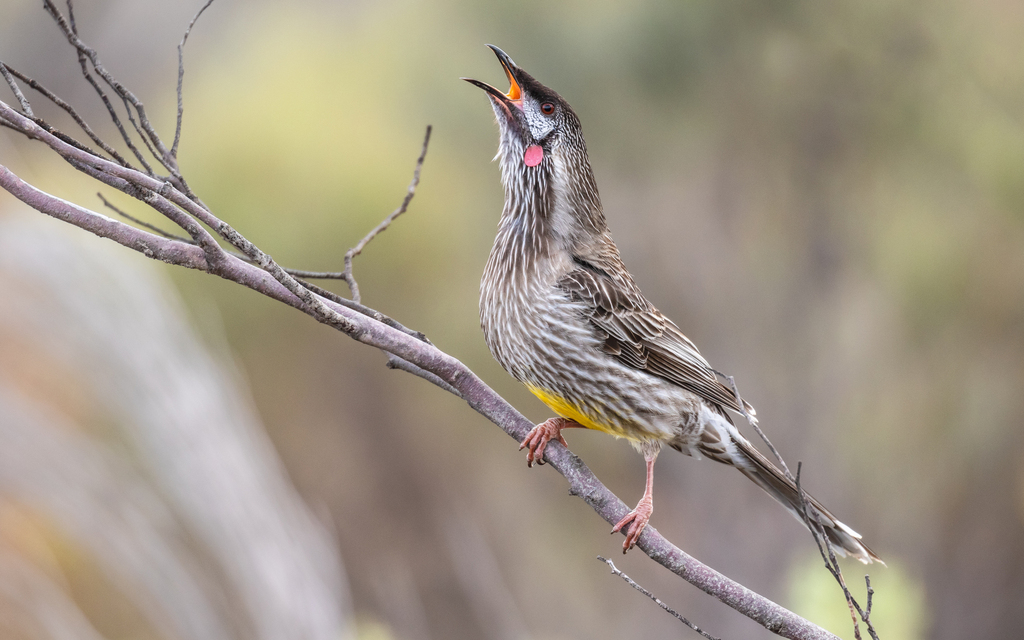
The red wattlebird (Anthochaera carunculata) is a passerine bird native to southern Australia. At 33–37 cm (13–14+1⁄2 in) in length, it is the second largest species of Australian honeyeater, after the yellow wattlebird. It has mainly grey-brown plumage, with red eyes, distinctive pinkish-red wattles on either side of the neck, white streaks on the chest and a large bright yellow patch on the lower belly. The sexes are similar in plumage. Juveniles have less prominent wattles and browner eyes. John White described the red wattlebird in 1790. Three subspecies are recognized.
The species is found in southeast Queensland, New South Wales, Victoria, South Australia and southwest Western Australia in open forest and woodland, and is a common visitor to urban gardens and parks. Loud and conspicuous, the red wattlebird is generally found in trees, where it gets most of its food; occasionally it forages on the ground. It is one of the largest nectarivorous birds in the world, feeding from a wide variety of flowering plants. Insects also comprise part of its diet. It is territorial and at times aggressive towards birds of other species, often defending rich sources of nectar. Breeding throughout its range, the red wattlebird builds a cup-shaped nest in a tree and raises one or two broods a year. Although it has declined in places from land-clearing, it is classified as Least Concern on the IUCN Red List.
From the article Red wattlebird on Wikipedia (CC BY-SA), quoted section by section
Description
The sexes of the red wattlebird are similar in size and plumage, the length of the adult male ranging from 33 to 37 centimetres (13 to 15 in) and the adult female from 34 to 37 centimetres (13 to 15 in). With an average weight of 100–120 grams (3.5–4.2 oz), the red wattlebird is one of the largest nectar-feeding birds in the world, and the second largest species of honeyeater native to Australia, eclipsed only by the yellow wattlebird. The crown, forehead and upper lores (area between the eyes and nostrils) are dark brown, streaked with pale brown at the front of the crown and white at the rear of the crown. The nape (back of the neck) is slightly paler brown, with white streaks. A whitish triangular marking covers the lower lores and anterior ear covert feathers, bordered below by a dark brown stripe from the lower mandible down to the wattle and around to behind the eye. The throat is dark brown streaked with white. The iris of the eye is orange-red to crimson. The distinctive pinkish-red wattles dangle from the lower rear corner of the ear coverts on either side of the neck, and there is a sliver of pink bare skin at the lower border of the white patch on the face. The chest and belly are streaked white, and there is a bright yellow patch towards the tail. The strong legs and feet are pink or pinkish-brown, and the downward-curving bill is black. …
Range & habitat
The red wattlebird is found in southeast Queensland, where it occurs south of Noosa and Cooloola, becoming more common south of Brisbane and Toowoomba. Further south into New South Wales it is found most places east of (and including) the Great Dividing Range and stretching west to the southern North-West Plain, Central Western Slopes and eastern Riverina, and is an occasional visitor to points along the Murray River valley. It is found across Victoria, though is uncommon in the northwest of the state. In South Australia, Devonborough Downs Station, Manunda, Wilpena Pound and Nullarbor Station mark the northern limits of its range. There are scattered records from the Nullarbor Plain, but the species is common in Western Australia west of 125 °E and south of 29 °S. The yellow wattlebird replaces it in Tasmania. The red wattlebird has become more common in some localities, such as the Sunraysia district in the 1960s, and Nambucca Heads and Lefevre Peninsula in the 1980s. Breeding numbers have increased in Sydney and Adelaide. The red wattlebird is a rare vagrant to New Zealand, with confirmed records at Matakana in 1865 and Rohutu, Taranaki, in 1885, and a third unconfirmed report from Motupiko in 1938. The red wattlebird appears to be a permanent resident in much of its range, though its movements are poorly known. …
Wikipedia: “Distribution and habitat”
What it does
A loud and active bird, the red wattlebird is found in pairs, in a small family group, or alone during the breeding season, and gathers in larger groups of up to several hundred birds over winter. It flies straight or with a slightly undulating pattern, alternating between gliding and flapping its wings with quick shallow beats, at or slightly above the level of the tree canopy. The red wattlebird moves on the ground by hopping, cocking its tail upwards slightly. Aggressive and territorial, the red wattlebird defends its nest and sources of food against other birds. It either calls at, snaps at the tails of, or flies at other birds, sometimes scuffling with members of the same species or other large honeyeaters in the air. Displacement is a dominant display in which a red wattlebird will land on a perch that has been immediately vacated by another bird. A smaller red wattlebird adopts a horizontal appeasement posture side-on to the aggressor in which it lowers its head, flutters its wings and edges closer to the other bird. …
Wikipedia: “Behaviour”
Listen
Looking for field recordings…
Where it lives
Recorded sightings
—
geo-referenced records in GBIF, from museums, herbaria and field observers.
Drag the globe to turn it. Dots are where records exist, not a range map; darker means more records.
In the stacks
Searching the stacks…
Every page naming Anthochaera carunculata in the Biodiversity Heritage Library →
This page is assembled live from iNaturalist, GBIF, Wikipedia, the Source Library and the Internet Archive. It is not yet part of the hand-edited codex. iNaturalist taxon 12622.