On eBird ↗
Scarlet Myzomela
Live sightings near you, the range map, bar charts of when it is seen, and Macaulay Library photos and recordings.
Scarlet Myzomela
Myzomela sanguinolenta
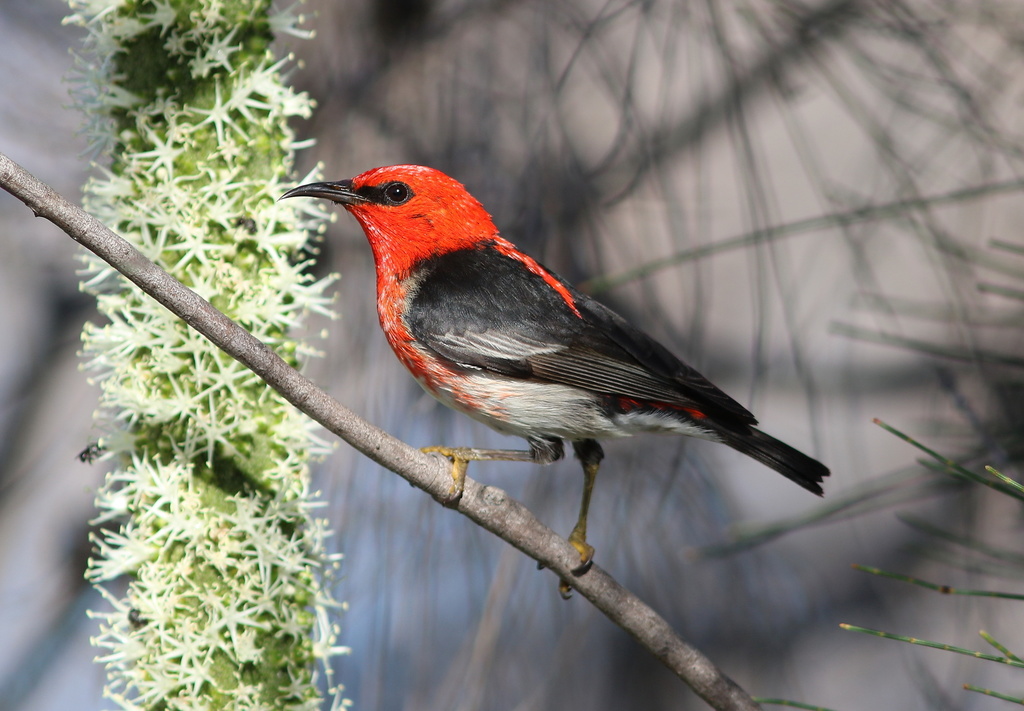
The scarlet myzomela or scarlet honeyeater (Myzomela sanguinolenta) is a small passerine bird of the honeyeater family Meliphagidae native to Australia. It was first described by English ornithologist John Latham in 1801. At 9 to 11 cm (3.5 to 4.3 in) long, it is the smallest honeyeater in Australia. It has a short tail and relatively long down-curved bill. It is sexually dimorphic; the male is a striking bright red with black wings, while the female is entirely brown. The species is more vocal than most honeyeaters, and a variety of calls have been recorded, including a bell-like tinkling.
The scarlet myzomela is found along most of the eastern coastline, from Cape York in far north Queensland to Gippsland in Victoria. It is migratory in the southern parts of its range, with populations moving north in the winter. Its natural habitat is forest, where it forages mainly in the upper tree canopy. It is omnivorous, feeding on insects as well as nectar. Up to three broods may be raised over the course of a breeding season. The female lays two or rarely three flecked white eggs in a 5 cm (2 in) diameter cup-shaped nest high in a tree. The International Union for Conservation of Nature (IUCN) has assessed it as being of least concern on account of its large range and apparently stable population.
From the article Scarlet myzomela on Wikipedia (CC BY-SA), quoted section by section
Description
The smallest honeyeater native to Australia, the scarlet myzomela is a distinctive bird with a compact body, short tail and relatively long down-curved black bill and dark brown iris. It is between 9 and 11 cm (3.5 and 4.3 in) long, with an average wingspan of 18 cm (7.1 in) and a weight of 8 g (0.28 oz). It has relatively long wings for its size; when the wings are folded, the longest primary feathers reach over half the length of the tail. It exhibits sexual dimorphism, with the male much more brightly coloured than the female. The adult male has a bright red (scarlet) head, nape and upper breast, with a narrow black stripe from beak to eye and a thin black eye-ring. The red plumage extends as a central stripe down the back and rump. On its breast, the red becomes more mottled with grey towards the belly and flanks, which are grey-white. The sides of the breast are brown-black. The mantle and scapulars are black and the upperwing a dull black, with white edges to the secondary covert feathers. The tail is black above and dark grey below. The underwing is white with a dark grey trailing edge and tip. The female has a brown head and neck, darker on top and lighter and greyer on the sides, with a pale grey-brown throat and chin. It sometimes has pinkish or reddish patches on the forehead, throat and cheeks. …
Range & habitat
The scarlet myzomela is found from Cooktown in Far North Queensland down the east coast to Mitchell River National Park in Gippsland, Victoria. It is rarer south of the Hacking River in New South Wales. Its range extends inland to Charters Towers, Carnarvon Gorge and Inglewood in Queensland, and the Warrumbungles in New South Wales. It is a rare vagrant to Melbourne. The species' movements are not well known, but it appears to be migratory in the southern part of its range and more sedentary in the north. Populations of scarlet myzomelas move northwards up a portion of the Australian east coast for winter. Nomadic movements of populations, generally following the flowering of preferred food plants, also occur. Population numbers have been reported as fluctuating in some areas, with local movements possibly related to the flowering of preferred food plants. Local irruptions have occurred in Sydney in 1902 (during a drought), 1981, 1991 (both in northwestern Sydney), and 1994 (centred on Lane Cove River valley), in Nowra in 1980, across southern Victoria in 1985, and in the Eurobodalla district in 1991 and 1993. A field study in Mangerton over 18 years found that scarlet myzomelas arrived in the area in early spring (August) and left by November, though they were entirely absent in three separate years. …
Wikipedia: “Distribution and habitat”
What it does
The scarlet myzomela is territorial, with males advertising their territories by singing from the tops of trees. They compete with members of the same species, and are usually driven away from some feeding areas by hungry larger honeyeaters, such as Lewin's, New Holland, white-naped, and brown honeyeaters, as well as eastern spinebills and noisy friarbirds. In particular, breeding New Holland honeyeaters actively drive off scarlet myzomelas.
Breeding. The species breeds from winter through to summer, generally beginning around July or August and winding up in January. There have been odd records of nesting in April or May. A pair generally raises one or two broods a year. Nest failures may lead to a third brood, with females able to lay eggs around three weeks after the previous young have fledged. The nest consists of a tiny cup of shredded bark with spider web as binding, high up in the tree canopy, or even in mistletoe. Trees with dense foliage, such as lillypilly (Syzygium smithii), Pittosporum species, turpentine (Syncarpia glomulifera), mangroves, species of paperbark, eucalypts or wattles (Acacia spp.) are more often chosen as nesting sites. The nest is around 5 cm (2.0 in) in diameter, and takes around 8 days to build before eggs are laid in it. Both sexes build the nest, though some observations have the male doing the bulk of construction and others the female. …
Wikipedia: “Behaviour”
In human culture
Scarlet myzomelas are rarely seen in aviculture, though they have been kept by enthusiasts in Sydney. As all honeyeaters are territorial, they tend to be aggressive in mixed-species aviaries. Various state regulations govern the keeping of the species; in South Australia, for instance, a Specialist Licence is required, while in New South Wales a Class B2 (Advanced Bird) licence is required. Applicants for the New South Wales B2 licence must have at least two years' experience keeping birds, and be able to demonstrate that they can provide the appropriate care and housing for the species they wish to obtain.
Wikipedia: “Aviculture”
Listen
Looking for field recordings…
Where it lives
Recorded sightings
—
geo-referenced records in GBIF, from museums, herbaria and field observers.
Drag the globe to turn it. Dots are where records exist, not a range map; darker means more records.
In the stacks
Searching the stacks…
Every page naming Myzomela sanguinolenta in the Biodiversity Heritage Library →
This page is assembled live from iNaturalist, GBIF, Wikipedia, the Source Library and the Internet Archive. It is not yet part of the hand-edited codex. iNaturalist taxon 12443.