- Animals
- ›Arthropods
- ›Hexapods
- ›Insects
- ›Winged and Once-winged Insects
- ›Butterflies and Moths
- ›Pyralid and Crambid Snout Moths
- ›Pyralid Snout Moths
- ›Knot-horn Moths
- ›Phycitini
- ›Plodia
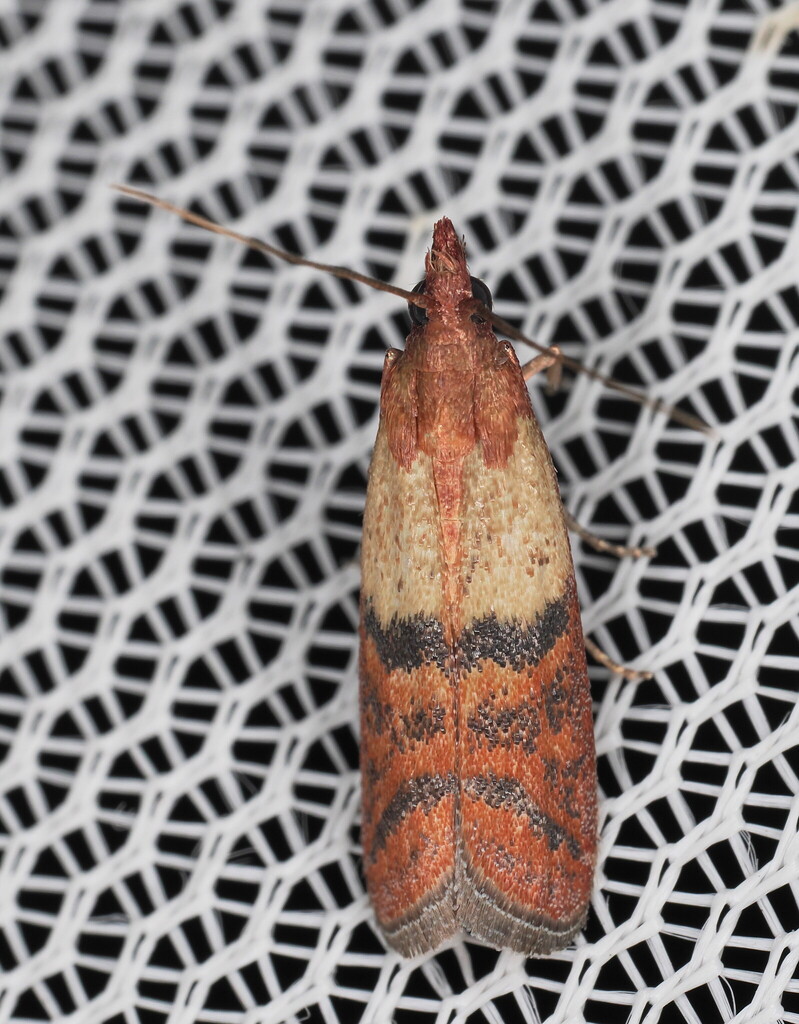
Indian-Meal Moth
Plodia interpunctella
The Indianmeal moth (Plodia interpunctella), also spelled Indian meal moth and Indian-meal moth, is a pyraloid moth of the family Pyralidae. Alternative common names are weevil moth, pantry moth, flour moth or grain moth. The almond moth (Cadra cautella) and the raisin moth (Cadra figulilella) are commonly confused with the Indianmeal moth due to similar food sources and appearance. The species was named for feeding on Indian meal (the cornmeal and maize flour from maize), with Indian in the New World sense; it does not occur natively in India. It is also not to be confused with the Mediterranean flour moth (Ephestia kuehniella), another common pest of stored grains.
P. interpunctella larvae (caterpillars) are commonly known as waxworms. They are not the same species as the waxworms often bred as animal feed. Rather, they are a common grain-feeding pest found around the world, consuming cereals, fruits, and similar products. Substantial efforts have been taken in the United States to control the moth's damage to grain crops.
From the article Indianmeal moth on Wikipedia (CC BY-SA), quoted section by section
Description
Adults are 8–10 millimetres (5⁄16–13⁄32 in) in length with 16–20 millimetres (5⁄8–13⁄16 in) wingspans. The distal two thirds of their forewings are generally reddish brown in color with a copper luster. They can also be bronze or dark gray. The more proximal parts of the wings are yellow-gray or white-gray, with a dark band at the intersection between the proximal and distal regions. The hindwings, in general, are uniformly gray. The eggs of the Indianmeal moth are white, ovate, and very small. It is difficult to see them with the naked eye. Newly hatched larvae are equally difficult to see. They are mostly off-white in color, have brown heads, and develop through five to seven larval instars. When these larvae mature, they measure about 12–14 millimetres (15⁄32–9⁄16 in) long. Larvae also have three sets of legs near the head and five sets of prolegs protruding from the abdomen. The legs help the larvae move over long distances in order to find pupation sites.
Range & habitat
Plodia interpunctella is found on every continent in tropical habitats, excluding Antarctica. Within the United States, the moth is most commonly found in Florida, where it thrives in the tropical habitat. The moth lives in a wide range of conditions, making it a persistent pest. It is often found at food storage facilities worldwide, specifically in grain bins or grain storage buildings.
Wikipedia: “Distribution and habitat”
At the table
Moths feed on many plant-based foods including dry pet food (plant based), birdseed, cereal, soup mixes, bread, pasta, rice, flour, spices, dried fruits and nuts. There is strong evidence that the northern Manitoba wheat supports the development of the moth. Other optimal diets include sultanas, American yellow corn and almonds. Groundnuts and maize meal, on the other hand, result in a longer development time for the moths.
Wikipedia: “Plant-based foods”
In human culture
The Indianmeal moth is the only known living species of the genus Plodia. It is closely related to the genera Cadra and Ephestia, which include other pest species like E. kuehniella, also known as the "flour moth". The species has been described under a number of junior synonyms, which may occasionally still be found in non-entomological sources.
Ephestia glycinivora Matsumura, 1917 Ephestia glycinivorella Matsumura, 1932 (unjustified emendation) Plodia castaneella (Reutti, 1898) Plodia glycinivora (Matsumura, 1917) Plodia interpunctalis (Hübner, 1825) Plodia latercula (Hampson, 1901) Plodia zeae (Fitch, 1856) Tinea castaneella Reutti, 1898 Tinea interpunctalis Hübner, 1825 Tinea interpunctella Hübner, [1813] Tinea zeae Fitch, 1856 Unadilla latercula Hampson, 1901 The common name, "Indianmeal moth", for this species was coined by Asa Fitch, an entomologist employed by the state of New York in the 19th century. In a report published in 1856, Fitch discussed the species, noting that the larvae had been observed to infest stores of cornmeal, which at the time was referred to as "Indian meal".
Wikipedia: “Taxonomy and etymology”
Listen
Looking for field recordings…
Where it lives
Recorded sightings
—
geo-referenced records in GBIF, from museums, herbaria and field observers.
Drag the globe to turn it. Dots are where records exist, not a range map; darker means more records.
In the stacks
Searching the stacks…
Every page naming Plodia interpunctella in the Biodiversity Heritage Library →
This page is assembled live from iNaturalist, GBIF, Wikipedia, the Source Library and the Internet Archive. It is not yet part of the hand-edited codex. iNaturalist taxon 124184.