On eBird ↗
Micronesian Myzomela
Live sightings near you, the range map, bar charts of when it is seen, and Macaulay Library photos and recordings.
Micronesian Myzomela
Myzomela rubratra
The Micronesian myzomela (Myzomela rubratra) is a small honeyeater. It is found on the Caroline and Mariana archipelagos, both part of Micronesia. It occurs in and around the edges of forests, as well as coconut plantations, coastal strand, savanna brush, villages, towns, and gardens.
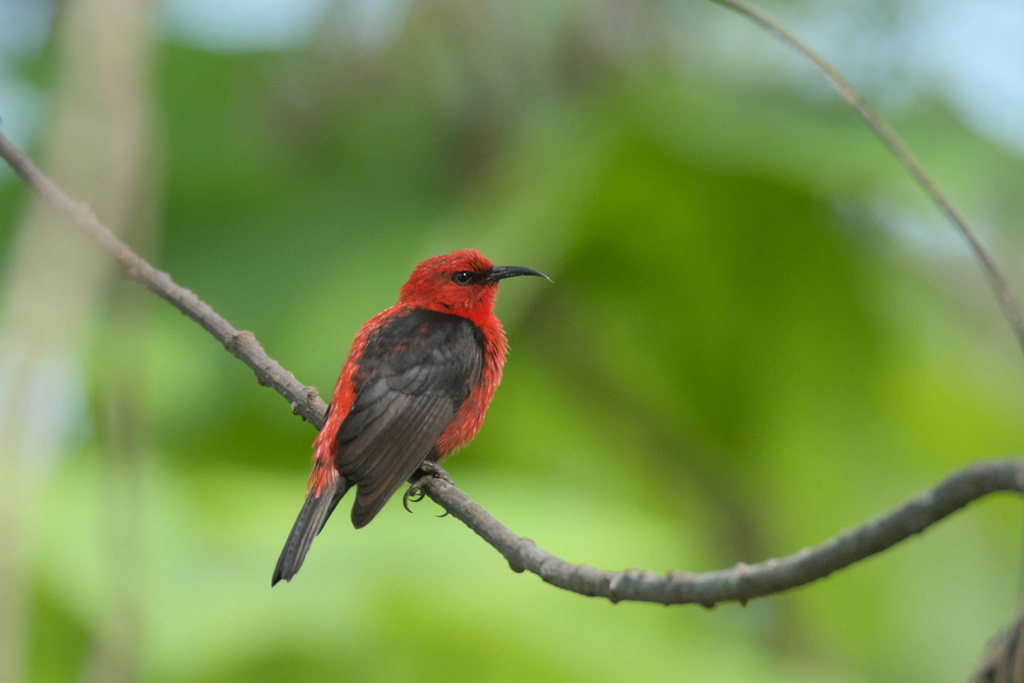
Both sexes have a predominantly dark body with scarlet patches—the location and coloration, however, varies widely by subspecies. When mature, the female, unlike the male, usually has olive fringing on her tail and wing feathers and brown on her body. The male does not have any brown on his body. Juveniles are much more brown than adults and have little or no red coloring. The Micronesian myzomela has a unique song at dawn—a continuous stream of trilled whistles and phrases, lasting for about 25 minutes on Kosrae, Yap, or Pohnpei, or a wheezy whistle on the Mariana Islands. Later in the day, the Kosrae bird produces a short, variable song and a wide array of scolding or buzzy calls. On the Mariana Islands, the daytime song is a simple and tuneful "per-mit-you". The Palau bird's call is unique to the species, resembling that of the great crested flycatcher or Micronesian starling. It is omnivorous, feeding on nectar and small invertebrates, mainly insects.
From the article Micronesian myzomela on Wikipedia (CC BY-SA), quoted section by section
Description
The Micronesian myzomela is a small honeyeater measuring 13 cm in length. The sexes differ in size and appearance: the adult male weighs 15 g (range 12.7–18 g) and has a 72 mm wing chord, a 13 mm bill, a 55 mm tail, and a 21 mm tarsus. The adult female is smaller, weighing 12.7 g (range 10.4–15 g) and with a wing chord measuring 66 mm, a 11 mm bill, a 55 mm tail, and a 20 mm tarsus. The bill is distinctly curved downwards. It is colored brown with a yellow base in juveniles, darkening with age, becoming completely black in adults. Similarly, the interior of the mouth also darkens with age, starting bright yellow and becoming black in adults. The tongue is also bright yellow. Its iris is dark brown, and its toes and tarsi are scaly and dark brown, with the undersides of the feet being dull yellow. The female has dusky brown tail and wing feathers fringed with olive, and a predominantly black or brown body with scarlet patches. The male is similar, though his patches are more vermilion and he lacks any brown coloring. The extent and placement of the patches vary between subspecies in both sexes. Juveniles of both sexes are browner compared to adults and have little to no red coloring. Juveniles molt three months after fledging, taking on a new formative plumage that greatly resembles adults; however, they may have slightly duller body feathering. …
Range & habitat
The Micronesian myzomela is a permanent resident of the Caroline and Mariana islands. It has not been observed moving between islands, but the short distances between some in a chain means it is probably capable of interinsular travel: the closely related Rotuma myzomela, which is found on Rotuma 1,500 to 1,800 km of open ocean away from Pohnpei, is likely the result of a rare dispersion between the two islands. The Micronesian myzomela can be found in and on the edges of forests, including secondary, Clinostigma, mangrove, and agroforest types. It also inhabits coconut plantations, coastal strand, savanna brush, villages, towns, and gardens. On Kosrae, it inhabits every land habitat up to around 600 m, including tall trees along lagoons, mangroves, canals, coconut groves, coconut palms near houses and gardens, and riverbanks. It is especially common in the lowlands. On Pohnpei, it can be found in most habitats, most commonly in undisturbed vegetation, mangroves, and agroforest, and less often in secondary vegetation, although the species is detected more often in disturbed habitats. On Yap, it can be found in all suitable habitats on all islands, being most abundant in low brush. …
Wikipedia: “Distribution and habitat”
What it does
With few exceptions, honeyeaters are monogamous. The Micronesian myzomela is a weak flyer, usually only travelling at most 5 meters by flight. It primarily moves while foraging by flying or hopping.
Breeding. The Micronesian myzomela nests year-round, and likely breeds year-round as well. On Pohnpei, eggs were recorded in nests from July to September. On Chuuk, eggs have been found year-round, with most nests dated to May–July and one to March. On Kosrae, a nest with nestlings was found in April. During 1983–1984, newly fledged birds were recorded on Chuuk in March, on Yap in May, and on Kosrae in July. On Saipan, nest-building has been observed in February in each year from 1988 to 1993, and seven nests were found there in 2003–2004; two contained eggs, two contained nestlings, two were empty, and the seventh was occupied by a female, which prevented the nest's contents from being checked. Courtship was observed on Aguiguan in May 1992, and newly fledged birds on Rota in March 1982. Courtship on Aguiguan consisted of the pair walking in tandem along a sturdy branch with elevated heads, periodically switching directions so that the follower became the leader. …
Wikipedia: “Behavior”
Listen
Looking for field recordings…
Where it lives
Recorded sightings
—
geo-referenced records in GBIF, from museums, herbaria and field observers.
Drag the globe to turn it. Dots are where records exist, not a range map; darker means more records.
In the stacks
Searching the stacks…
Every page naming Myzomela rubratra in the Biodiversity Heritage Library →
This page is assembled live from iNaturalist, GBIF, Wikipedia, the Source Library and the Internet Archive. It is not yet part of the hand-edited codex. iNaturalist taxon 12403.