On eBird ↗
Black-chinned Honeyeater
Live sightings near you, the range map, bar charts of when it is seen, and Macaulay Library photos and recordings.
Black-chinned Honeyeater
Melithreptus gularis
The black-chinned honeyeater (Melithreptus gularis) is a species of passerine bird in the family Meliphagidae. It is endemic to Australia. Two subspecies are recognised. Its natural habitats are temperate forests and subtropical or tropical dry forests.
From the article Black-chinned honeyeater on Wikipedia (CC BY-SA), quoted section by section
Description
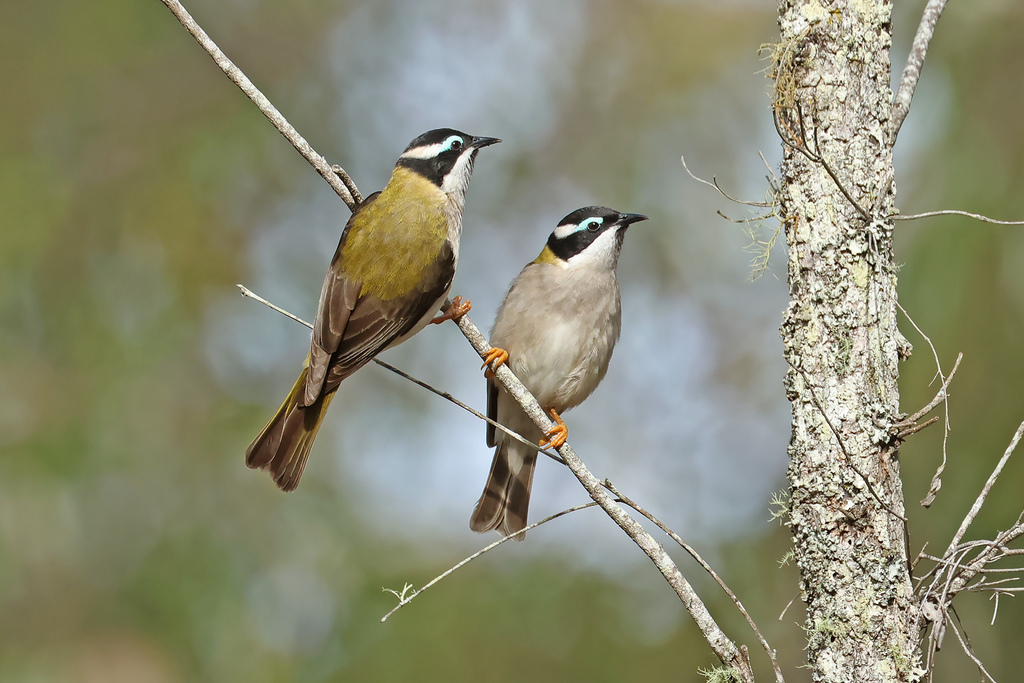
A mid-sized honeyeater ranging from 14 to 16 cm (5.6–6.4 in) in length, it is olive-brown above and buff below, with a black head, nape and throat, with a bluish patch of bare skin over the eye and a white crescent-shaped patch on the nape. The legs and feet are orange. Juveniles have an all-over browner plumage. It makes a scratchy creep-creep-creep call, as well as a more musical one. Ford noted that individuals from southeastern Queensland northwards had more yellow-tinged upperparts and paler underparts; and that those of northeastern Queensland more matched the golden-backed subspecies, though the bare skin around their eyes remained aqua-blue. The golden-backed subspecies differs by having a yellow nape and rump, green-yellow back, smaller black on chin, more grey-white than buff breast, white flanks and abdomen, lighter brown wings, green-edged rectrices, and yellow-green bare skin around the eyes.
Range & habitat
The range of the black-chinned honeyeater is across northern Australia, from northwest Western Australia (including the Kimberley, Pilbara, Great Sandy and northern Gibson deserts), through the Top End and the Gulf Country to Cape York in Queensland, through central and eastern Queensland and into central New South Wales. It occurs east of the Great Divide in the Northern Rivers region of New South Wales, but is rare further south and appears to have declined in the Sydney region. It is found across central and northern Victoria and into eastern South Australia. It is considered vulnerable in New South Wales and South Australia, although it is secure overall. It lives in open woodland and dry sclerophyll forest, often near watercourses. The species is absent from savanna on the western edge of the Einasleigh Uplands, particularly around the Newcastle and Gregory Ranges.
Wikipedia: “Distribution and habitat”
What it does
Insects form the bulk of the diet, and like its close relatives, the brown-headed and strong-billed honeyeaters, the black-chinned honeyeater forages by probing in the bark of trunks and branches of trees.
Wikipedia: “Feeding”
Listen
Looking for field recordings…
Where it lives
Recorded sightings
—
geo-referenced records in GBIF, from museums, herbaria and field observers.
Drag the globe to turn it. Dots are where records exist, not a range map; darker means more records.
In the stacks
Searching the stacks…
Every page naming Melithreptus gularis in the Biodiversity Heritage Library →
This page is assembled live from iNaturalist, GBIF, Wikipedia, the Source Library and the Internet Archive. It is not yet part of the hand-edited codex. iNaturalist taxon 12249.