On eBird ↗
Western Spinebill
Live sightings near you, the range map, bar charts of when it is seen, and Macaulay Library photos and recordings.
Western Spinebill
Acanthorhynchus superciliosus
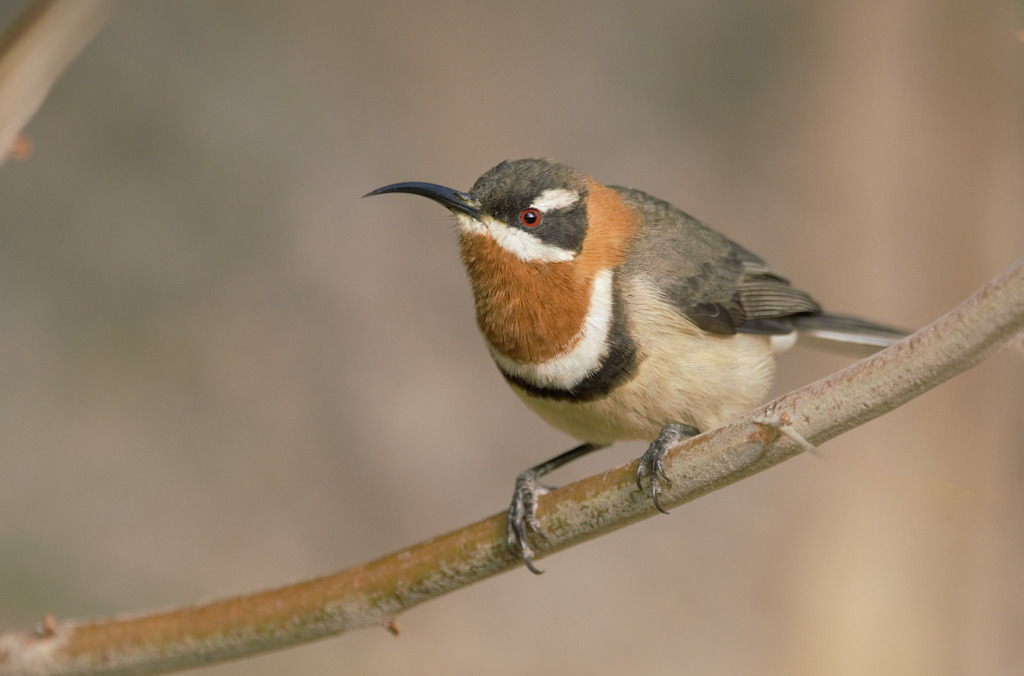
The western spinebill (Acanthorhynchus superciliosus) is a honeyeater found in the heath and woodland of south-western Australia. Ranging between 12–16 centimetres (4.7–6.3 in) long, it weighs around 10 grams (0.35 oz). It has a black head, gray back and wings, with a red band behind its neck and from its throat to its breast. Its curved bill is long and slender.
Like other honeyeaters, the western spinebill feeds on nectar. It tends to obtain its nectar from lower shrubs than most other honeyeaters, including Banksia, Dryandra, Grevillea, Adenanthos, and Verticordia. It also feeds from trees of Banksia and Eucalyptus, and from herbs such as Anigozanthos. In addition to nectar, it feeds on insects that it captures in the air or on plants.
From the article Western spinebill on Wikipedia (CC BY-SA), quoted section by section
Description
The western spinebill is a small honeyeater with a slender, curved bill. It ranges in length from 12 to 16 cm (4.7 to 6.3 in), and in weight from 8–11 g (0.28–0.39 oz). Males are, on average, slightly larger than females. The sexes differ somewhat in plumage. The male is dark olive-grey above with a chestnut nape. Below, his throat and breast are chestnut, edged below with a white band and a black band; his abdomen is buff. He has a white eyebrow and a black mask, and white outer tail feathers which are 'flirted' in flight. The female is plainer, with a pale rufous nape. Her throat and underparts are variously described as rufous-buff or pale grey, and she lacks the distinctive banding of the male. The immature resembles a plainer female, though with a yellow base to the bill.
Voice. The high, shrill, staccato piping of the western spinebill is transcribed as kleet-kleet or kleat-kleat.
Range & habitat
Endemic to the southwestern corner of Western Australia, the western spinebill is found from north of Jurien Bay to Israelite Bay, and inland to an arc described by Moora, Corrigin and Lake Grace. It is common in the understorey of heaths, coastal scrub, woodlands and forest, and in Banksia thickets. The species is kept in Western Australian aviaries, as the sister species Acanthorhynchus tenuirostris of the east is held in captivity in Sydney, due to the local species being available to avicultural enthusiasts of honeyeaters.
Wikipedia: “Range and habitat”
What it does
Like other honeyeaters, the western spinebill feeds primarily on nectar. It feeds for longer time periods—and ingests more nectar—in the first 60 to 90 minutes of each day than it does later in the day. Banksia ilicifolia is particularly sought over other banksias, which may be foraged, including B. menziesii (although birds do not congregate in greater numbers when this species is flowering), and B. sessilis. The western spinebill has been observed foraging at flower spikes lower down in the tree canopy, possibly to avoid larger and more aggressive honeyeaters.
Wikipedia: “Feeding”
Listen
Looking for field recordings…
Where it lives
Recorded sightings
—
geo-referenced records in GBIF, from museums, herbaria and field observers.
Drag the globe to turn it. Dots are where records exist, not a range map; darker means more records.
In the stacks
This page is assembled live from iNaturalist, GBIF, Wikipedia, the Source Library and the Internet Archive. It is not yet part of the hand-edited codex. iNaturalist taxon 12237.