On eBird ↗
Yellow-throated Miner
Live sightings near you, the range map, bar charts of when it is seen, and Macaulay Library photos and recordings.
Yellow-throated Miner
Manorina flavigula
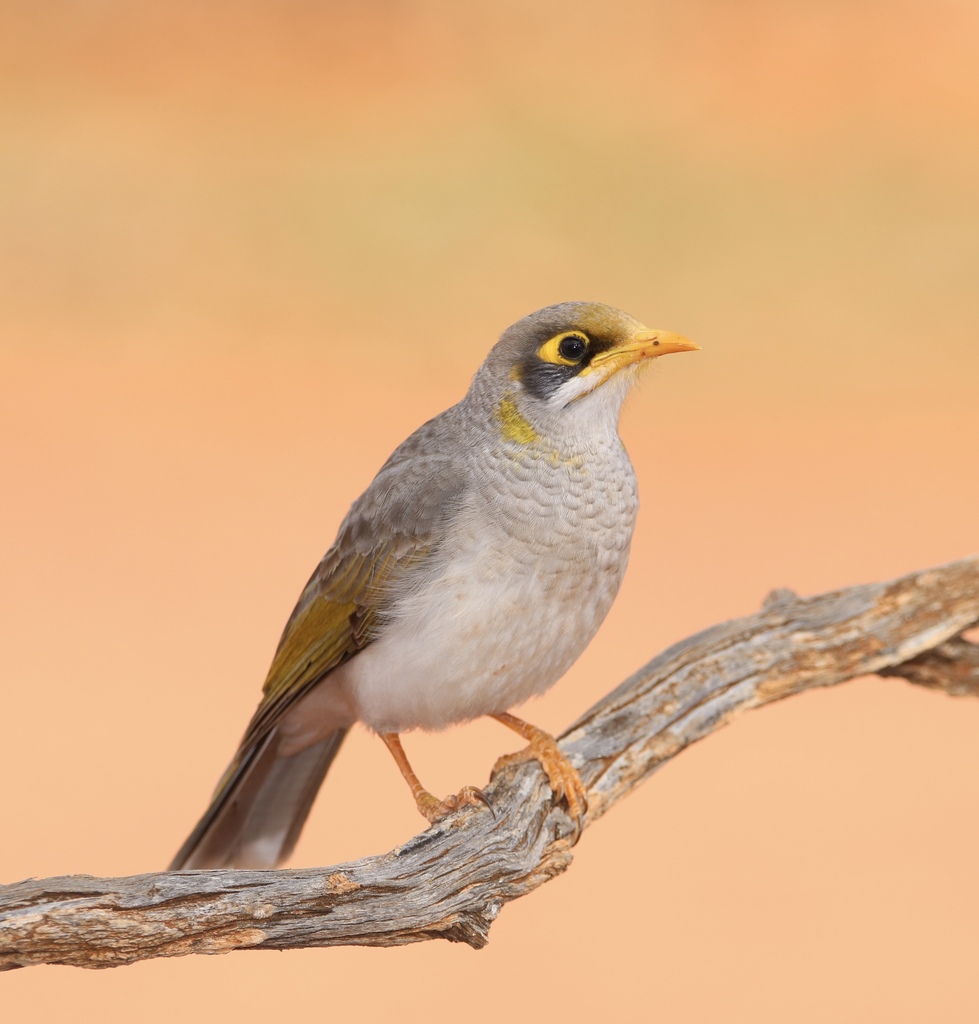
The yellow-throated miner (Manorina flavigula) is a species of colonial honeyeater, endemic to Australia. It is also known as the white-rumped miner. The distinctive white rump is easy to observe in the field and distinguishes it from the other miner species. Yellow-throated miners are medium-sized, grey passerines with yellow throat markings, legs, and bare patches around the eye. The common name 'miner' is an alternative spelling of the word myna, mynah or minah, and is shared with other members of the genus Manorina. Though miners were originally named due to their resemblance to the common myna of South and Southeast Asia that shares similar yellow eye-patch and legs, common mynas are from the starling family and are not closely related to the honeyeater family. Common mynas are an aggressive introduced pest in Australia, which causes some confusion with the native aggressive miners.
Yellow-throated miners feed on invertebrates, nectar, pollen, lerps, and seeds. They are the most widely distributed of the genus Manorina and inhabit open woodlands and scrublands across most of Australia. Yellow-throated miners live in groups, are social, noisy, and defend territory or resources from other avian species. Their behavior is generally compared to their close relative the noisy miner as they share postures, calls and interactions, though yellow-throated miners are not as well studied.
From the article Yellow-throated miner on Wikipedia (CC BY-SA), quoted section by section
Description
The yellow-throated miner's color and shape is very similar to the closely related noisy and black-eared miners. A medium-sized honeyeater, it reaches a total length of 22 to 28 centimetres (8.7–11.0 in), a wing length of 12–13.8 cm (4.7–5.4 in), and a bill length of 25 mm (0.9 in). Adult yellow-throated miners weigh between 50 g (1.8 oz)and 61 g (2.2 oz). Yellow-throated, black-eared and noisy miners share a dark grey dorsal surface with medium grey patterning on the feathers. Wings are dark grey with varying levels of yellow highlighting. The ventral feathering is light grey to white with light grey scalloping on the chest. The feathering surrounding the eye is black. The beak and bare skin-patch around the eyes are bright yellow, and the iris is brown. Legs are also yellow, though shade and brightness varies. Fledgling birds have undefined, fluffy light grey chests without scalloping. Immature birds can be identified in the hand by retained juvenile remiges and rectrices, which are more brownish. Yellow-throated miners are distinctive from the other miners by their clean white rump, instead of the continuous grey from the back that the noisy and black-eared miners have. The white-rump is clearly visible as yellow-throated miners are flying away, so this feature is often used in the field where two miner species overlap. …
Range & habitat
The yellow-throated miner has the widest distribution of the Manorina species, and it is found across most of Australia, except east of the Great Dividing Range, on Cape York Peninsula, the very north-eastern Northern Territory, and small patches of the driest parts in Central Australia. M. f. wayensis has the largest distribution across the middle of Western Australia through to Western Queensland. M. f. flavigula is the easternmost sub-species, and covers most of Queensland except Cape York and the coast from South East Queensland south and extends south through New South Wales and inland Victoria. M. f. lutea extends across the northern parts of Western Australia and the Northern Territory. M. f. obscura occurs in south-western Western Australia . M. f. melvillenis is found in the very northern part of the Northern Territory. Yellow-throated miners are primarily found in arid and semi-arid regions, but do extend into temperate, subtropical, and tropical areas. They are found in woodlands and scrublands, including acacia, eucalyptus, mallee, and casuarina. Similar to noisy miners they like edges and so adapt well to disturbed habitat, and can be found in regrowth and along roads or next to cleared lands. They like some undergrowth and recolonize restored habitat, but are rarely found in dense growth like mature mallee. …
Wikipedia: “Distribution and habitat”
What it does
Behaviour has been observed to be similar to other Manorina species, but the yellow-throated miner is not as well studied as the noisy miner or bell miner. Behaviour comparisons are generally with the noisy miner as they seem to be more similar: both prefer more open forests and adapt well to certain types of disturbed habitats. Yellow-throated miners are possibly less sedentary than the other miner species, though they occur in some locations year around, and there are no known migration patterns for them. They are more often seen in larger groups during the non-breeding season, but these are likely local movements only.
Social organization and aggression. Yellow-throated miners, like the other Manorina species, have a complex social structure and can live in communal groups of up to 50 birds. They are often found in smaller groups of up to a dozen birds, and sometimes in pairs or solitary. No major behaviour studies have been conducted, but they appear to have a similar social structure to noisy miners as they share many calls, postures, and interactive behaviours. Calls are higher pitched than noisy miner calls, but are readily recognizable as a miner call. They are watchful and are often the first to alarm when a predator appears. As with the other miner species, they are known to be very aggressive to other birds, particularly smaller insectivores and honeyeaters. …
Wikipedia: “Behaviour”
Listen
Looking for field recordings…
Where it lives
Recorded sightings
—
geo-referenced records in GBIF, from museums, herbaria and field observers.
Drag the globe to turn it. Dots are where records exist, not a range map; darker means more records.
In the stacks
Searching the stacks…
Every page naming Manorina flavigula in the Biodiversity Heritage Library →
This page is assembled live from iNaturalist, GBIF, Wikipedia, the Source Library and the Internet Archive. It is not yet part of the hand-edited codex. iNaturalist taxon 12223.