On eBird ↗
Purple-gaped Honeyeater
Live sightings near you, the range map, bar charts of when it is seen, and Macaulay Library photos and recordings.
Purple-gaped Honeyeater
Lichenostomus cratitius
The purple-gaped honeyeater (Lichenostomus cratitius) is a species of bird in the family Meliphagidae. It is endemic to semi-arid southern Australia, where it inhabits mallee, tall heath and associated low eucalypt woodland.
From the article Purple-gaped honeyeater on Wikipedia (CC BY-SA), quoted section by section
Description
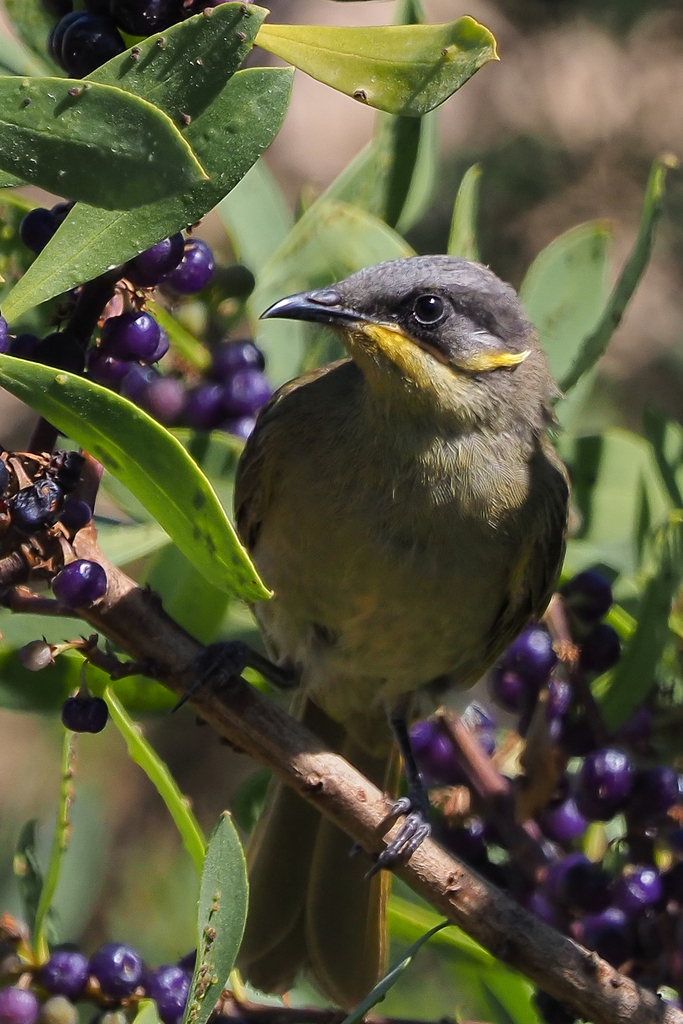
The purple-gaped honeyeater is a medium-sized (16-19 centimetres) honeyeater which is generally grey-olive above and buffish yellow below. They have a patterned head, with a black eyestripe against a grey background and purple gape above a yellow streak on the throat and pointed yellow ear coverts. Juveniles are similar, but with duller facial patterns, slightly browner plumage, and a yellow gape and gape line. The Kangaroo Island subspecies is considered to be larger and darker than the mainland subspecies. Similar species include yellow-plumed honeyeater and singing honeyeater. The bird is also named Wattle-Cheeked Honeyeater in Birds of Australia vol 11 by Gregory Mathews
Call. The song is a clear toweet-toweet-toweet, followed by a high-pitched yep-yep-yep, often performed from a tall branch, including before dawn.
Range & habitat
They occur in disjunct populations across southern Australia, east from southern Western Australia, with the eastern population largely occurring south of the Murray River, and NSW forming the extreme north-east of its range. Despite its naturally disjunct populations, the purple-gaped honeyeater has very low genetic diversity across its range.
Wikipedia: “Distribution”
What it does
The main habitat type for purple-gaped honeyeater is mallee woodland and shrubland. This includes bull mallee, with patches of green mallee or blue mallee. They also occur in yellow gum woodland with dense thickets of 'totem-poles' or violet honey-myrtle on low-lying flats and gullies in mallee areas. They are occasionally recorded in river red gums bordering waterways, and seasonally in red ironbark woodlands when they are in flower. Purple-gaped honeyeaters can also occasionally be found in gardens. They are gregarious, usually seen in pairs, or groups of 3-8 birds. Generally considered quiet and unobtrusive, except in spring when they may call often. They are known to regularly drink and bathe, particularly in warmer weather. Purple-gaped honeyeaters associate with yellow-plumed honeyeater and tawny-crowned honeyeater, but can be aggressive towards other honeyeaters, and frequently chase other birds, particularly when feeding.
Diet. Purple-gaped honeyeaters feed mainly on nectar and insects, especially from flowering mallee eucalypts, and banksias. They also forage for insects under loose bark on trunks and branches of trees, or catch flying insects on the wing. Seeds, pollen and honeydew from scale insects are less frequently consumed.
Reproduction. …
Wikipedia: “Ecology and behaviour”
Listen
Looking for field recordings…
Where it lives
Recorded sightings
—
geo-referenced records in GBIF, from museums, herbaria and field observers.
Drag the globe to turn it. Dots are where records exist, not a range map; darker means more records.
In the stacks
Searching the stacks…
Every page naming Lichenostomus cratitius in the Biodiversity Heritage Library →
This page is assembled live from iNaturalist, GBIF, Wikipedia, the Source Library and the Internet Archive. It is not yet part of the hand-edited codex. iNaturalist taxon 12164.