- Animals
- ›Arthropods
- ›Hexapods
- ›Insects
- ›Winged and Once-winged Insects
- ›Flies
- ›Brachyceran Flies
- ›Cyclorrhaphan Flies
- ›Schizophoran Flies
- ›Calyptrate Flies
- ›Bot Flies, Blow Flies, and Allies
- ›Blow Flies
- ›Chrysomyinae
- ›Cochliomyia
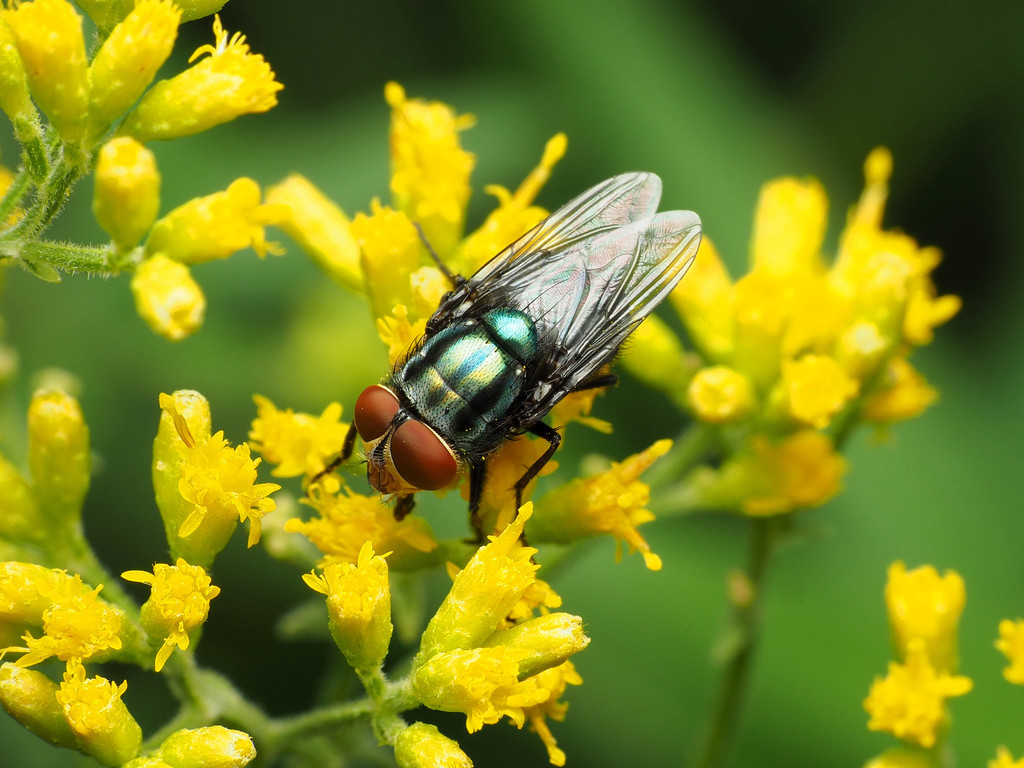
Secondary Screwworm Fly
Cochliomyia macellaria
Cochliomyia macellaria, also known as the secondary screwworm, is a species of blow fly in the family Calliphoridae. These screwworms are referred to as "secondary" because they typically infest wounds after invasion by primary myiasis-causing flies. While blow flies may be found in every terrestrial habitat, C. macellaria is primarily found in the United States, American tropics, and sometimes southern Canada. They are most common in the southeastern United States in states like Florida. C. macellaria have a metallic greenish-blue thorax and a red-orange head and eyes. These adult blowflies range from 5–8 mm in size.
Since the fly larvae infect the wounds and dead tissue of animals, these flies pose a grave medical and economic risk to humans and livestock. C. macellaria are attracted to carrion and garbage and are often found in slaughterhouses and outdoor markets in the tropics. While these flies carry many various types of Salmonella and viruses like the swine influenza, C. macellaria can also serve as important decomposers in our ecosystem.
From the article Cochliomyia macellaria on Wikipedia (CC BY-SA), quoted section by section
Description
Cochliomyia macellaria are classified as intermediate sized flies with a dull or bright metallic, blue-green coloration. On their thorax, there are three black longitudinal stripes that interrupt the blue-green color. The eye and head of these flies are orange-red in color. C. macellaria also has pale setae on the fronto-orbital plate outside of the frontal bristles. On C. macellaria the frontal row of bristles extend anteriorly to the base of the first antennal segment and consist of 12–14 bristles. The legs of the fly are orange brown to dark brown, and the coxae are orange brown to black with a green metallic luster. C. macellaria possess a dark reddish brown anterior femur and an orange-red anterior tibia. The anterior tibia also has four short bristles that are placed on the dorsal side. The color of the wings of the fly is orange brown tint towards the base. On these wings, the veins in the fly are orange brown to dark brown. The costal sessions 2 to 6 are in the proportions 78:56:96:30:6:6. The first genital section is black with a metallic green luster. On the fly, the scattered setae and a defined marginal row of bristles; the second segment is smaller with a dark brown to black tint with scattered setae.
Distinguishing features. Cochliomyia macellaria is closely related to C. hominivorax but can be distinguished from C. …
Range & habitat
Cochliomyia macellaria is most often found in the southeastern part of the United States, in states like Florida, Louisiana, and Georgia. Despite the high concentration in these states, these flies have been found as far north as Southern Canada and as south as the Neotropics, with the exclusion of countries like Chile and Argentina. While they have been found in this large expanse of areas, they have been shown to thrive most in warm and humid areas like the Southern United States, Caribbean Islands, Central America, and northern South America. In these areas, the population size typically increases during periods of extended rainfall. The territories of these blowflies are relatively small, especially during the time of mating. In this period, these flies will stay within a couple meters of one another.
Wikipedia: “Distribution and territory”
What it does
The average life span of an adult C. macellaria is 2–6 weeks. In this time period, the females try to increase the chances of producing as many surviving offspring as possible. In a lifetime, C. macellaria may lay up to 1000 or more eggs. These eggs are typically laid in groups of 40 to 250. Females may also lay their eggs with other females, leading to an accumulation of thousands of eggs.
Eggs. The eggs of C. macellaria are laid in large groups (40–250 eggs at one time) and typically hatch in about 24 hours. The time taken for eggs to hatch often depends on moisture, temperature, and precipitation. In favorable conditions, the eggs may hatch in just four hours. These eggs are about 1 mm long and appear white to pearl white in color.
Larvae. The larval stage of C. macellaria is referred to by the common name of secondary screwworms; this is due to the presence of small spines on each body segment that resemble parts of a screw. The larval stage of C. macellaria immediately follows the egg stage and is typically broken down into three substages or instars. Upon hatching, the larve appear a cream color, have cylindrical bodies with 10 or more spines around the spiracular area, possess incomplete peritremes (an indistinct or absent button), and have bands of small spines on each segment. C. macellaria, unlike like C. …
Wikipedia: “Life cycle and history”
At the table
Depending on the gender and stage in their development, C. macellaria will utilize different resources for energy and nutrients. During the larval stage, the C. macellaria will dig deeper into the necrotic wounds of their host animal and feed on the dead tissue. Both males and females will feast through this method. This time period is extremely crucial to the flies, as they must gather enough nutrients in order to last through the pupal stage without any food sources. This is one reason why the larvae are much larger than the size of the adult C. macellaria. As adults, the food specifications of the flies change. Female flies will continue to feed on tissues of animals; however, now they preferentially feed off of live tissue and tissue plasma. Males, at this point, will no longer consume tissue, but instead will eat nearby vegetation and intake nutrients from the nectar of flowers.
Wikipedia: “Food resources”
In medicine
Cochliomyia macellaria has extensive medical and economic implications. When C. macellaria larvae infest the dead and decaying tissues of animals or humans, myiasis may often occur. Once infestation occurs, a dark brown discharge will start to leaking from the wound. As the infestation increases, there is more agitation and inflamed tissue, which is accompanied by unpleasant smells. After the process of clinical diagnosis begins and the myiasis is recognized, then the larvae are easier to identify. Treatment of these infestations can be time intensive and leads to increased chances of reoccurrences. The first step is manual removal of the larvae followed by an antibiotic smear.
Wikipedia: “Medical”
Listen
Looking for field recordings…
Where it lives
Recorded sightings
—
geo-referenced records in GBIF, from museums, herbaria and field observers.
Drag the globe to turn it. Dots are where records exist, not a range map; darker means more records.
In the stacks
Searching the stacks…
Every page naming Cochliomyia macellaria in the Biodiversity Heritage Library →
This page is assembled live from iNaturalist, GBIF, Wikipedia, the Source Library and the Internet Archive. It is not yet part of the hand-edited codex. iNaturalist taxon 120921.