- Animals
- ›Arthropods
- ›Hexapods
- ›Insects
- ›Winged and Once-winged Insects
- ›Flies
- ›Brachyceran Flies
- ›Cyclorrhaphan Flies
- ›Aschizan Flies
- ›Hover Flies
- ›Drone Flies and Allies
- ›Rat-tail Maggot Flies
- ›Helophilina
- ›Arctosyrphus
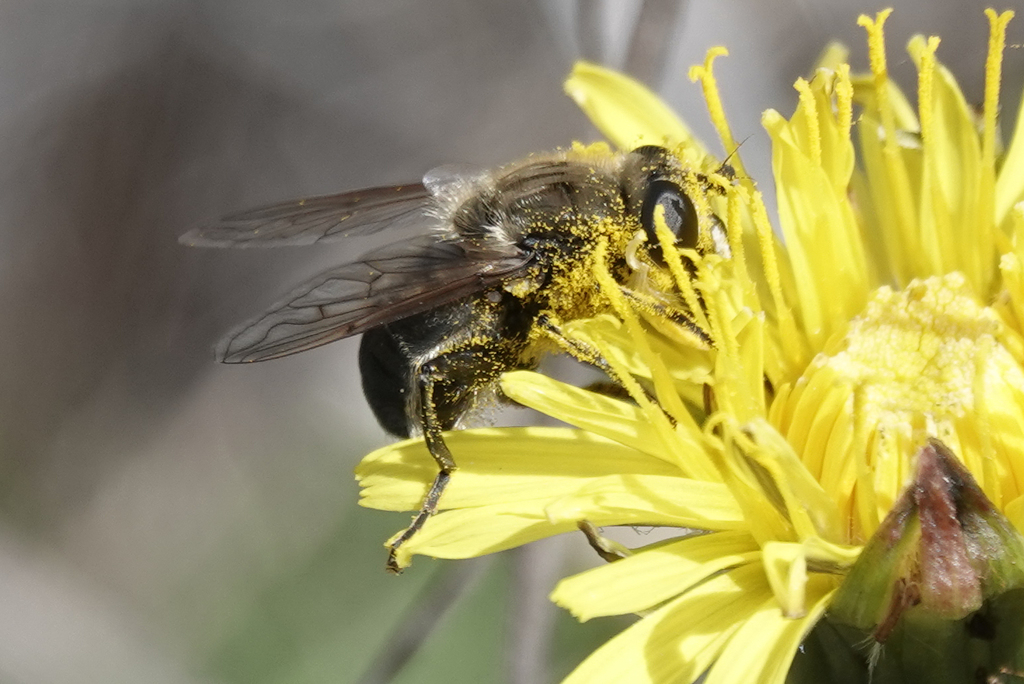
Northern Longbeak
Arctosyrphus willingii
Arctosyrphus willingii, the northern longbeak, is a species of rat-tail maggot fly in the family Syrphidae.
This species was formerly a member of the genus Lejops.
From the article Arctosyrphus willingii on Wikipedia (CC BY-SA), quoted section by section
Description
For terminology seeSpeight key to genera and glossary
Size Length 11–12 mm (0.43–0.47 in)
Head In males, the frons is about one-half as wide as the eyes, while in females it is nearly as wide. In males, the pile on the upper half of the frons is black, while on the lower half it is grayish white. In females, there is black pile on the frons that extends a little below the upper half. The vertex is shining black and very thinly dusted gray pollinose and the ocelli are very widely separated. The posterior orbits have whitish pile below and yellowish pile above. The face on the lower half is produced obtusely downward and forward into a cone. The face is shining black, densely grayish-white pollinose on the sides, and bearing pile of a similar color along the margins of the eyes. The face beneath the antennae is concave for a short distance and then nearly straight to the tip. There is a moderately broad shining black stripe in the middle of the face extending from the tip of the epistoma nearly to the base of the antennas. The ventral side of the epistoma is shining black. The gena below the eyes are narrow, dull black, and grayish pilose. The antennal prominence is narrowly reddish above the antennae. The first two joints of the antennae are shining black, while the third joint is brownish black and oval with white dusted gray pollen. …
Range & habitat
Canada: Yukon, Alberta, Manitoba, Saskatchewan. United States: Alaska, Minnesota, North Dakota.
== References ==
Wikipedia: “Distribution”
Listen
Looking for field recordings…
Where it lives
Recorded sightings
—
geo-referenced records in GBIF, from museums, herbaria and field observers.
Drag the globe to turn it. Dots are where records exist, not a range map; darker means more records.
In the stacks
Searching the stacks…
Every page naming Arctosyrphus willingii in the Biodiversity Heritage Library →
This page is assembled live from iNaturalist, GBIF, Wikipedia, the Source Library and the Internet Archive. It is not yet part of the hand-edited codex. iNaturalist taxon 1144324.