- Animals
- ›Chordates
- ›Vertebrates
- ›Ray-finned Fishes
- ›Spiny-rayed fishes
- ›Wrasses and allies
- ›False scorpionfishes, wrasses, and parrotfishes
- ›Wrasses and Parrotfishes
- ›Parrotfishes
- ›Sparisoma
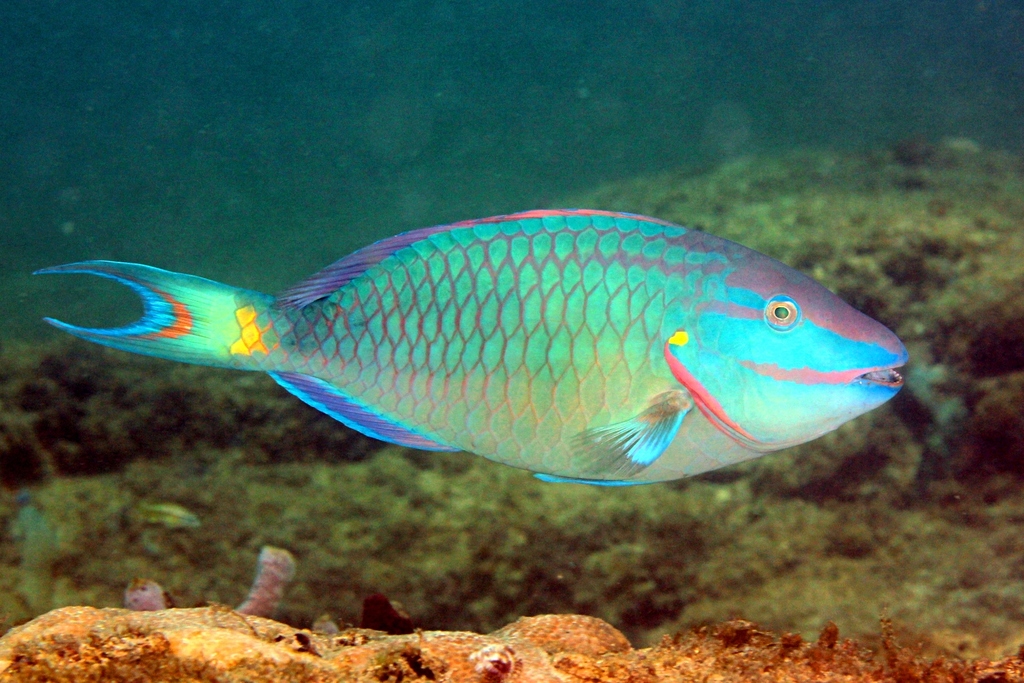
Stoplight Parrotfish
Sparisoma viride
The stoplight parrotfish (Sparisoma viride) is a species of parrotfish inhabiting coral reefs in Florida, Caribbean Sea, Gulf of Mexico, Bermuda and as far south as Brazil. Like most of its relatives, it is able to change sex. Its typical length is between 1 and 1.5 ft (30–45 cm), but it can reach up to 2 ft (64 cm). It is normally found during the day at depths between 15 and 80 ft (5–25 m), but can be found from 10 to 165 ft...
From the article Stoplight parrotfish on Wikipedia (CC BY-SA), quoted section by section
Description
The common name "stoplight parrotfish" comes from the marked yellow spot near the pectoral fin, which is clearly visible only in specimens in the terminal phase. Its typical length is between 1 and 1.5 ft (30–45 cm), but it can reach up to 2 ft (64 cm).
Range & habitat
It is normally found during the day at depths between 15 and 80 ft (5–25 m), but can be found from 10 to 165 ft (3–50 m) The stoplight parrotfish inhabits shallow coral reefs not disturbed by humans in Florida, the Caribbean Sea, Gulf of Mexico, Bermuda and Brazil. They are only active during the day and spend most of their time foraging, swimming, or hovering. At night, they remain hidden under coral boulders. Large individuals typically spend more time swimming and spend a significant amount of time sheltering among crevices, while smaller individuals spend more time hovering. The stoplight parrotfish have a high density in areas of higher algal production. As adults, the stoplight parrotfish are site-attached with limited home ranges. In the Florida Keys, the stoplight parrotfish were found most frequently in areas with high cover of the macroalgae Dictyota. They have also been found to select for the branching coral Porites porites, however Dictyota are an effective recruitment substrate when branching corals are not available. Due to its abundance in the Caribbean, the stoplight parrotfish are very ecologically important there.
Wikipedia: “Habitat and distribution”
What it does
Stoplight parrotfishes engage in reproductive activity throughout the year. They are harem-forming fishes and territorial terminal phase males defend areas that are shared with 1–14 initial phase parrotfishes, with whom they mate. There is more territorial defense in areas with high-quality food. Single terminal phase males also defend the deeper reef from conspecifics. Stoplight parrotfish males will often control territories containing many sexually mature females to breed with. Males that have territories and those that don't will have vastly different levels of testosterone. Onshore coral reefs have a greater proportion of older juvenile fish, suggesting that the mortality and/or emigration of adults is more common onshore.Stoplight parrotfishes on offshore coral reefs have a greater average standard length, greater mean asymptotic size, and live twice as long as other fish from onshore coral reefs. Fish onshore were no older than 4 years, while the fish offshore reached 7–8 years. The age difference between offshore and onshore reefs could be due to the stoplight parrotfish migrating from onshore to offshore reefs with age, however, there is no evidence of ontogenetic migration.
Sex change. …
Wikipedia: “Reproduction”
Where it lives
Recorded sightings
—
geo-referenced records in GBIF, from museums, herbaria and field observers.
Drag the globe to turn it. Dots are where records exist, not a range map; darker means more records.
In the stacks
Searching the stacks…
Every page naming Sparisoma viride in the Biodiversity Heritage Library →
This page is assembled live from iNaturalist, GBIF, Wikipedia, the Source Library and the Internet Archive. It is not yet part of the hand-edited codex. iNaturalist taxon 112867.