- Animals
- ›Chordates
- ›Vertebrates
- ›Ray-finned Fishes
- ›Spiny-rayed fishes
- ›Wrasses and allies
- ›False scorpionfishes, wrasses, and parrotfishes
- ›Wrasses and Parrotfishes
- ›Parrotfishes
- ›Sparisoma
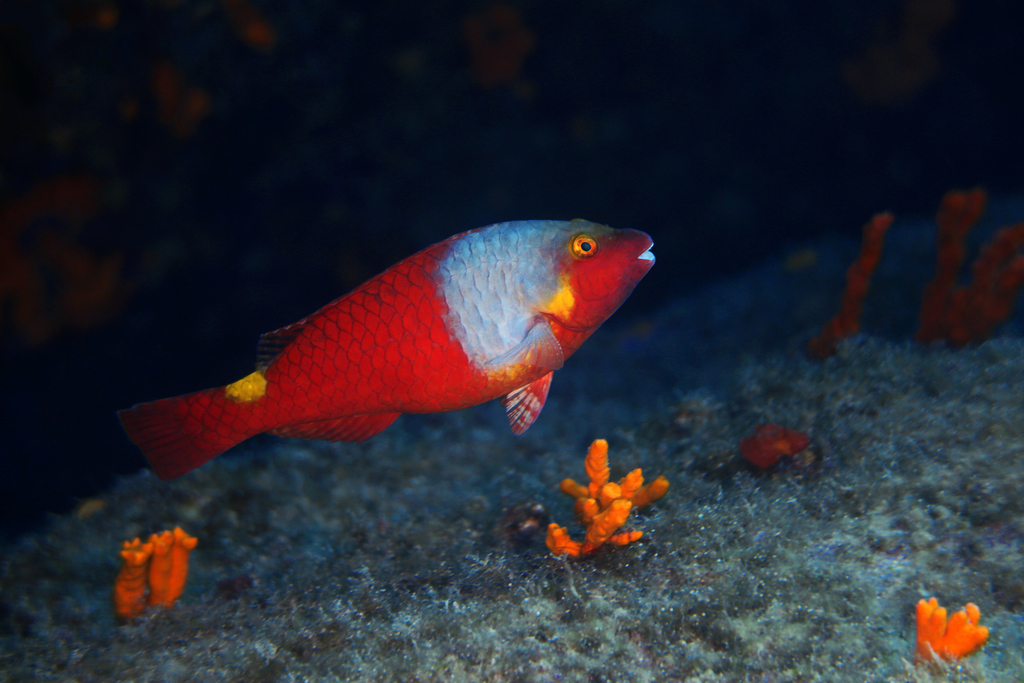
European Parrotfish
Sparisoma cretense
The Mediterranean parrotfish (Sparisoma cretense), also known as the European parrotfish, is a species of parrotfish found at depths up to 50 m (160 ft) along rocky shores in the Mediterranean and the eastern Atlantic, from Portugal south to Senegal. It is generally common, but uncommon or rare (locally even absent) in the northwestern Mediterranean and in the Adriatic Sea. It prefers relatively warm temperatures and there is an ongoing northward range expansion, possibly due to global warming. The primary adult habitat is rocky reefs, especially in areas with macroalgae, but they may visit adjacent seagrass patches. Juveniles also occur more widely in the latter habitat.
In parts of its range it is a commercially important food fish. Although some populations have been affected by fishing pressure, it is not considered threatened. It has been studied in detail in parts of its range, including the Azores.
From the article Sparisoma cretense on Wikipedia (CC BY-SA), quoted section by section
Description
As its relatives, this parrotfish starts as female and then changes to male (known as the terminal phase). However, unlike most of its relatives, it is a secondary gonochorist. This means that some females do not change sex (they remain females throughout their lives), the ones that do change from female to male do it while still immature (reproductively functioning females do not change to males) and there are no males with female-like colours (known as initial phase males in other parrotfish). Juveniles less than 7 cm (3 in) long are mottled with a yellowish head and have undifferentiated gonads (not male or female). Immatures that are 7–12 cm (3–5 in) long are mottled brownish and have immature female gonads (ovaries). If stressed, they adopt a pattern with broad horizontal white stripes. At larger sizes, the adult colours appear and the male or female gonads are mature. The adult females are red with a yellow-edged greyish saddle shape on the back and a yellow spot at the base of the tail. The males are overall greyish with paler underparts and no distinctive markings, although typically with blackish bars on the throat and opercular. Adults reach a maximum length of about 52 cm (20 in), but most are 15–30 cm (6–12 in) long. There is an almost complete overlap in the sizes of the adult females and adult males, although the former are on average smaller than the latter.
Wikipedia: “Appearance”
What it does
The Mediterranean parrotfish feeds primarily on epilithic and coralline algae, but may also take epiphytic algae (growing on seagrass) and small invertebrates. The jaws and dentition are specially adapted to this feeding. It primarily breeds during the summer, from July to September, but breeding can occur as early as May and late as December. It is a diurnal fish, but spawning is around dawn or dusk and can occur in pairs or groups. The pelagic eggs hatch into free-swimming larvae. The pelagic stage for the eggs and larvae is 50–60 days in Sparisoma parrotfish, after which they settle on rocky reefs and among seagrass.
Wikipedia: “Behavior”
Where it lives
Recorded sightings
—
geo-referenced records in GBIF, from museums, herbaria and field observers.
Drag the globe to turn it. Dots are where records exist, not a range map; darker means more records.
In the stacks
Searching the stacks…
Every page naming Sparisoma cretense in the Biodiversity Heritage Library →
This page is assembled live from iNaturalist, GBIF, Wikipedia, the Source Library and the Internet Archive. It is not yet part of the hand-edited codex. iNaturalist taxon 112860.