- Animals
- ›Chordates
- ›Vertebrates
- ›Ray-finned Fishes
- ›Spiny-rayed fishes
- ›Wrasses and allies
- ›False scorpionfishes, wrasses, and parrotfishes
- ›Wrasses and Parrotfishes
- ›Parrotfishes
- ›Scarus
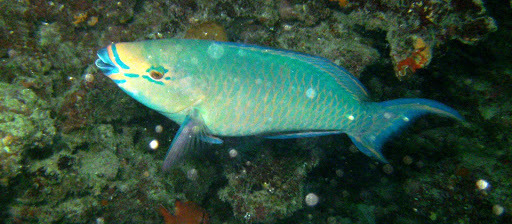
Redbarred Parrotfish
Scarus caudofasciatus
Scarus is a genus of parrotfishes. With 52 currently recognised extant species, it is by far the largest parrotfish genus. The vast majority are found at reefs in the Indo-Pacific, but a small number of species are found in the warmer parts of the eastern Pacific and the western Atlantic, with a single species, Scarus hoefleri in the eastern Atlantic. Most are very colourful, and have strikingly different initial (males and females) and terminal (males only)...
From the article Scarus on Wikipedia (CC BY-SA), quoted section by section
Description
Adults of most species reach maximum lengths of between 30 and 50 cm (12–20 in), but the rainbow parrotfish (Scarus guacamaia) can grow to lengths of 1.2 m (3.9 ft) and is the second largest species of parrotfish after the humphead parrotfish. S. guacamaia weighs a hundred times more than the smallest Scarus species Scarus iseri, which only reaches a maximum length of 27 cm. In comparison to its sister genus Chlorurus, Scarus species in general have less obtuse head profiles, less extensive cheek areas, and smaller dental plates, although a few species of Scarus are exceptions to this. This may possibly reflect comparatively lower biting power, and a disparity in the ability to excavate calcareous reef subtrata. The number of pectoral rays, which varies from 13 to 16 between Scarus species, is useful for identifying species, as well as the number of predorsal scales and the number of rows of scales on the cheek. However, most other meristic data is of limited use when identifying species of Scarus: dorsal rays, anal rays, and lateral line scales do not vary much in number between parrotfish species, and there is high intra-specific variation in gill raker count.
Sexual dichromatism. Most Scarus species are very colourful, and most are sexually dichromatic, with strikingly different initial (male and female) and terminal (male only) phases. …
What it does
Scarus species are important herbivores in reef ecosystems, feeding predominantly on algae and dead coral. In the process, they facilitate bioerosion and create sediment. Lifespan varies across different species. More short-lived species, such as the common parrotfish (S. psittacus), live for up to 6 years. Other species are more long-lived; the endangered greenback parrotfish (S. trispinosus) has been recorded living for over 20 years, and is the largest herbivorous reef fish in the South Atlantic. Its close relative, the midnight parrotfish (S. coelestinus), has been recorded reaching 31 years of age. Such large bodied and long-lived species are highly vulnerable to over-exploitation by fisheries. Many species within the genus are sympatric with each other, and often are sympatric with their sister species; Scarus frequently underwent sympatric speciation through adaptive radiation.
Wikipedia: “Ecology”
Where it lives
Recorded sightings
—
geo-referenced records in GBIF, from museums, herbaria and field observers.
Drag the globe to turn it. Dots are where records exist, not a range map; darker means more records.
In the stacks
Searching the stacks…
Every page naming Scarus caudofasciatus in the Biodiversity Heritage Library →
This page is assembled live from iNaturalist, GBIF, Wikipedia, the Source Library and the Internet Archive. It is not yet part of the hand-edited codex. iNaturalist taxon 112132.