- Animals
- ›Arthropods
- ›Hexapods
- ›Insects
- ›Winged and Once-winged Insects
- ›Beetles
- ›Water, Rove, Scarab, Long-horned, Leaf, and Snout Beetles
- ›Cucujiform Beetles
- ›Lady, Fungus, Scavenger, and Bark Beetles
- ›Lady Beetles
- ›Ortaliinae
- ›Noviini
- ›Novius
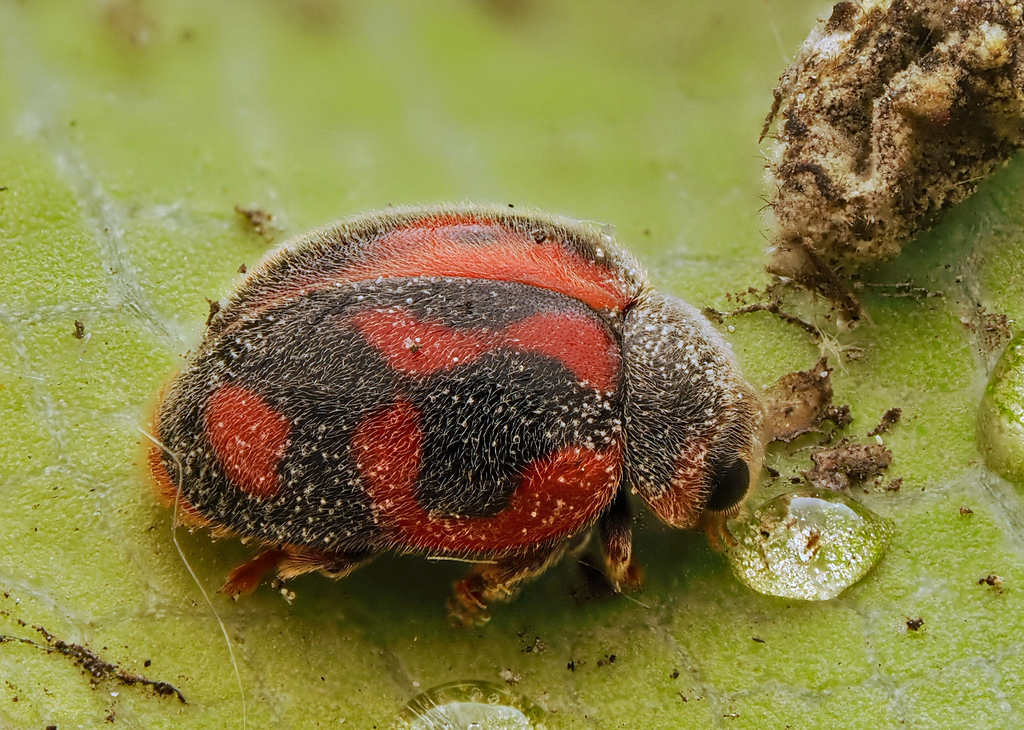
Vedalia Beetle
Novius cardinalis
Novius cardinalis (common names vedalia beetle or cardinal ladybird) is a species of ladybird beetle native to Australia. It was formerly placed in the genus Vedalia then renamed to Rodolia, but that genus was synonymized under the genus Novius in 2020. The "vedalia beetle" came to public attention as an effective biological control agent against cottony cushion scale, a serious pest of citrus plantations.
From the article Novius cardinalis on Wikipedia (CC BY-SA), quoted section by section
Description
The adult has a domed oval body, flattened underneath, 2.5–4 millimetres (0.10–0.16 in) long, covered with dense, short hairs. Its coloration is an irregular and variable pattern of red and black, sometimes with more red, sometimes with more black. The head, the back of the prothorax, and the scutellum are all black.
The species feeds exclusively on the cottony cushion scale, Icerya purchasi, which feeds on trees including acacia, citrus, magnolia, olive, and rose. The beetle's young larvae eat the scale insect's eggs; older larvae and adults eat all lifecycle stages of the scale insect.
Range & habitat
Novius cardinalis is native to Australia and has since been introduced to citrus-growing regions of Europe and the United States.
Wikipedia: “Distribution”
Listen
Looking for field recordings…
Where it lives
Recorded sightings
—
geo-referenced records in GBIF, from museums, herbaria and field observers.
Drag the globe to turn it. Dots are where records exist, not a range map; darker means more records.
In the stacks
Searching the stacks…
Every page naming Novius cardinalis in the Biodiversity Heritage Library →
This page is assembled live from iNaturalist, GBIF, Wikipedia, the Source Library and the Internet Archive. It is not yet part of the hand-edited codex. iNaturalist taxon 1065202.