On eBird ↗
Little Inca-Finch
Live sightings near you, the range map, bar charts of when it is seen, and Macaulay Library photos and recordings.
Little Inca-Finch
Incaspiza watkinsi
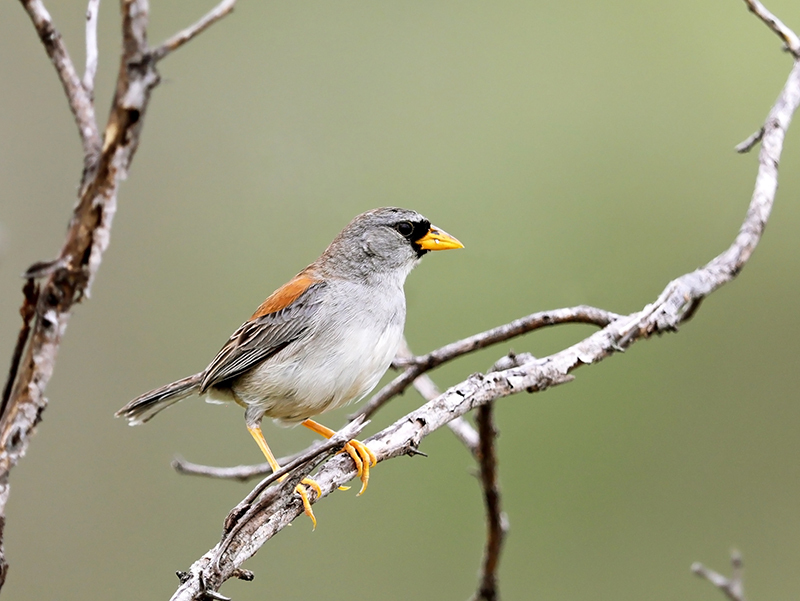
The little Inca finch (Incaspiza watkinsi) is a species of bird in the family Thraupidae. It is endemic to Peru where its natural habitat is subtropical or tropical dry shrubland. It is threatened by habitat loss.
From the article Little Inca finch on Wikipedia (CC BY-SA), quoted section by section
Description
The little Inca finch is 13 cm (5.1 in) long and weighs about 20 g (0.71 oz). It has a long tail and a slim pointed bill. The species is sexually dimorphic though the sexes are very similar. Adult males have a mostly gray head and nape, black lores, and a black forecrown and mask that extends past and under the eye. Their back and rump are mostly brown with rufous scapulars and faint streaks. Their uppertail coverts are gray. Their wings are mostly black or dusky with rufous brown edges on the inner coverts and tertials and gray edges on the rest of the coverts and flight feathers. Their tail's central pair of feathers are black and the rest black with some to much white on the inner webs. Their chin and upper throat are black, their lower throat and breast are gray, their flanks have a gray wash, and their belly and undertail coverts are buff. Adult females have the same plumage pattern as males but have a browner crown and more conspicuous streaks on the back. Both sexes have a dark brown iris, a bright yellow bill, and yellow or pale brown legs and feet.
Range & habitat
The little Inca finch is found in northwestern Peru only in the lower valley of the Marañón River and its tributaries in northeastern Cajamarca and west-central Amazonas departments. It inhabits arid scrublands with cacti and terrestrial bromeliads. In elevation it ranges between 350 and 900 m (1,100 and 3,000 ft).
Wikipedia: “Distribution and habitat”
What it does
The little Inca finch's diet has not been studied but appears to include seeds. It forages on the ground, usually singly or in pairs.
Wikipedia: “Feeding”
Listen
Looking for field recordings…
Where it lives
Recorded sightings
—
geo-referenced records in GBIF, from museums, herbaria and field observers.
Drag the globe to turn it. Dots are where records exist, not a range map; darker means more records.
In the stacks
Searching the stacks…
Every page naming Incaspiza watkinsi in the Biodiversity Heritage Library →
This page is assembled live from iNaturalist, GBIF, Wikipedia, the Source Library and the Internet Archive. It is not yet part of the hand-edited codex. iNaturalist taxon 10549.