- Animals
- ›Arthropods
- ›Hexapods
- ›Insects
- ›Winged and Once-winged Insects
- ›True Bugs, Hoppers, Aphids, and allies
- ›Plant-parasitic Hemipterans
- ›Aphids and Allies
- ›Aphidoidea
- ›Aphids
- ›Woolly Aphids and Gall-making Aphids
- ›Fordini
- ›Paracletus
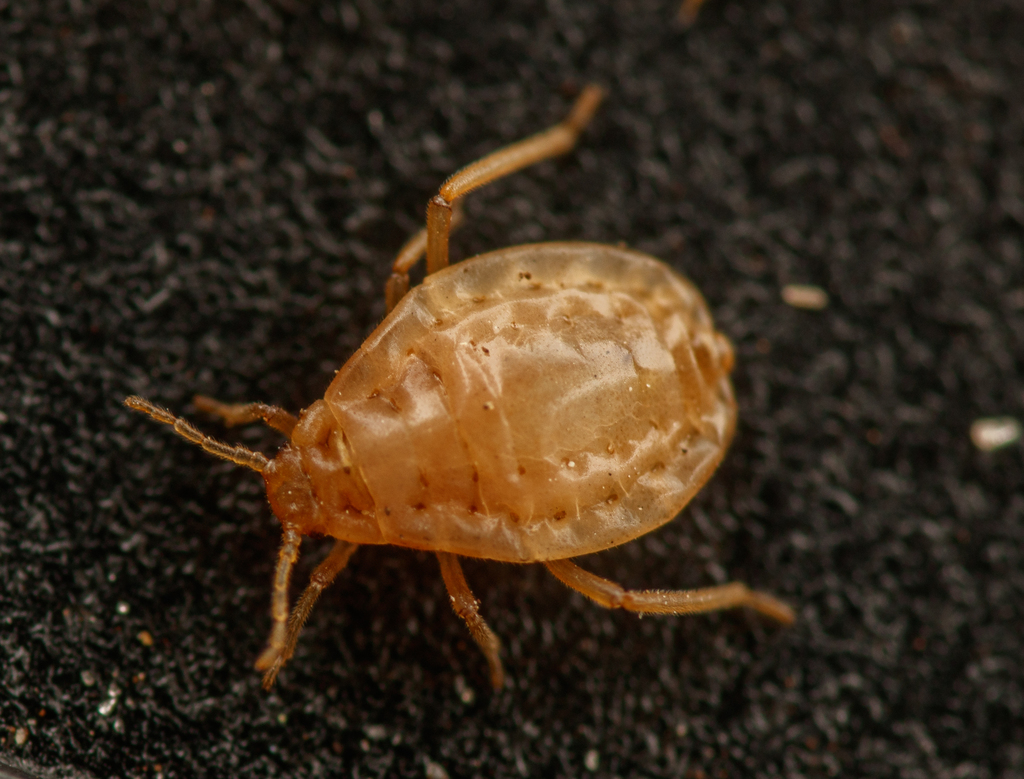
Paracletus cimiciformis
Paracletus cimiciformis is a species of aphid with a complex life cycle. Its primary host plant is Pistacia and its secondary host is a grass, where it is present on the roots. Here it is associated with an ant and part of its life cycle is spent in the ant's nest.
From the article Paracletus cimiciformis on Wikipedia (CC BY-SA), quoted section by section
Range & habitat
Paracletus cimiciformis is native to much of Europe and has been recorded in North Africa and Asia.
Wikipedia: “Distribution”
What it does
The life cycle of P. cimiciformis is complex. For most of the year, wingless females are produced parthenogenetically, but in the late summer on their secondary hosts (grass), winged males and females are produced which fly to their primary host, the terebinth tree. Here they mate and overwintering eggs are laid. In the spring these hatch and the wingless females that develop create swollen galls on the leaves; they live in these galls and reproduce asexually. In late summer some winged females develop which fly off and colonise the roots of grasses. Some of these aphids are carried into their nests by ants, where they overwinter, emerging in the spring to recolonise the roots of their secondary hosts, the whole cycle taking two years.
Wikipedia: “Life cycle”
Listen
Looking for field recordings…
Where it lives
Recorded sightings
—
geo-referenced records in GBIF, from museums, herbaria and field observers.
Drag the globe to turn it. Dots are where records exist, not a range map; darker means more records.
In the stacks
Searching the stacks…
Every page naming Paracletus cimiciformis in the Biodiversity Heritage Library →
This page is assembled live from iNaturalist, GBIF, Wikipedia, the Source Library and the Internet Archive. It is not yet part of the hand-edited codex. iNaturalist taxon 1048559.