- Animals
- ›Arthropods
- ›Hexapods
- ›Insects
- ›Winged and Once-winged Insects
- ›Butterflies and Moths
- ›Butterflies
- ›Brush-footed Butterflies
- ›Milkweed Butterflies
- ›Tiger and Crow Butterflies
- ›Euploeina
- ›Idea
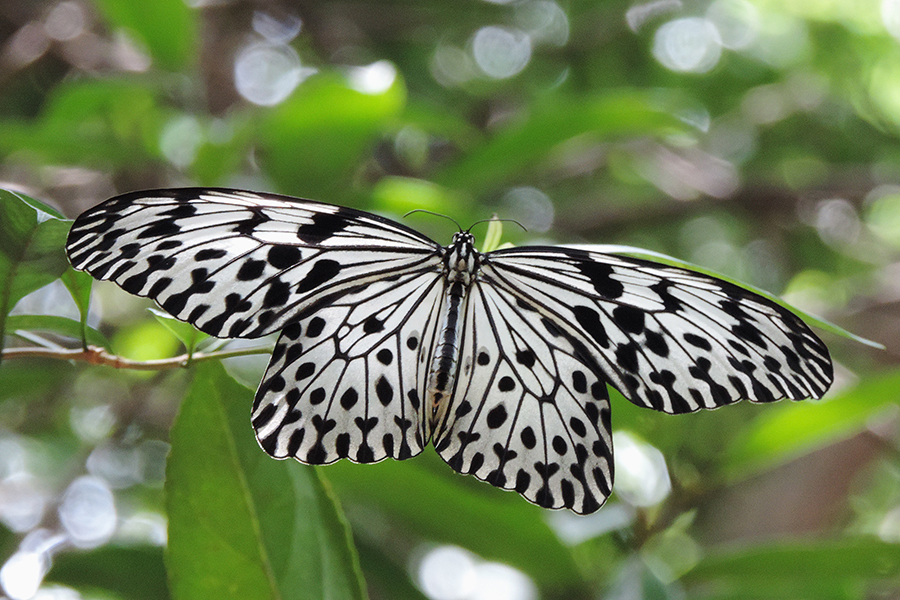
Ceylon Tree Nymph
Idea iasonia
The Ceylon tree nymph (Idea iasonia) is a species of nymphalid butterfly in the Danainae subfamily. It is endemic to Sri Lanka. First described by John Westwood in 1848, the Ceylon tree nymph can be found in both wet and dry zones of Sri Lanka. It is the largest member of the Danaidae family in that country. It is listed as a near threatened species in the IUCN Red List.
From the article Ceylon tree nymph on Wikipedia (CC BY-SA), quoted section by section
Description
The Ceylon tree nymph has a wingspan of 110–155 mm, making it the largest member of the family Danaidae in Sri Lanka. Both its wings have similar patterns and colouration. The wings are of a translucent silvery-white colour. The forewings are almost twice as long as their width. The female is larger than the male, and the males have narrower forewings than the females. The surface area of the Ceylon tree nymph's wings is relatively large when compared with its weight; this allows it to fly with little effort and stay aloft for long periods of time. Ceylon tree nymphs from the dry zone of the country are usually larger in size and lighter in colour than ones from the wet zone.
Range & habitat
The species is endemic to Sri Lanka. There are two populations of the Ceylon tree nymph. The smaller and darker variety is found in the wet zone of Sri Lanka from sea level to about 5,000 feet (1,500 m). They usually inhabit the sub-canopies of lowland tropical rain forests. The other variety, which is larger and lighter coloured, is found in the low country dry zone. They are usually encountered near water courses.
Wikipedia: “Distribution and habitat”
What it does
Since the Ceylon tree nymph requires very little effort to fly, its wing beats are very slow, so slow that the individual movements of each wing can be easily observed. Most of its time is spent flying and hovering in the high tree canopies. However, it descends to ground level to feed and to breed, but does not rest on the ground. It usually rests on the ends of dead branches or twigs. Mating occurs at ground level and the male and female fly together for an hour or more before mating. The male releases pheromones and other chemicals from its hair-pencils to stimulate the female. These include danaidone, a poisonous substance that helps to protect it from predators, which is later passed on to the eggs. The early stages of life of the Ceylon tree nymph are not well recorded. One account by naturalists Lionel de Nicéville and N. Manders dating from about 1900 describes the larva as "velvety black with four pairs of long filamentous tentacles" with each segment of its body marked with a pale yellow band. The record further mentions that it has twelve segments and that the sixth segment has a "large oval crimson spot". Its head and legs are black.
Wikipedia: “Behaviour”
Listen
Looking for field recordings…
Where it lives
Recorded sightings
—
geo-referenced records in GBIF, from museums, herbaria and field observers.
Drag the globe to turn it. Dots are where records exist, not a range map; darker means more records.
In the stacks
Searching the stacks…
Every page naming Idea iasonia in the Biodiversity Heritage Library →
This page is assembled live from iNaturalist, GBIF, Wikipedia, the Source Library and the Internet Archive. It is not yet part of the hand-edited codex. iNaturalist taxon 103296.