 NL·0616
Herbarium of the Nature Library
- Name
- Tetrao urogallus
- Family
- Phasianidae
- Native to
- Boreal and mountain conifer forests from Scotland, Scandinavia, the Alps, Pyrenees and Cantabrians across Russia to central Siberia
- Habitat
- Boreal forest, Temperate coniferous forest, Mountains
On eBird ↗
Western Capercaillie
Live sightings near you, the range map, bar charts of when it is seen, and Macaulay Library photos and recordings.
Western capercaillie
Tetrao urogallus
Also calledCapall-coille (Scottish Gaelic) · Auerhuhn (German) · Grand tétras (French) · Urogallo (Spanish) · Glukhar (Russian) · Metso (Finnish)
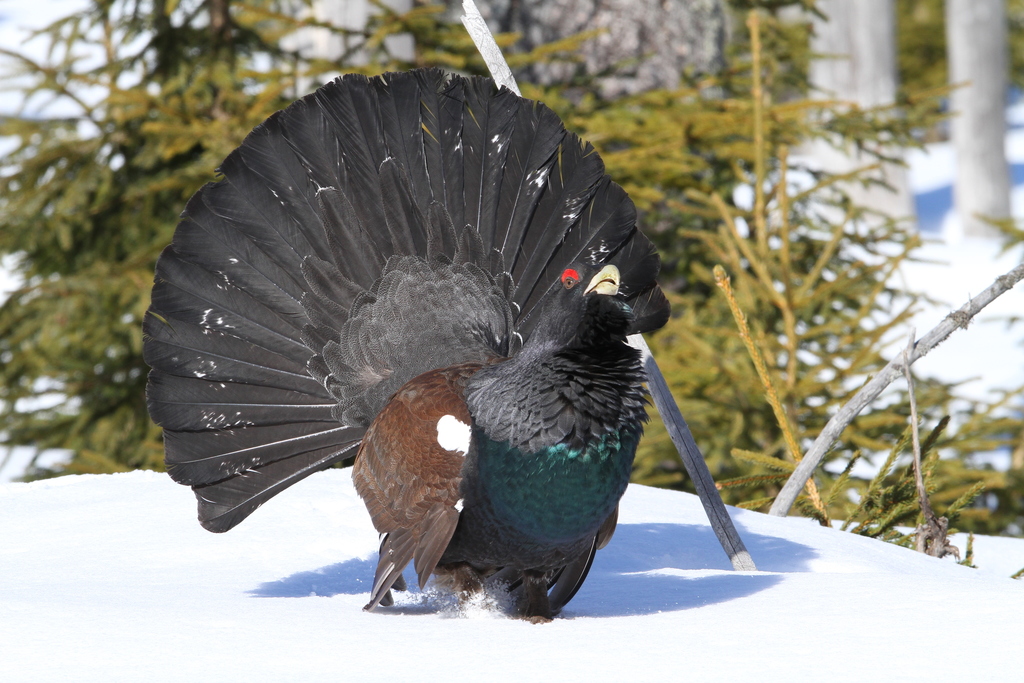
The world's largest grouse, a turkey-sized black cock of old pine forests that fans its tail and clicks, pops and gurgles at dawn displays. It survives a whole winter largely on pine needles.
The western capercaillie, also known as the Eurasian capercaillie, wood grouse, heather cock, cock-of-the-woods, or simply capercaillie, is a heavy member of the grouse tribe and the largest of all extant grouse species. Found across Europe and the Palearctic, this primarily-ground-dwelling forest grouse is renowned for its courtship display. The bird shows extreme sexual dimorphism, with males nearly twice the size of females. The global population is listed as "least concern" under the IUCN, although the populations of central Europe are declining and fragmented, or possibly extirpated. Wikipedia
What it can do
- iSurvives winter mainly on pine needles, digested with the help of long caeca
- iiMales are roughly twice the size of females
- iiiDisplaying males are so absorbed in their song that they briefly cannot hear, giving the Russian name 'glukhar' (deaf one)
- ivAggressive males in display sometimes attack people and vehicles
In the field
Field marks
- aMale huge and dark slate-grey with a glossy green breast
- bFanned, rounded black tail and shaggy throat 'beard'
- cIvory bill and red wattle above the eye
- dFemale much smaller, barred brown with a rufous breast patch
- Voice
- Male display song is a sequence of accelerating clicks ending in a 'pop' like a cork and a wheezing, scraping phrase.
- Not to be confused with
- Black grouse is smaller with a lyre-shaped tail and white undertail. Female capercaillie can be confused with female black grouse but is larger with a plain orange-rufous breast and rounded tail.
- Where to see it
- Abernethy Forest and Strathspey (Scotland), Finnish and Swedish taiga, the Bavarian Forest, the Alps and the Pyrenees; leks must be watched only on guided visits.
- When
- Resident; leks Apr–May
Listen
Looking for field recordings…
Life & habits
- Diet
- Pine needles in winter; bilberry leaves and berries, buds, shoots, seeds; insects for chicks
- Habitat
- Old, open conifer forests with a rich bilberry understorey
- Size
- Males 74–90 cm, around 4 kg; females 54–63 cm, around 1.8 kg
- Lifespan
- Typically up to about 9–12 years
Males gather at traditional leks at dawn in spring, strutting with fanned tails and raised beards.
Where it lives
Recorded sightings
—
geo-referenced records in GBIF, from museums, herbaria and field observers.
Native range
Boreal and mountain conifer forests from Scotland, Scandinavia, the Alps, Pyrenees and Cantabrians across Russia to central Siberia
Drag the globe to turn it. Dots are where records exist, not a range map; darker means more records.
In the old herbals & bestiaries
Woodcuts and engravings matched from the Source Library’s scanned books by name. Plates marked “relative” show a close kin rather than this exact species. Click a plate to read the page it came from, with translation.


In the stacks
Searching the stacks…
Every page naming Tetrao urogallus in the Biodiversity Heritage Library →
Marginalia
Hunted out of Scotland by about 1785, it was reintroduced from Sweden to Taymouth Castle in Perthshire in 1837; the Gaelic name means 'horse of the woods'.
Curiosity
The Scottish population has fallen to a few hundred birds and is now largely confined to Strathspey.
Kinship
Photographs: iNaturalist contributors under the licences shown. Records: GBIF.org. Historical plates: Source Library (CC BY-SA 4.0; originals public domain). Summary text: Nature Library editors and Wikipedia (CC BY-SA). Medicinal and edibility notes are historical and educational, not advice. iNaturalist taxon 1026.