- Animals
- ›Arthropods
- ›Hexapods
- ›Insects
- ›Winged and Once-winged Insects
- ›Butterflies and Moths
- ›Butterflies
- ›Brush-footed Butterflies
- ›Satyrs, Morphos, and Allies
- ›Alpines, Arctics, Nymphs and Satyrs
- ›Erebiina
- ›Erebia
- ›Erebia
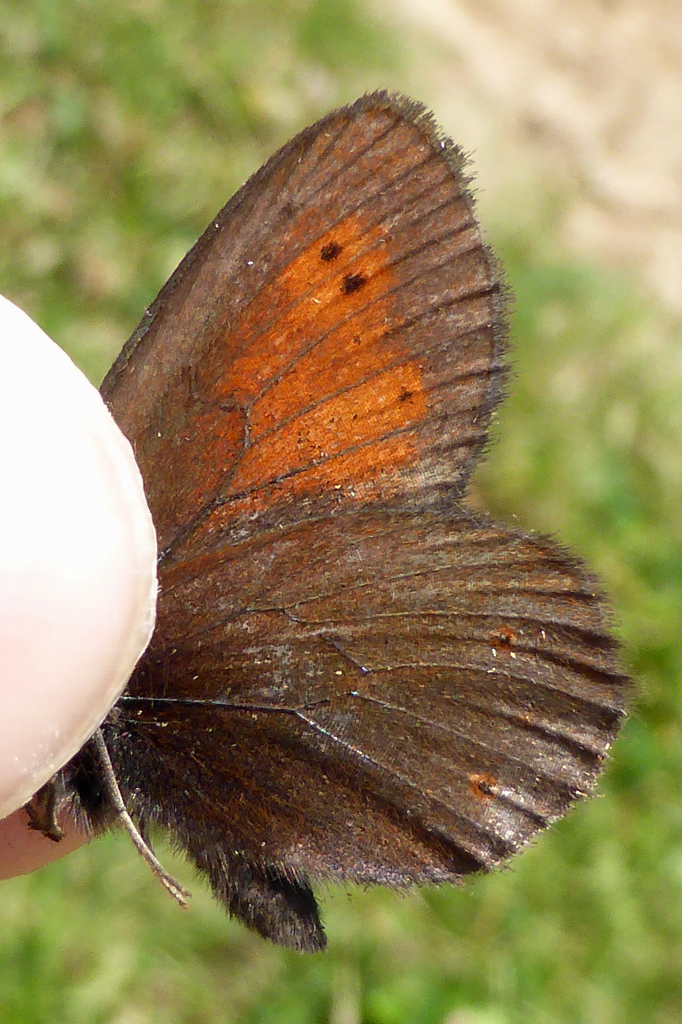
Mountain Ringlet
Erebia epiphron
The small mountain ringlet or mountain ringlet (Erebia epiphron) is a butterfly of the Nymphalidae family. It is found in mountainous regions of southern and central Europe.
From the article Small mountain ringlet on Wikipedia (CC BY-SA), quoted section by section
Range & habitat
Mountain areas of Albania, Andorra, Austria, Great Britain, Czech Republic, France, Germany, Greece, Italy, Liechtenstein, North Macedonia, Poland, Romania, Slovakia, Spain, Switzerland, Yugoslavia (Serbia, Kosovo, Voivodina, Montenegro, Bosnia and Herzegovina, Croatia).
Great Britain. It is Britain's only true alpine species of butterfly. The larva feeds on moor matgrass near bogs and springs and the nectar-feeding adult visits bilberry, tormentil and heath bedstraw.
Wikipedia: “Distribution”
In human culture
The pale cream eggs are laid singly, each female laying up to 70. The egg stage lasts two or three weeks. The larva is green with a double dorsal and a single lateral white or yellowish line. The third instar larvae hibernate in grass tussocks. They emerge in the spring and recommence feeding. Some larvae spend two years in this stage, the result of a late spring and short summer restricting growth. Recorded larval food plants are Aira praecox (Czechoslovakia, Spain), Deschampsia cespitosa (Czechoslovakia), Festuca ovina (Spain), Nardus stricta (British Isles) and Poa annua (Spain) The pupa is formed deep in grass tussocks, encased within a loose silk structure. The pupa stage lasts about three weeks. The flight period is extremely short, a few weeks only, June to August depending on altitude.
Wikipedia: “Life history”
Listen
Looking for field recordings…
Where it lives
Recorded sightings
—
geo-referenced records in GBIF, from museums, herbaria and field observers.
Drag the globe to turn it. Dots are where records exist, not a range map; darker means more records.
In the stacks
Searching the stacks…
Every page naming Erebia epiphron in the Biodiversity Heritage Library →
This page is assembled live from iNaturalist, GBIF, Wikipedia, the Source Library and the Internet Archive. It is not yet part of the hand-edited codex. iNaturalist taxon 100282.