 NL·0531
Herbarium of the Nature Library
- Name
- Melanocetus johnsonii
- Family
- Melanocetidae
- Native to
- Tropical to temperate waters of the Atlantic, Pacific and Indian oceans
- Habitat
- Bathypelagic (midnight zone), Mesopelagic (twilight zone)
Humpback anglerfish
Melanocetus johnsonii
Also calledBlack seadevil · Johnson's anglerfish · Rape abisal (Spanish)
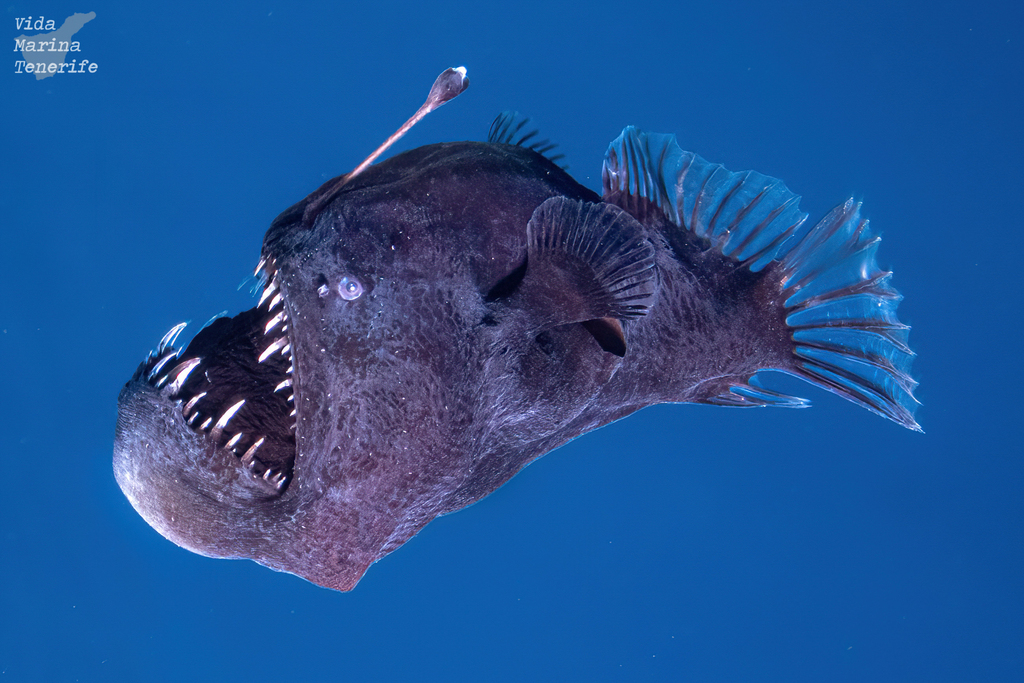
A fist-sized black predator of the deep sea that dangles a glowing lure in front of a mouth full of needle teeth. The tiny males seek out females by smell and attach only briefly to mate.
The humpback anglerfish is a species of black seadevil in the family of Melanocetidae, which means "black sea monster". The species is named after James Yate Johnson, an English naturalist who discovered the first specimen in Madeira in 1863. The common names include anglerfish, viperfish, and fangtoothfish. Wikipedia
What it can do
- iThe lure (esca) glows with light from symbiotic bioluminescent bacteria
- iiStomach and jaws stretch to swallow prey longer than itself
- iiiFree-living dwarf males use large nostrils to track female pheromones; unlike some ceratioid anglers, males do not fuse permanently
- ivSurvives at depths of 100–4,500 m in near-total darkness
In the field
Field marks
- aGlobular, velvety black body
- bHuge upturned mouth with long, fang-like teeth
- cSingle fishing-rod spine (illicium) on the snout with a bulbous glowing tip
- dSmall eyes and tiny fins
- Not to be confused with
- Other Melanocetus species differ in fin-ray counts and lure shape; footballfishes (Himantolophus) have a branched lure and bony plates.
- Where to see it
- Effectively only via deep-sea ROV footage (e.g. MBARI, Monterey Canyon, which filmed a live female in 2014); specimens in natural-history museums
- When
- Year-round in the deep sea
Life & habits
- Diet
- Fish, crustaceans and squid attracted to the lure
- Habitat
- Open ocean, mostly 200–1,500 m
- Size
- Females up to about 18 cm; males under 3 cm
- Lifespan
- Unknown
Hangs nearly motionless, twitching its lure to draw prey within striking distance in the dark.
Where it lives
Recorded sightings
—
geo-referenced records in GBIF, from museums, herbaria and field observers.
Native range
Tropical to temperate waters of the Atlantic, Pacific and Indian oceans
Drag the globe to turn it. Dots are where records exist, not a range map; darker means more records.
In the old herbals & bestiaries
No plate in the Source Library names this exact species, so these show its closest relatives as the old naturalists drew them: same genus, or the same kind of animal. Click a plate to read the page it came from, with translation.

History of Animals, Book II: On Oviparous Quadrupeds
Relative · Conrad Gessner · 1586 · p.487

Athanasii Kircheri Societatis Jesu Magnes sive de arte magnetica opus tripartium quo universa magnetis natura, eiusque in omnibus scientiis & artibus usus, nova medthodo explicatur, ac praeterae e viribus & prodigiosis effectibus magneticarum, aliarumque abditarum naturae motionum in elementis, lapidibus, plantis, animalibus, elucescentium, multa hucusque incognita natureae arcana, per physica, medica, chymica, & mathematica omnis generis experimenta recluduntur
Relative · Kircher, Athanasius · 1654 · p.557

History of Animals, Book II: On Oviparous Quadrupeds
Relative · Conrad Gessner · 1586 · p.486

History of Monsters
Relative · Ulisse Aldrovandi · 1642 · p.862

History of Monsters
Relative · Ulisse Aldrovandi · 1642 · p.863
In the stacks
Searching the stacks…
Every page naming Melanocetus johnsonii in the Biodiversity Heritage Library →
Marginalia
Described by Albert Günther in 1864 from a specimen taken off Madeira; MBARI's 2014 video is believed to be the first footage of a living Melanocetus in its habitat.
Curiosity
Its species name honours James Yate Johnson, the Madeira naturalist who sent the first specimen to the British Museum.
Kinship




Fact-checked: 1 correction made to this sheet. Photographs: iNaturalist contributors under the licences shown. Records: GBIF.org. Historical plates: Source Library (CC BY-SA 4.0; originals public domain). Summary text: Nature Library editors and Wikipedia (CC BY-SA). Medicinal and edibility notes are historical and educational, not advice. iNaturalist taxon 64212.