 NL·0657
Herbarium of the Nature Library
- Name
- Malayopython reticulatus
- Family
- Pythonidae
- Native to
- Southeast Asia, from Bangladesh, northeastern India and the Nicobar Islands through Myanmar, Indochina, Malaysia, Indonesia and the Philippines to Timor
- Habitat
- Tropical rainforest, Mangrove, Plantations, Towns
Reticulated python
Malayopython reticulatus
Also calledUlar sawa (Malay) · Sanca kembang (Indonesian) · Ngu lueam งูเหลือม (Thai) · Trăn gấm (Vietnamese)
The world's longest snake, patterned in a net of black, gold and silver-grey. It is non-venomous and kills by constriction. Large individuals take pigs and deer, and a few well-documented cases of people being killed and swallowed are known from Indonesia.
The reticulated python is a python species native to South and Southeast Asia. It is the world's longest snake, and the third heaviest after the green anaconda and Burmese python. It is a non-venomous constrictor and an excellent swimmer that has been reported far out at sea. It has colonized many small islands within its range. Because of its wide distribution, it is listed as least concern on the IUCN Red List. In several countries in its range, it is hunted for its skin, for use in traditional medicine, and for sale as pets. Due to this, it is one of the most economically important reptiles worldwide. Humans, including adults, have occasionally been killed by reticulated pythons, and several well-documented cases involve victims being swallowed wholly or partly. Most recent reported fatal predation cases have occurred in Indonesia, especially on Sulawesi and nearby islands. Wikipedia
What it can do
- iReliably measured individuals exceed 6 m, longer than any other snake
- iiKills by constriction, stopping blood flow to the prey's heart and brain
- iiiSwims well and has colonised many small islands by sea
- ivLives in big cities such as Bangkok and Singapore, eating rats in the drains
In the field
Field marks
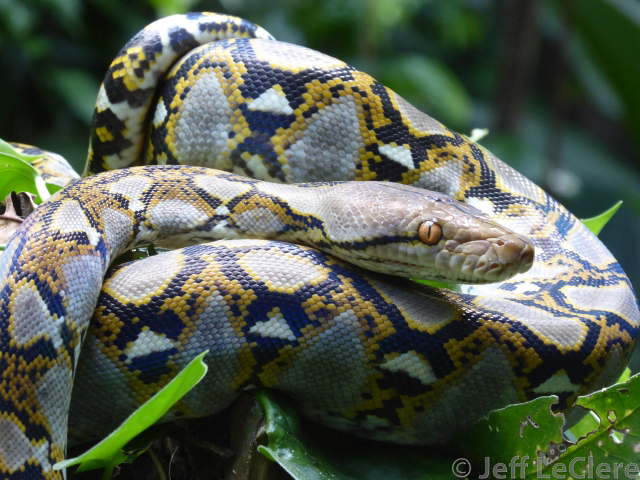
- aNet-like (reticulated) pattern of black-edged diamonds on gold or brown, with pale silvery patches along the flanks
- bThin black line running from the eye back along the head, and a narrow black line along the top of the head
- cIridescent sheen; orange or amber eyes
- dHeat-sensing pits in the lip scales
- Not to be confused with
- The Burmese python (Python bivittatus) has large dark blotches and a pale arrowhead mark on the top of its head instead of a thin black line, and is heavier for its length. Blood pythons (Python brongersmai) are short and very stout.
- Where to see it
- Rainforests and towns of Malaysia, Borneo, Sumatra and Thailand; Singapore's Sungei Buloh and Bukit Timah; often seen at night by rivers
- When
- Resident
Life & habits
- Diet
- Mammals and birds, from rats and chickens to pigs, monkeys and deer
- Habitat
- Rainforest, woodland, swamps, plantations and urban drains near water
- Size
- Commonly 3–6 m; exceptionally over 7 m
- Lifespan
- ~20–30 years in captivity
An ambush hunter that lies hidden near water or game trails. Females coil around their eggs and twitch their muscles to keep them warm. It is not venomous; serious attacks on people are very rare and usually involve very large snakes.
Where it lives
Recorded sightings
—
geo-referenced records in GBIF, from museums, herbaria and field observers.
Native range
Southeast Asia, from Bangladesh, northeastern India and the Nicobar Islands through Myanmar, Indochina, Malaysia, Indonesia and the Philippines to Timor
Drag the globe to turn it. Dots are where records exist, not a range map; darker means more records.
In the old herbals & bestiaries
No plate in the Source Library names this exact species, so these show its closest relatives as the old naturalists drew them: same genus, or the same kind of animal. Click a plate to read the page it came from, with translation.


In the stacks
Searching the stacks…
Every page naming Malayopython reticulatus in the Biodiversity Heritage Library →
Marginalia
Johann Gottlob Schneider described it as Boa reticulata in 1801. Hundreds of thousands of skins are still exported from Indonesia and Malaysia for luxury leather under CITES quotas.
Curiosity
The longest snake ever kept in captivity was a reticulated python called Medusa in Kansas City, measured at 7.67 m in 2011.
Kinship





Photographs: iNaturalist contributors under the licences shown. Records: GBIF.org. Historical plates: Source Library (CC BY-SA 4.0; originals public domain). Summary text: Nature Library editors and Wikipedia (CC BY-SA). Medicinal and edibility notes are historical and educational, not advice. iNaturalist taxon 491869.