 NL·0511
Herbarium of the Nature Library
- Name
- Lates calcarifer
- Family
- Latidae
- Native to
- Persian Gulf and Arabian Sea coasts east through South Asia and Southeast Asia to southern China, Taiwan, Papua New Guinea and northern Australia
- Habitat
- Estuaries, Mangroves, Coastal rivers, Coastal seas
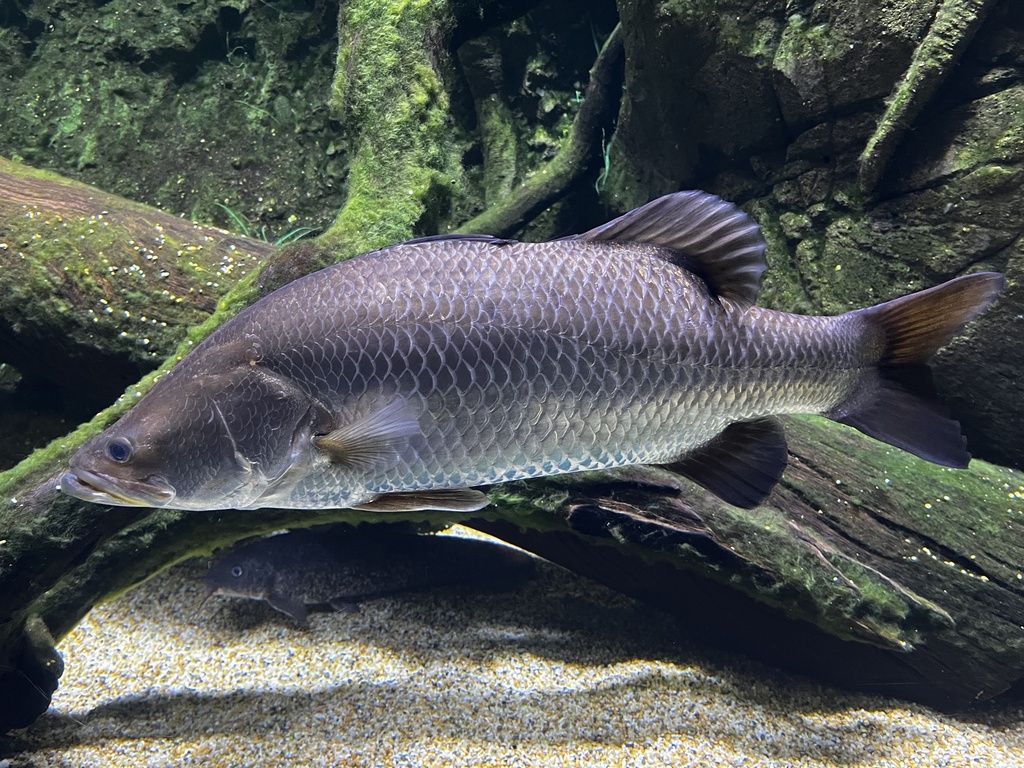
Barramundi (Asian sea bass)
Lates calcarifer
Also calledBhetki ভেটকি (Bengali) · Pla kapong khao ปลากะพงขาว (Thai) · Siakap (Malay) · Koduva (Tamil) · Cá chẽm (Vietnamese)
A large silver predator of Indo-Pacific rivers, estuaries and coasts that migrates downriver to spawn at sea. All barramundi are born male and most later change sex to female. In Bengal it is bhetki, the fish of the classic fish fry.
The barramundi, Asian sea bass, Asian sea lates, giant sea lates, or giant sea perch is a species of catadromous fish in the family Latidae of the order Carangiformes. The species is widely distributed in the Indo-West Pacific, spanning the waters of the Middle East, South Asia, Southeast Asia, East Asia, and Oceania. Wikipedia
What it can do
- iCatadromous: grows in rivers and swims to estuaries and coastal seas to spawn
- iiProtandrous hermaphrodite: born male, it usually becomes female at about 3–5 years old and 80–100 cm
- iiiLives in fresh, brackish or salt water
- ivA big female can release tens of millions of eggs in a season
In the field
Field marks
- aSilver body with a concave forehead and a pointed head
- bLarge mouth with the jaw extending behind the eye; red-glowing eye at night
- cSpiny and soft dorsal fins almost separate; rounded tail
- dFreshwater fish golden-bronze; estuarine and sea fish silver
- Not to be confused with
- Nile perch (L. niloticus) occurs only in Africa. Mangrove jack (Lutjanus argentimaculatus) has a reddish tint and canine teeth. Giant perch (Lates japonicus) of Japan is very similar.
- Where to see it
- Kakadu and the Northern Territory rivers (Australia); the Sundarbans and Hooghly estuary; Thai fish markets
- When
- Spawning migrations to estuaries at the start of the wet season (October–February in northern Australia; monsoon in South Asia)
Life & habits
- Diet
- Carnivore: fish, prawns, crabs and insects
- Habitat
- Rivers, billabongs, mangrove estuaries and coastal waters
- Size
- Commonly 60–120 cm; up to about 2 m and 60 kg
- Lifespan
- Up to about 20 years
Adults move down to river mouths and coastal flats at the start of the wet season to spawn on spring tides. Juveniles move up into freshwater swamps and creeks to grow.
Where it lives
Recorded sightings
—
geo-referenced records in GBIF, from museums, herbaria and field observers.
Native range
Persian Gulf and Arabian Sea coasts east through South Asia and Southeast Asia to southern China, Taiwan, Papua New Guinea and northern Australia
Drag the globe to turn it. Dots are where records exist, not a range map; darker means more records.
In the stacks
Searching the stacks…
Every page naming Lates calcarifer in the Biodiversity Heritage Library →
Marginalia
The name barramundi comes from an Aboriginal language of central Queensland and was popularised as a market name in Australia from the 1980s. Rock art in Kakadu and Arnhem Land includes 'X-ray' paintings of barramundi showing their spine and organs.
Curiosity
Because they change sex as they grow, almost all the very large barramundi are females.
Kinship


Photographs: iNaturalist contributors under the licences shown. Records: GBIF.org. Historical plates: Source Library (CC BY-SA 4.0; originals public domain). Summary text: Nature Library editors and Wikipedia (CC BY-SA). Medicinal and edibility notes are historical and educational, not advice. iNaturalist taxon 47353.