 NL·0472
Herbarium of the Nature Library
- Name
- Grus grus
- Family
- Gruidae
- Native to
- Breeds from Scandinavia and Germany across northern Europe and Asia to eastern Siberia; winters in Iberia, France, North Africa, the Middle East, India and China
- Habitat
- Wetland, Bog, Farmland, Temperate forest
On eBird ↗
Common Crane
Live sightings near you, the range map, bar charts of when it is seen, and Macaulay Library photos and recordings.
Common crane
Grus grus
Also calledKurki (Arabic) · Dorna (Persian) · Turna (Turkish) · Kulang (Urdu) · Kranich (German) · Grue cendrée (French) · Grulla común (Spanish)
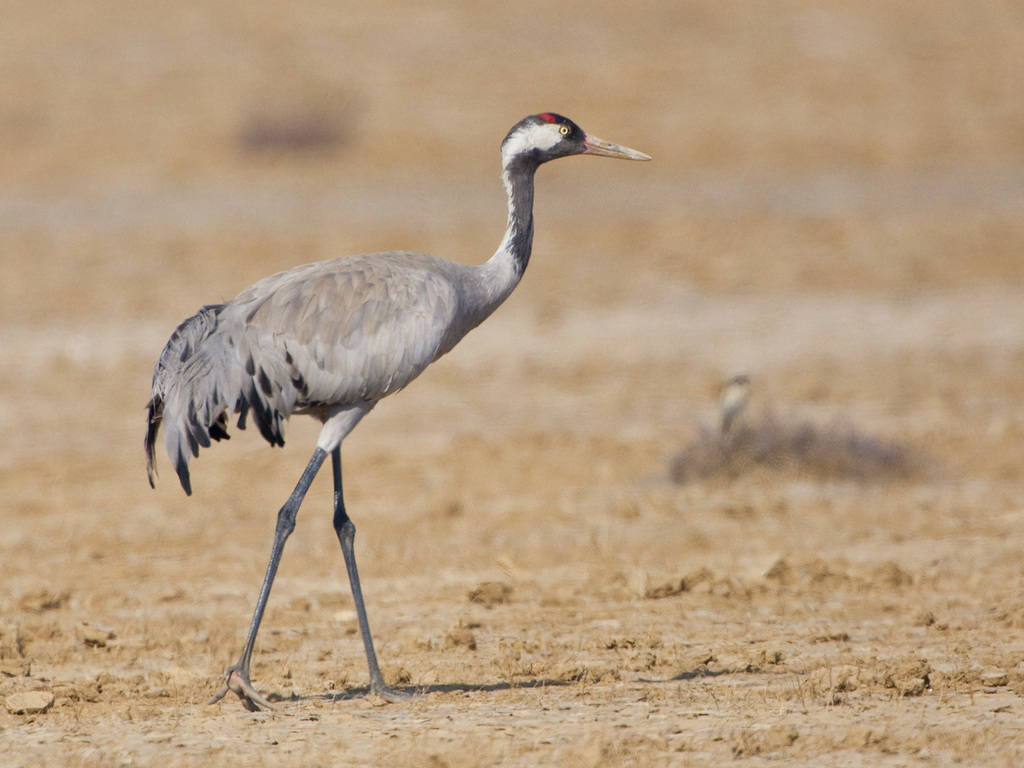
A tall, grey crane with a black-and-white head and a bushy tail-bustle, whose trumpeting flocks pass over Europe in spring and autumn. Paired birds perform elaborate leaping, bowing dances.
The common crane, also known as the Eurasian crane, is a bird of the family Gruidae, the cranes. A medium-sized species, it is the only crane commonly found in Europe besides the demoiselle crane and the Siberian crane that only are regular in the far eastern part of the continent. Along with the sandhill crane, demoiselle crane and the brolga, it is one of only four crane species not currently classified as threatened with extinction or conservation dependent on the species level. Despite the species' large numbers, local extinctions and extirpations have taken place in part of its range, and an ongoing reintroduction project is underway in the United Kingdom. Wikipedia
What it can do
- iA long, coiled windpipe within the breastbone amplifies its far-carrying trumpet calls
- iiPairs duet in synchronised 'unison calls'
- iiiMigrates in V-formations, with major stopovers used by tens of thousands
- ivStains its plumage brown with mud when nesting, for camouflage
In the field
Field marks
- aTall and grey with long black legs
- bBlack head and neck with a white stripe behind the eye; red crown patch
- cDrooping tail-bustle of curved inner wing feathers
- dFlies with neck outstretched
- Voice
- A loud, rolling, bugling 'krroo-krroo', audible from kilometres away.
- Not to be confused with
- Grey heron flies with neck folded and lacks the black head. Demoiselle crane is smaller with black breast plumes and white ear tufts. White stork is white with a red bill.
- Where to see it
- Lake Hornborgasjön (Sweden) in April, Rügen-Bock (Germany) and Lac du Der (France) in autumn, Gallocanta (Spain), Hula Valley (Israel) in winter; the Norfolk Broads and Somerset Levels in England.
- When
- Summer visitor to northern Europe Mar–Oct; passage migrant; winter visitor to the Mediterranean and Middle East
Listen
Looking for field recordings…
Life & habits
- Diet
- Grain, roots, acorns, shoots; insects, frogs and small animals in summer
- Habitat
- Bogs, forest swamps and marshes for breeding; open farmland and wetlands in winter
- Size
- 100–130 cm tall; wingspan 180–240 cm; 4.5–6 kg
- Lifespan
- Often 20+ years; over 40 in captivity
Dancing cranes bow, leap into the air with wings spread and toss sticks, at any time of year.
Where it lives
Recorded sightings
—
geo-referenced records in GBIF, from museums, herbaria and field observers.
Native range
Breeds from Scandinavia and Germany across northern Europe and Asia to eastern Siberia; winters in Iberia, France, North Africa, the Middle East, India and China
Drag the globe to turn it. Dots are where records exist, not a range map; darker means more records.
In the old herbals & bestiaries
Woodcuts and engravings matched from the Source Library’s scanned books by name. Plates marked “relative” show a close kin rather than this exact species. Click a plate to read the page it came from, with translation.


In the stacks
Searching the stacks…
Every page naming Grus grus in the Biodiversity Heritage Library →
Marginalia
In Greek legend the cranes of Ibycus witnessed the poet's murder and revealed his killers, and Persian poetry uses the call of the 'kulang' and 'dorna' as an image of exile and longing.
Curiosity
Cranes returned to England's Norfolk Broads in 1979 and first bred there in 1981, around 400 years after they were lost as a breeding bird.
Kinship
Fact-checked: 1 correction made to this sheet. Photographs: iNaturalist contributors under the licences shown. Records: GBIF.org. Historical plates: Source Library (CC BY-SA 4.0; originals public domain). Summary text: Nature Library editors and Wikipedia (CC BY-SA). Medicinal and edibility notes are historical and educational, not advice. iNaturalist taxon 41.