 NL·0438
Herbarium of the Nature Library
- Name
- Eublepharis macularius
- Family
- Eublepharidae
- Native to
- Afghanistan, Pakistan and northwestern India; possibly eastern Iran
- Habitat
- Rocky desert, Dry grassland, Scrub
Leopard gecko
Eublepharis macularius
Also calledCommon leopard gecko · Spotted fat-tailed gecko
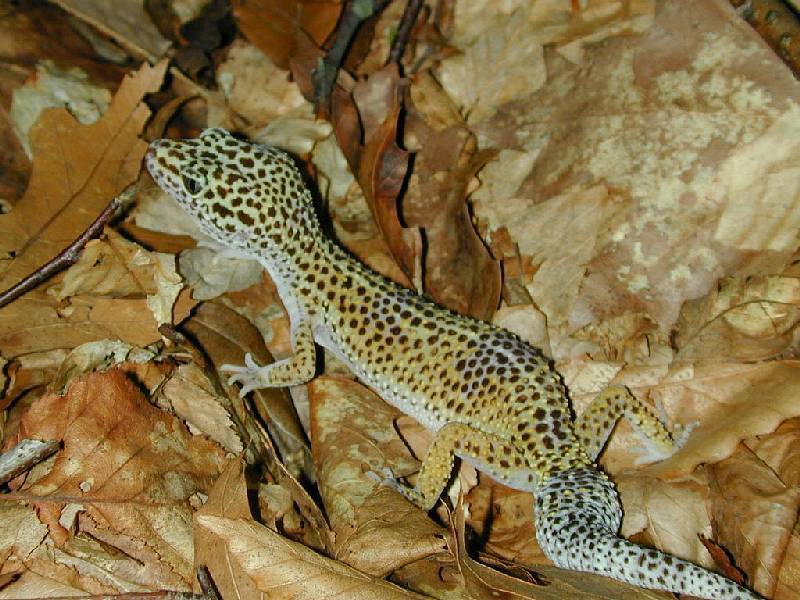
A ground-dwelling gecko of the rocky deserts of Pakistan and Afghanistan, with movable eyelids and no sticky toe pads. It stores fat in its tail and is one of the most widely kept pet lizards.
The leopard gecko or common leopard gecko is a ground-dwelling gecko native primarily to the rocky dry grassland and desert regions of Afghanistan, Iran, Pakistan, India, and Nepal. The leopard gecko is a popular pet, and due to extensive captive breeding it is sometimes considered as the first domesticated species of lizard. Wikipedia
What it can do
- iHas movable eyelids, unlike most geckos
- iiStores fat in its thick tail to survive lean months
- iiiCan drop its tail and regrow it
- ivSex of the hatchlings is set by the incubation temperature
In the field
Field marks
- aYellow body with black spots in adults; juveniles boldly banded
- bMovable eyelids
- cThick, fat tail
- dSlender toes without adhesive pads
- Not to be confused with
- Closely related leopard geckos of western India (E. fuscus) and eastern India (E. hardwickii) look similar; range is the best guide. The African fat-tailed gecko (Hemitheconyx) is brown-banded and lives in West Africa.
- Where to see it
- Rocky slopes of Balochistan and Sindh, Pakistan, and dry hills of Afghanistan
- When
- Active March–October; dormant in winter
Life & habits
- Diet
- Insects, spiders, scorpions
- Habitat
- Rocky semi-desert, dry grassland and scrub
- Size
- ~20–25 cm
- Lifespan
- 20+ years in captivity
Nocturnal: it hides under stones by day and hunts insects on the ground at night. It waves its tail before pouncing.
Where it lives
Recorded sightings
—
geo-referenced records in GBIF, from museums, herbaria and field observers.
Native range
Afghanistan, Pakistan and northwestern India; possibly eastern Iran
Drag the globe to turn it. Dots are where records exist, not a range map; darker means more records.
In the old herbals & bestiaries
No plate in the Source Library names this exact species, so these show its closest relatives as the old naturalists drew them: same genus, or the same kind of animal. Click a plate to read the page it came from, with translation.


In the stacks
Searching the stacks…
Every page naming Eublepharis macularius in the Biodiversity Heritage Library →
Marginalia
Edward Blyth described it in 1854 from the Salt Range of Punjab.
Curiosity
Leopard geckos can shed their tails when grabbed and regrow them, but the new tail is shorter and fatter and lacks bones.
Kinship
Photographs: iNaturalist contributors under the licences shown. Records: GBIF.org. Historical plates: Source Library (CC BY-SA 4.0; originals public domain). Summary text: Nature Library editors and Wikipedia (CC BY-SA). Medicinal and edibility notes are historical and educational, not advice. iNaturalist taxon 34675.