 NL·0454
Herbarium of the Nature Library
- Name
- Eciton burchellii
- Family
- Formicidae
- Native to
- Neotropics, from southern Mexico through Central America to the Amazon basin
- Habitat
- Tropical rainforest
Burchell's army ant
Eciton burchellii
Also calledFormiga-de-correição (Portuguese) · Hormiga guerrera (Spanish) · Marabunta (Latin American Spanish, army ants generally)
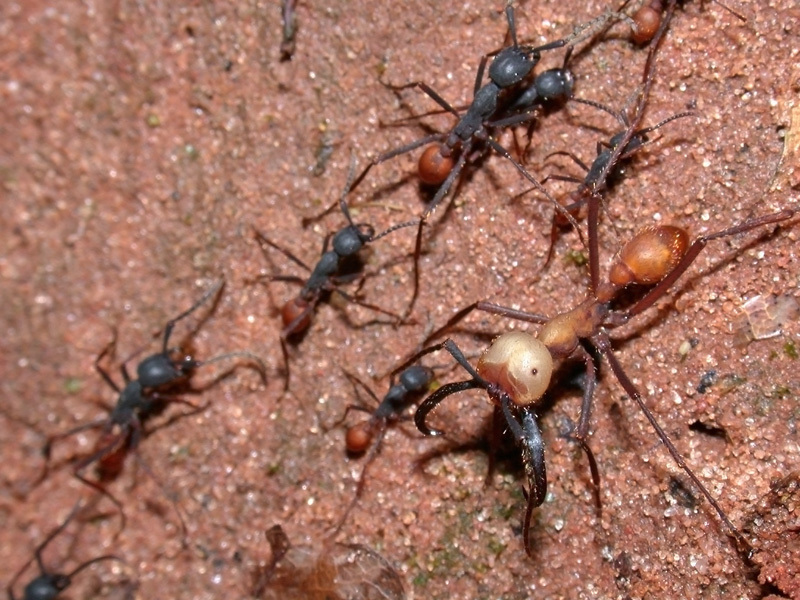
A nomadic ant whose colonies of hundreds of thousands sweep the rainforest floor in a raiding front many metres wide, flushing out insects as they go. It builds no nest, but sleeps in a living ball of its own workers.
Eciton burchellii is a species of New World army ant in the genus Eciton. This species performs expansive, organized swarm raids that give it the informal name, Eciton army ant. This species displays a high degree of worker polymorphism. Wikipedia
What it can do
- iSwarm raids up to about 15 m wide, carrying off huge numbers of insects and other arthropods
- iiWorkers link legs to form a living nest (bivouac), bridges and road plugs
- iiiColony alternates between a nomadic phase (moving every night) and a stationary phase while the queen lays eggs
- ivSupports more than 300 associated species, including antbirds that follow its raids
In the field
Field marks
- aDense, broad carpet of reddish-brown to black ants moving across the forest floor
- bSoldiers with long, pale hook-shaped mandibles
- cAntbirds calling and flies hovering above the raid front
- dColumns carrying insect brood back to the bivouac
- Not to be confused with
- Eciton hamatum raids in branching columns rather than a broad swarm and preys mostly on other social insects. Labidus army ants raid partly underground and are smaller and darker.
- Where to see it
- Rainforest reserves such as Barro Colorado Island (Panama), La Selva (Costa Rica) and Amazonian lodges in Peru and Ecuador.
- When
- Year-round
Listen
Looking for field recordings…
Life & habits
- Diet
- Mostly other arthropods, especially social insects' brood, plus spiders, cockroaches and occasionally small vertebrates
- Habitat
- Lowland rainforest floor and understorey
- Size
- Workers from about 3 mm to 12 mm; soldiers largest
- Lifespan
- Colonies can persist for years; queens are replaced by budding
Raids flush fleeing insects that antbirds, woodcreepers and parasitic flies exploit; the bivouac's temperature is regulated by the living ants.
Where it lives
Recorded sightings
—
geo-referenced records in GBIF, from museums, herbaria and field observers.
Native range
Neotropics, from southern Mexico through Central America to the Amazon basin
Drag the globe to turn it. Dots are where records exist, not a range map; darker means more records.
In the stacks
Searching the stacks…
Every page naming Eciton burchellii in the Biodiversity Heritage Library →
Marginalia
Henry Walter Bates described Eciton army ants in The Naturalist on the River Amazons (1863); the 20th-century studies of T. C. Schneirla on Barro Colorado revealed their nomadic cycle.
Curiosity
Some antbird species are 'professional' ant-followers that feed almost only at Eciton burchellii raids and check bivouacs each morning to see where the ants will go.
Kinship





Photographs: iNaturalist contributors under the licences shown. Records: GBIF.org. Historical plates: Source Library (CC BY-SA 4.0; originals public domain). Summary text: Nature Library editors and Wikipedia (CC BY-SA). Medicinal and edibility notes are historical and educational, not advice. iNaturalist taxon 126838.